[Asia Economy Reporter Lee Gwan-joo] This year marks the 40th anniversary of the first hematopoietic stem cell transplantation (HSCT) in Korea. Professor Kim Chun-chu of Seoul St. Mary’s Hospital, a pioneer in leukemia treatment who retired in 2009, successfully performed the first allogeneic hematopoietic stem cell transplantation in 1983. Since then, HSCT has continuously advanced, including autologous hematopoietic stem cells, donor hematopoietic stem cells, cord blood, non-myeloablative conditioning, and haploidentical transplantation, offering hope to countless patients. These efforts have led to the development and administration of chimeric antigen receptor T-cell (CAR-T) therapies, known as the “miracle anticancer drugs,” further expanding the dream of conquering hematologic cancers.
Advancing Hematopoietic Stem Cell Transplantation
Hematopoietic stem cells are special cells found in bone marrow, blood, and umbilical cord blood. True to their name as “mother cells that produce blood,” hematopoietic stem cells grown in the bone marrow generate red blood cells, white blood cells, platelets, and various immune cells in the bloodstream. However, blood disorders interfere with the differentiation and proliferation of hematopoietic stem cells, preventing the production of normal blood cells.
Hematopoietic stem cell transplantation is a treatment method that removes diseased hematopoietic stem cells and then transplants healthy ones. More specifically, patients with hematologic cancers such as leukemia, malignant lymphoma, and multiple myeloma undergo high-dose chemotherapy or total body irradiation to eliminate cancer cells and hematopoietic stem cells, followed by transplantation of healthy hematopoietic stem cells.
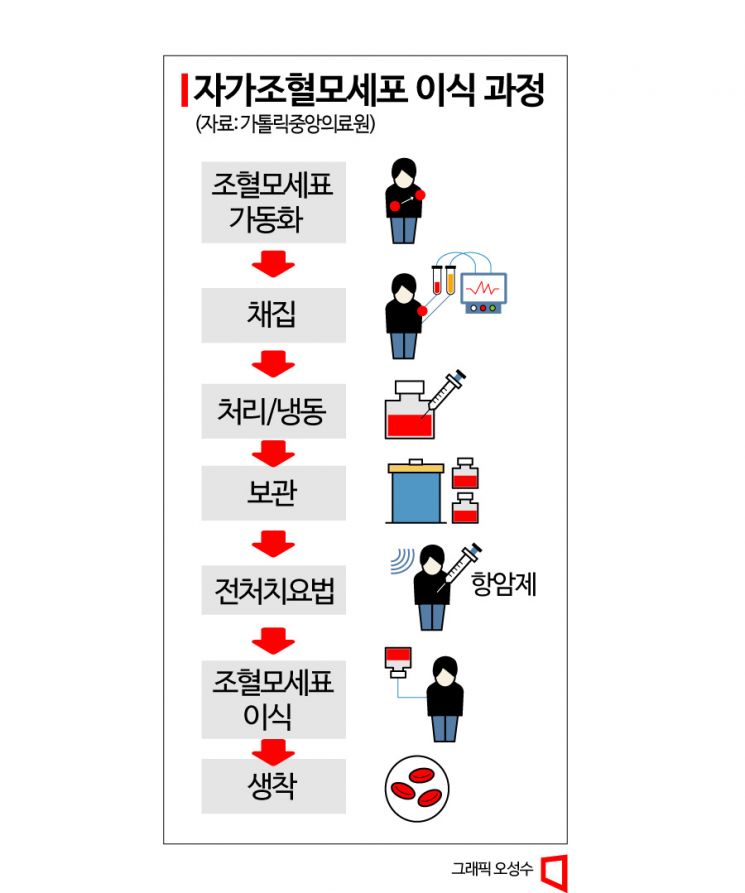
HSCT is broadly divided into allogeneic transplantation, where hematopoietic stem cells are received from family members or unrelated donors, and autologous transplantation, where the patient’s own cells are collected and cryopreserved for later use. Generally, allogeneic transplantation is performed much more frequently than autologous transplantation, which has limited methods such as cord blood storage. In the early days, only siblings with matching human leukocyte antigens (HLA) could serve as donors, but now transplantation from HLA-matched unrelated donors, unrelated cord blood, and haploidentical family members is possible, greatly expanding the donor pool.
In autologous transplantation, the patient’s own hematopoietic stem cells are collected and cryopreserved after chemotherapy, then thawed and infused following high-dose chemotherapy. Unlike allogeneic transplantation, there is no graft-versus-tumor effect, but it maximizes the benefits of chemotherapy. Professor Min Chang-ki of the Department of Hematology at Seoul St. Mary’s Hospital explained, “Autologous hematopoietic stem cell transplantation is an important first-line standard treatment for multiple myeloma. Recently, the combination of new drugs before and after transplantation has significantly improved treatment outcomes.”
Seoul St. Mary’s Hospital Achieves First 10,000 HSCT Cases
Seoul St. Mary’s Hospital is indispensable in the history of HSCT in Korea. It was the first in the country to successfully perform allogeneic hematopoietic stem cell transplantation (1995), cord blood transplantation (1996), non-myeloablative HSCT (1998), and haploidentical transplantation among family members (2001). In 2002, it achieved the world’s first successful liver transplantation following HSCT in a patient with both chronic myeloid leukemia and liver cirrhosis, and in 2012, it performed simultaneous kidney and HSCT transplantation.
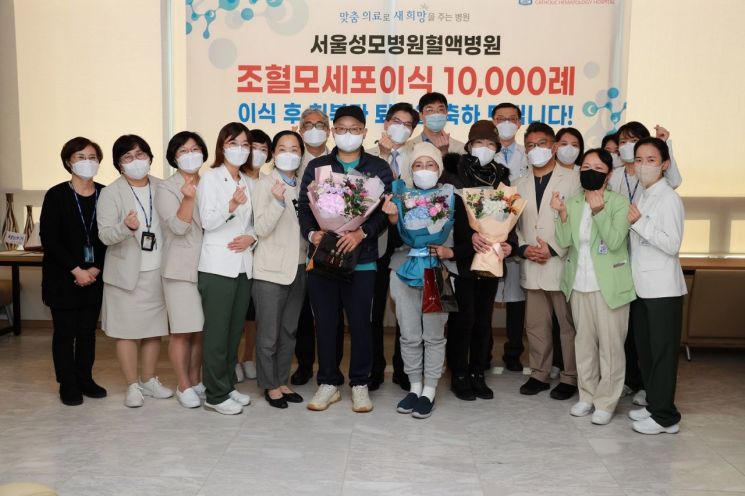 Seoul St. Mary's Hospital Hematology Center held a ceremony last month to celebrate reaching 10,000 cases of hematopoietic stem cell transplantation.
 [Photo by Seoul St. Mary's Hospital]
Building on this experience and expertise, Seoul St. Mary’s Hospital is responsible for about 20% of all HSCTs nationwide and has achieved the first 10,000 cases in Korea. Looking at the number of transplants by disease, acute myeloid leukemia leads with 3,315 cases, followed by acute lymphoblastic leukemia with 1,769 cases, multiple myeloma with 1,286 cases, aplastic anemia with 990 cases, myelodysplastic syndrome with 783 cases, non-Hodgkin lymphoma with 765 cases, chronic myeloid leukemia with 472 cases, and myeloproliferative neoplasms with 119 cases.
Behind this achievement is a close multidisciplinary collaboration system and the largest hematology faculty in Korea, consisting of 35 professors. The hospital has seven specialized centers for different diseases, with each professor focusing intensively on one area of research and treatment, ensuring thorough specialization. Inpatient care is provided by 10 dedicated inpatient specialists, offering high-quality care and real-time consultations with caregivers. Kim Hee-je, director of the Hematology Hospital at Seoul St. Mary’s Hospital, said, “The milestone achievement of 10,000 HSCT cases at a single institution is a brilliant landmark leading the advancement of transplant medicine in Korea. We will continue to grow as a global center of excellence for hematologic disease treatment.”
© The Asia Business Daily(www.asiae.co.kr). All rights reserved.
![Clutching a Stolen Dior Bag, Saying "I Hate Being Poor but Real"... The Grotesque Con of a "Human Knockoff" [Slate]](https://cwcontent.asiae.co.kr/asiaresize/183/2026021902243444107_1771435474.jpg)

















