[Asia Economy Reporter Noh Kyung-jo] Seoul apartment prices have fallen for 38 consecutive weeks, but the decline narrowed again after a week. Amid repeated fluctuations in the rate of decline due to changes in market interest rates and government policies, the sales market is still reported to be largely in a wait-and-see mode.
According to the weekly apartment price trend announced by the Korea Real Estate Board on the 16th, Seoul apartment prices fell by 0.28% in the second week of February (as of the 13th), narrowing the decline compared to the previous week (-0.31%). Although the decline widened in last week's survey for the first time in six weeks, it did not continue as a trend.
The Real Estate Board stated, "Although the volume of transactions slightly increased due to the government's measures to lower mortgage loan interest rates and ease loan regulations, active trading activities excluding urgent sales are not occurring due to concerns about further price declines in a buyer's market."
Among the 25 autonomous districts in Seoul, only Jongno-gu (-0.22% → -0.28%), Dobong-gu (-0.34% → -0.46%), Yangcheon-gu (-0.18% → -0.29%), Gwanak-gu (-0.47% → -0.50%), and Songpa-gu (-0.18% → -0.19%) saw an increase in the rate of decline compared to the previous week. Geumcheon-gu fell by 0.57% for two consecutive weeks, with a noticeable decline in large complexes in Siheung and Doksan-dong. Gangseo-gu saw price drops mainly in Deungchon, Magok, and Hwagok-dong. Dobong-gu and Gangbuk-gu experienced price declines centered around large complexes in Chang-dong and Dobong-dong, and areas such as Suyu and Mia-dong, respectively.
Gyeonggi (-0.64%) and Incheon (-0.39%) also continued their downward trends with a reduced rate of decline compared to the previous week. Inventory accumulation had an impact. In Hanam-si, Gyeonggi (-1.21%), the decline was centered on the Gam-il district, and in Yeongtong-gu, Suwon-si (-1.19%), the decline was mainly in Yeongtong and Mangpo-dong, affected by new housing supply. Hwaseong-si, home to Dongtan New Town, fell by 1.06%. In Incheon, Bupyeong-gu (-0.51%) and Yeonsu-gu (-0.45%) also declined.
The five major metropolitan cities in the provinces fell by 0.48%. These include Busan (-0.51%), Daegu (-0.57%), Gwangju (-0.35%), Daejeon (-0.49%), and Ulsan (-0.37%). Sejong showed the largest decline among all cities and provinces, falling by 0.99%.
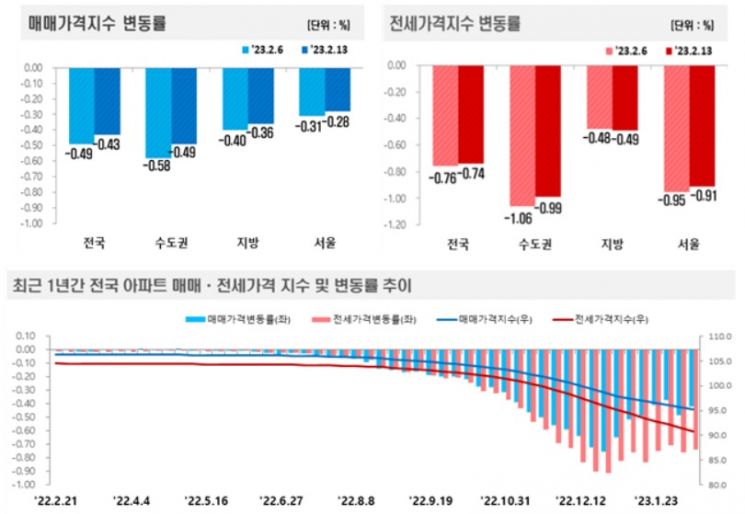
Nationally, apartment jeonse (long-term lease) prices also fell by 0.74%, narrowing the decline compared to the previous week (-0.76%). However, the Seoul metropolitan area, including Gyeonggi (-1.07%), which is the only region among the 17 cities and provinces recording a decline rate in the 1% range, as well as Seoul (-0.91%) and Incheon (-0.85%), experienced a larger rate of decline than the national average. The five major metropolitan cities in the provinces also saw an increased rate of decline, falling by 0.66% compared to the previous week (-0.64%).
The Real Estate Board explained, "Inventory accumulation is worsening mainly in areas with new housing supply, and due to the continuous downward trend, concerns about reverse jeonse (lease) are growing, leading to jeonse transactions centered on low-priced properties."
© The Asia Business Daily(www.asiae.co.kr). All rights reserved.
![Clutching a Stolen Dior Bag, Saying "I Hate Being Poor but Real"... The Grotesque Con of a "Human Knockoff" [Slate]](https://cwcontent.asiae.co.kr/asiaresize/183/2026021902243444107_1771435474.jpg)
















