[Asia Economy Reporter Park Sun-mi] As Tesla leads the price-cutting competition in electric vehicles, Samsung Electro-Mechanics, which is actively targeting the automotive MLCC (Multilayer Ceramic Capacitor) market, has opened up an opportunity to expand its market share.
On the 16th, market research firm TrendForce predicted that Samsung Electro-Mechanics' global market share based on automotive MLCC production volume will surge from 4% last year to 13% this year. Meanwhile, Japan's Murata, the industry leader, is expected to drop 3 percentage points to 41% this year, and TDK and Taiyo Yuden, ranked second and third, are forecasted to decline by 4 and 5 percentage points to 16% and 13%, respectively. If Samsung Electro-Mechanics' share jumps to 13%, it will cause a major shift in the industry competition. Last year, the top market share holder was Japan's Murata (44%), followed by Japan's TDK (20%), Japan's Taiyo Yuden (18%), Taiwan's Yageo (9%), and South Korea's Samsung Electro-Mechanics (4%). However, this year Samsung Electro-Mechanics is expected to approach a similar market share to the Japanese companies, which previously had about five times the share.
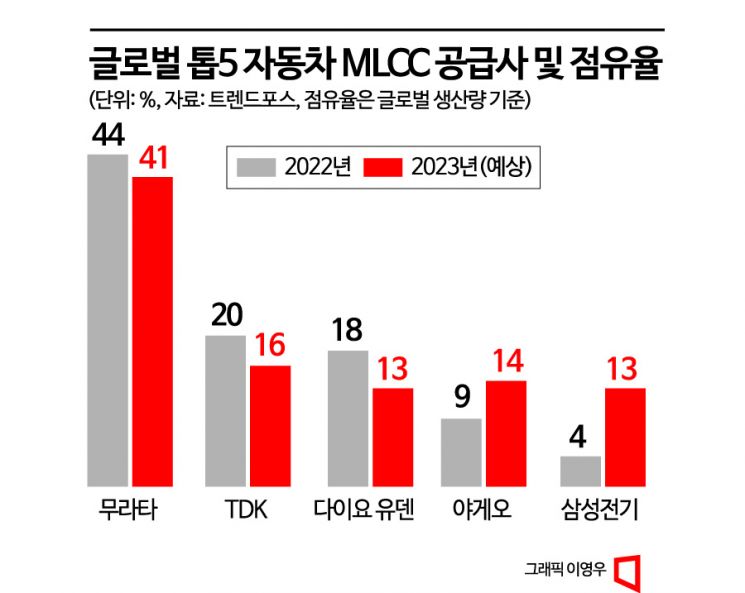
The opportunity was opened by the price-cutting competition in electric vehicles initiated by Tesla.
As Tesla has lowered vehicle prices, other electric vehicle manufacturers are also joining the price reduction to maintain their market share. This price-cutting competition stimulates electric vehicle sales, increasing orders for MLCCs, which are essential components in electric vehicles. MLCCs help stabilize current flow in electronic circuits and are used in most electronic products such as mobile phones, PCs, and electric vehicles, earning the nickname "the rice of the electronics industry." Typically, an electric vehicle contains 15,000 to 20,000 MLCCs, more than ten times the 1,000 to 1,200 units installed in smartphones.
TrendForce expects companies specializing in MLCC production to significantly expand their automotive MLCC output this year. Since the demand for IT components sharply declined from the third quarter of last year, MLCC manufacturers have had no choice but to seek opportunities in the automotive sector. Industry leader Murata has planned to increase its automotive MLCC production by 10% annually and is investing 45 billion yen in China to build a new factory from a mid- to long-term investment perspective. TDK is also expanding its Iwate Prefecture plant, enabling an additional monthly production of 5 to 8 billion MLCCs starting September 2024.
Samsung Electro-Mechanics also has a market expansion strategy to strengthen its automotive MLCC lineup, which is its core product, and to open new customer channels. The company is determined to continue sales growth exceeding the market by reinforcing promotions to high-growth global electric vehicle customers and European clients, while continuously discovering new customers.
However, the price-cutting trend in electric vehicles poses a risk of pressuring component suppliers to lower their prices. TrendForce stated, "The vehicle price reductions by automakers are likely to lead to price competition in MLCCs," leaving open the possibility that efforts by electric vehicle companies to reduce production costs could worsen the profitability of MLCC manufacturers. Kim Won-taek, Vice President of Samsung Electro-Mechanics, said at a recent earnings briefing, "MLCC shipments increased only in the automotive sector in the fourth quarter of last year, and we expect automotive MLCC demand to continue growing this year."
He added, "Electric vehicles, which use about three times more MLCCs than internal combustion engine vehicles, saw sales increase by more than 30% compared to last year, and the adoption of advanced driver assistance systems (ADAS) with Level 2 (partial driving automation) or higher is expanding by nearly 20%, so the trend toward automotive electrification will remain valid in 2023." He continued, "We plan to continuously expand our product and process sophistication to meet market demand not only for infotainment and ADAS but also for high-temperature, high-voltage powertrain product lineups."
© The Asia Business Daily(www.asiae.co.kr). All rights reserved.
![Clutching a Stolen Dior Bag, Saying "I Hate Being Poor but Real"... The Grotesque Con of a "Human Knockoff" [Slate]](https://cwcontent.asiae.co.kr/asiaresize/183/2026021902243444107_1771435474.jpg)
















