"Thorough Preparedness Needed for Earthquakes"
[Asia Economy Reporter Park Hyun-joo] As a magnitude 7 or higher earthquake struck T?rkiye and Syria, an analysis suggests that South Korea is not a seismic safe zone either.
The recent T?rkiye earthquake is estimated to have occurred along the East Anatolian Fault. T?rkiye is located at the junction of the Anatolian Plate, Eurasian Plate, Arabian Plate, and African Plate, making it prone to frequent earthquakes. The East Anatolian Fault had been quiet without recent seismic activity, but it appears to have released accumulated energy all at once.
South Korea is not situated on the boundary of major seismic plates. However, following significant earthquakes of magnitude 5 or higher near Gyeongju in 2016 and Pohang in 2017, calls for earthquake preparedness have increased. Some academic analyses also suggest that the 2011 Great East Japan Earthquake (magnitude 9.0) caused the Korean Peninsula's crust to shift east-west by about 1 to 5 cm, creating conditions more conducive to earthquakes.
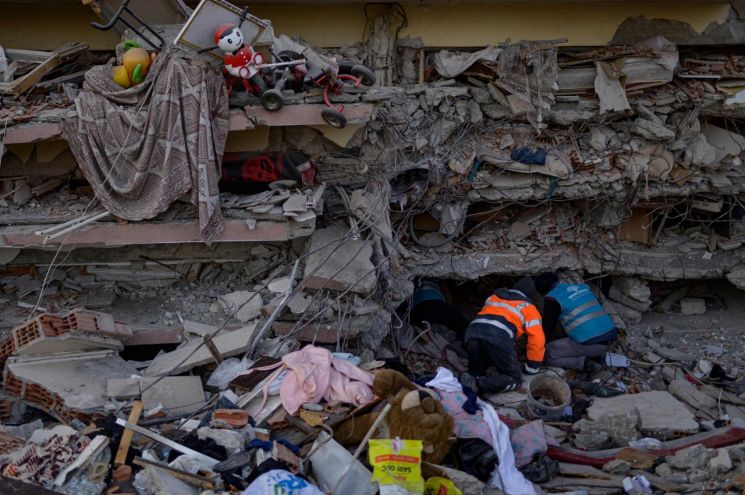 On the 9th day since the earthquake, on the 14th (local time), rescue workers are searching for survivors in Hatay Province, southeastern Turkey. [Image source=AFP, Yonhap News]
In fact, last year, earthquakes of magnitude 2.0 or higher occurred more frequently on the Korean Peninsula than in previous years. According to the Korea Meteorological Administration's '2022 Earthquake Yearbook' released on the 15th, there were 77 earthquakes of magnitude 2.0 or higher in and around the Korean Peninsula last year. This is about 10% more than the average (70.6 events) from 1999, when digital seismometers began observations, through 2021.
The yearbook also reports that a magnitude 4.1 earthquake occurred in Goesan County, Chungbuk, an area with relatively few significant earthquakes. The Korea Meteorological Administration explained, "The Goesan earthquake is an example showing that damaging earthquakes can occur anywhere in our country, so thorough preparedness for earthquakes is always necessary."
While there is no way to prevent earthquakes that strike without warning, damage can be reduced through seismic design. In the T?rkiye earthquake, poorly constructed buildings violating building codes were identified as the main cause of increased damage. In the small city of Erzin in Hatay Province, southeastern T?rkiye, where illegal buildings have been strictly regulated, no buildings collapsed and no casualties were reported despite the earthquake's impact.
After the 2017 Pohang earthquake, South Korea decided to apply seismic design to buildings with two or more floors or over 200㎡, as well as all residential houses. However, since this is not applied retroactively, most buildings constructed before the law's enforcement remain exposed to earthquake risks.
In fact, only 20% of buildings in Seoul have seismic performance. According to the Seoul Earthquake Safety Portal, as of last month, out of 593,533 buildings in Seoul, only 115,824 buildings (19.5%) have secured seismic performance meeting certain standards through seismic design or reinforcement work. This means 8 out of 10 buildings in Seoul are vulnerable to earthquakes.
© The Asia Business Daily(www.asiae.co.kr). All rights reserved.
![Clutching a Stolen Dior Bag, Saying "I Hate Being Poor but Real"... The Grotesque Con of a "Human Knockoff" [Slate]](https://cwcontent.asiae.co.kr/asiaresize/183/2026021902243444107_1771435474.jpg)















