KAIST Research Team
[Asia Economy Reporter Kim Bong-su] A domestic research team has developed a technology that can diagnose epilepsy, a refractory brain disease, with an 80% probability.
The Korea Advanced Institute of Science and Technology (KAIST) announced on the 15th that a research team led by Professor Lee Jeong-ho of the Graduate School of Medical Science and Engineering developed a method to detect mutations present in an extremely small amount of brain cells through the study of brain tissue from patients with focal cortical dysplasia, a pediatric refractory epilepsy, thereby understanding the mechanism of disease occurrence and laying the foundation for treatment.
The research was published on the 26th of last month in the world-renowned neurology journal Annals of Neurology.
Epilepsy is a neurological disorder characterized by recurrent seizures. The prevalence of epilepsy is about 0.5?1%, with over 50 million patients worldwide, and approximately 300,000 to 400,000 patients in South Korea, making it the third most common neurological disorder after dementia and stroke. Although there are more than 20 FDA-approved antiepileptic drugs that suppress seizures, about 30% of epilepsy patients suffer from refractory epilepsy, where seizures are not controlled and daily life is impaired. Existing antiepileptic drugs only prevent and control seizure symptoms by suppressing excessive brain excitation but do not affect the cause or the disease itself. The causes of epilepsy vary, including genetic factors, encephalitis, and brain tumors, but more than half of patients still do not know the exact cause. In particular, uncontrolled seizures in pediatric refractory epilepsy can lead to brain damage. Patients may live with lifelong disabilities such as intellectual disability and developmental disorders, and the social costs of caring for them are high, making the development of treatments urgent.
Focal cortical dysplasia is a representative pediatric refractory epilepsy disease characterized by localized abnormal structure of the cerebral cortex caused by abnormalities during fetal brain development, accompanied by epileptic seizures. There is no treatment for refractory epilepsy caused by focal cortical dysplasia, and brain resection surgery is currently the only treatment method; however, the recurrence rate after surgery is high at 30?40%, and many patients are ineligible for surgery.
The research team previously reported for the first time worldwide in Nature Medicine in 2015 that focal cortical dysplasia, whose cause was previously unknown, occurs due to brain cell-specific mutations in genes related to the mTOR (mechanistic target of rapamycin, a signaling protein that regulates cell growth and division) pathway, causing seizures. Reflecting this, the International League Against Epilepsy (ILAE) revised the diagnostic criteria for focal cortical dysplasia in 2022. However, existing brain mutation analysis methods have the limitation that genetic diagnosis is possible in only about 50% of patients.
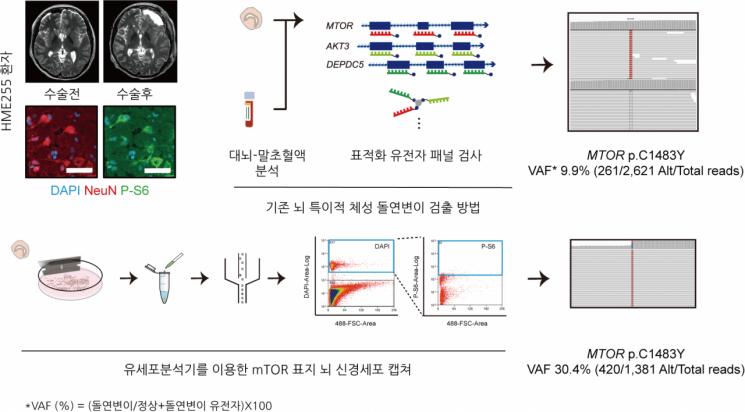
The research team had already confirmed in animal experiments that even if less than 1% of total brain cells carry the relevant genetic mutation, it can change the overall brain seizure activity and cause seizures. Based on this, the team aimed to overcome the limitations of existing diagnostic methods by selectively collecting only brain neurons with abnormal mTOR pathway expression from brain tissue of patients who tested negative in conventional genetic diagnosis.
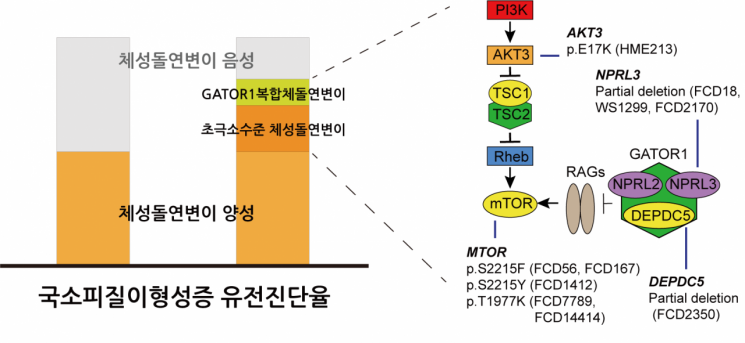
The team collected brain neurons showing mTOR activation signals from 19 patients with focal cortical dysplasia, whose causes were not found by conventional methods, using flow cytometry and conducted genome sequencing analysis. Among them, 30% of patients had extremely low levels of mutations, and 20% had germline mutations in the GATOR1 complex, an mTOR inhibitory gene. In brain tissues from three patients donated by the Netherlands Brain Bank, the team’s method enabled genetic diagnosis in all three cases.
This diagnostic approach was able to detect mutations up to 34 times more sensitively compared to existing methods and increased the genetic diagnosis rate of all focal cortical dysplasia patients to 80%. This presents a new approach to elucidate the fundamental cause of focal cortical dysplasia and is expected to provide a major turning point in the treatment of refractory epilepsy. Through a KAIST faculty startup company, it will be used to assist precise genetic diagnosis of focal cortical dysplasia patients and to develop innovative RNA therapeutics that precisely target mutant genes in these patients.
The research team said, "We hope that this new approach to detect extremely low levels of somatic mutations will help understand the exact cause of focal cortical dysplasia and serve as a small stepping stone for developing treatments for refractory epilepsy."
© The Asia Business Daily(www.asiae.co.kr). All rights reserved.
![Clutching a Stolen Dior Bag, Saying "I Hate Being Poor but Real"... The Grotesque Con of a "Human Knockoff" [Slate]](https://cwcontent.asiae.co.kr/asiaresize/183/2026021902243444107_1771435474.jpg)
















