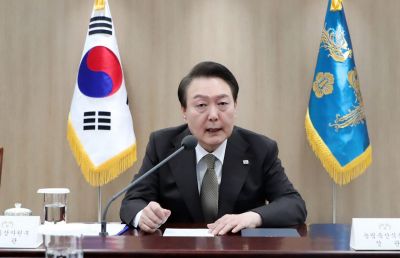
The 13th Emergency Livelihood and Economic Meeting
[Asia Economy Reporter Yu Je-hoon] The government is initiating efforts to improve the management and business practices, as well as the systems, of the banking industry. Additionally, support for vulnerable groups through voluntary new and additional contributions from the banking sector will be expanded. This comes amid criticism that banks, dominated by an oligopoly centered around the five major financial holding companies, are holding a "money feast" based on enormous interest profits during the period of rising interest rates.
On the 15th, the government disclosed these financial sector policy tasks and implementation plans at the 13th Emergency Economic and Livelihood Meeting held at the Yongsan Presidential Office. This is a follow-up measure to President Yoon Suk-yeol’s directive on the 13th to "prepare measures to prevent public discomfort caused by the banks' money feast."
Accordingly, the government will pursue measures to alleviate the high-interest burden on borrowers and the banking sector, while expanding banks' proactive loss absorption capacity.
To reduce the high-interest burden, an online refinancing loan platform and a deposit product comparison and brokerage platform will be implemented in the second quarter. Furthermore, to activate the right to request interest rate reductions, financial companies will be required to disclose the average interest rate reduction amount by the first quarter, and selectively inform borrowers with improved credit ratings about the right to request interest rate reductions.
To enhance banks' loss absorption capacity, a special loan loss reserve requirement will be introduced through amendments to banking supervision regulations in the second quarter, and additional measures such as the introduction of stress buffer capital or the accumulation of countercyclical capital buffer (CCvB) will be considered in the second half of the year.
The voluntary social contributions of the banking sector will also be strengthened. Banks plan to improve financial accessibility for vulnerable groups and reduce interest burdens through voluntary new and additional contributions.
Alongside this, adjustments will be made to the oligopoly system centered on the five major financial holding companies to establish a win-win financial system. Improvements will be pursued in business practices and structures that transfer interest rate fluctuation risks to consumers. For example, to prevent the expansion of borrowers' burdens during interest rate hikes, the expansion of fixed-rate loans will be promoted.
Moreover, to break away from the oligopoly, the entry of new players such as fintech and innovative businesses into the market will be expanded to promote competition among financial companies. Supervision will also be strengthened, including inspections of compensation committees and performance pay systems, audits related to loan loss provisions, and reviews of social contribution achievements.
To this end, the government plans to form a "Banking Sector Management, Business Practices, and System Improvement Task Force (TF)" within this month, involving the Financial Services Commission, Financial Supervisory Service, banking sector, academia, legal experts, and consumer specialists, to undertake fundamental structural improvements.
The TF will discuss key issues such as structural improvement measures to promote competition in the banking sector, compensation systems including performance and retirement pay, enhancement of loss absorption capacity, expansion of non-interest income ratios, improvement of interest rate systems including increasing the proportion of fixed-rate loans, and activation of social contributions. The government will establish and launch the TF within this month and, after discussions, derive institutional improvement plans within the first half of the year.
At the meeting, President Yoon stated, "The financial sector has a strong public goods nature and is a government-licensed business maintaining an oligopoly. Since it greatly affects the financially struggling households, alongside government-level institutional improvement efforts, the industry also needs to voluntarily participate in sharing the burden for price stabilization."
© The Asia Business Daily(www.asiae.co.kr). All rights reserved.
![Clutching a Stolen Dior Bag, Saying "I Hate Being Poor but Real"... The Grotesque Con of a "Human Knockoff" [Slate]](https://cwcontent.asiae.co.kr/asiaresize/183/2026021902243444107_1771435474.jpg)
















