Neglected for Nearly 19 Years, Becoming a Nuisance... Mapo-gu Makes Tireless Efforts to Expedite Project
District Mayor Park Gang-su: “We Will Actively Support Administrative Procedures Such as Urban Management Plan Changes and Building Permits”
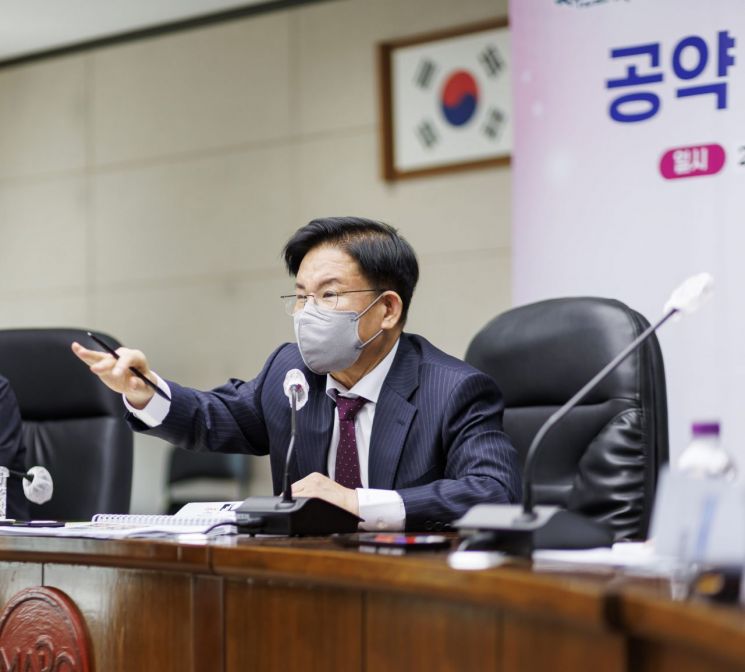
[Asia Economy Reporter Park Jong-il] Mapo-gu (District Mayor Park Gang-su) has seen the fruits of its relentless efforts to swiftly advance the long-stalled Sangam-dong DMC Landmark project, which had been drifting for 11 years.
The district received news of the project’s restart after media reports revealed that Seoul City plans to announce a 4 trillion won-scale supply plan for the DMC Landmark site in March.
Park Gang-su, Mayor of Mapo-gu, stated, “Since the initial land supply announcement, the site has been neglected for nearly 19 years, damaging the surrounding residential environment. The project had been halted for 11 years, remaining a long-cherished wish of local residents. With the project resuming, we expect DMC to once again become a hub for Seoul’s media industry and the economic center of the northwest region as originally intended.”
In particular, since the “Sangam Landmark Rapid Promotion Support” was selected as a pledge project for the 8th local government term and continuous efforts have been made, the district welcomed the project’s restart plan even more enthusiastically.
Mapo-gu has judged that the prolonged lack of development of a cutting-edge industrial site suitable for the Fourth Industrial Revolution era is not only a loss for the northwest region of Seoul but also a missed opportunity to enhance the competitiveness of South Korea.
Accordingly, Mapo-gu has continuously urged Seoul City to expedite the project to revitalize the local economy and improve the surrounding environment as soon as possible.
Now, the district plans to actively cooperate with Seoul City’s development plan and support administrative procedures such as urban management plan changes and building permits once the project operator is selected through land sales.
Mayor Park Gang-su said, “Sangam DMC is a region where Korea’s excellent and abundant IT technology and human resources, along with the cultural entertainment industry that sparked the Korean Wave, converge. Among them, the landmark site represents the centrality and symbolism of DMC. We will closely cooperate with Seoul City to ensure the smooth progress of the landmark project.”
The DMC Landmark development site began in 2004 when Seoul City first announced the land supply, deciding to build a supertall building of 133 floors and selecting a project operator. However, in 2012, Seoul City canceled the sales contract due to delayed land payments, causing the project to collapse.
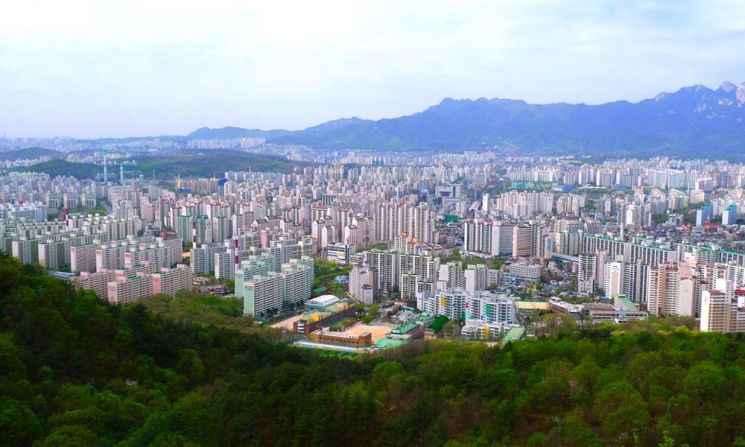
Nowon-gu Operates 'Visiting Dispute Mediation Team' to Resolve Apartment Conflicts
Activating Visiting Dispute Mediation Team to Prepare for Various Conflicts Accompanying Reconstruction
Reducing Conflict Costs through Proactive and Preventive Mediation, Spreading Resolution Cases, and Encouraging Voluntary Resolution
Nowon-gu (District Mayor Oh Seung-rok) announced that it will operate a 'Visiting Dispute Mediation Team' to resolve disputes and conflicts occurring in multi-family housing.
Recently, with active redevelopment and reconstruction in the area, sharp conflicts have arisen even at the preparatory committee stage, increasing collective complaints and showing more diverse and specialized characteristics than before.
Although each autonomous district has a dispute mediation committee to resolve these issues, there have been problems with effectiveness when conflicting parties refuse mediation, preventing the committee from convening. To address this, the district decided to operate and activate the ‘Visiting Dispute Mediation Team’ to identify conflict factors before disputes become entrenched and propose solutions tailored to the situation.
The mediation areas include ▲operation matters such as appointment and dismissal of resident representative meetings and building representatives ▲collection and use of management fees and long-term repair funds ▲maintenance, repair, and improvement of common facilities in multi-family housing ▲remodeling of common areas in multi-family housing ▲and other disputes related to multi-family housing.
First, the district selects multi-family housing requiring mediation using a conflict diagnosis checklist, analyzes the nature and characteristics of the dispute, and then forms a mediation team suited to the case.
The mediation team consists of 3 to 5 mediators, including a chief mediator specialized in conflict resolution and experts in legal, budget/accounting, and management/facility fields such as housing managers, technical experts, accountants, and lawyers.
Each mediator conducts active field investigations and resident interviews to prepare individual review opinions containing mediation suggestions and solutions. The chief mediator compiles these into a comprehensive review opinion to propose specific and reasonable mediation plans. To ensure objectivity and reliability, all activities of the mediation team will be recorded on a conflict management card.
The mediation plans and resolution cases will be disseminated to each apartment to prevent similar conflicts from arising and foster an atmosphere of voluntary dispute resolution through dialogue and compromise.
To ensure transparent multi-family housing elections, election management education is conducted annually. Complaints related to multi-family housing elections increased from 119 cases in 2020 to 134 cases in 2022, making it a representative area of disputes.
The district provides practical education focused on relevant laws, dispute cases, and precedents to election management committee members, management office heads, building representatives, and residents wishing to attend, aiming to reduce potential conflicts in resident representative meetings and building representative elections.
Oh Seung-rok, Mayor of Nowon-gu, said, “As urban regeneration projects become more active in the area, conflicts within multi-family housing are expected to increase further. We will activate the Visiting Dispute Mediation Team project to proactively prepare for various conflicts accompanying reconstruction and strive to create a happy residential community.”
Seongdong-gu Expands Red Brick Building Project South of Ttukseom Station in Seongsu-dong
Following the Successful Completion of the Seoul Forest Road Pilot Project, the Red Brick Building Project Expands to the South Side of Ttukseom Station
District to Support up to 20 Million Won or 50% of Total Construction Costs for New Construction, Extensions, and Major Repairs with a 600 Million Won Budget
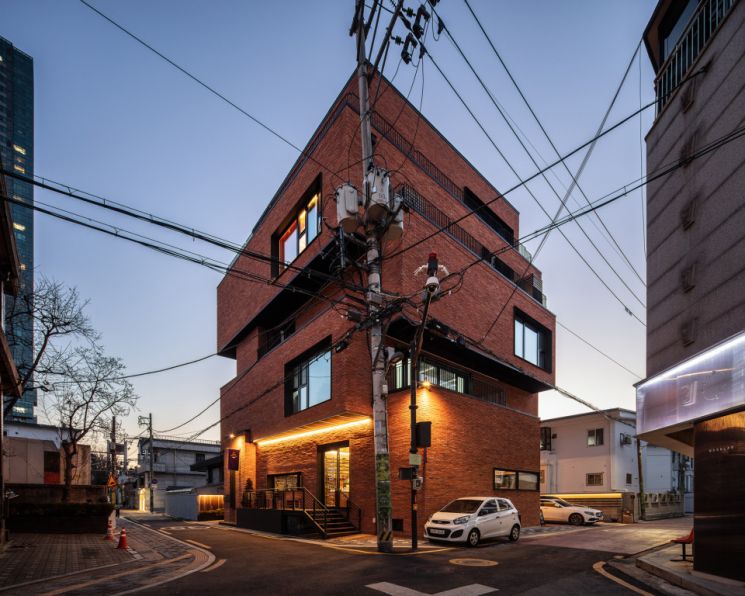
Seongdong-gu (District Mayor Jung Won-oh) announced that it has newly designated the area south of Ttukseom Station as a red brick-dense zone and will provide support of up to 20 million won when constructing or undertaking major repairs of red brick buildings.
The newly designated area covers the south side of Ttukseom Station and Wangsimni-ro 4-gil area (total area 27,970㎡). By 2026, with a total district budget of 600 million won, support will be provided for new construction, extensions, and major repairs up to 50% of the total construction cost, capped at 20 million won.
Red brick houses, a symbol of Seoul’s residential cultural history, were largely built in the 1980s and 1990s. The Seoul Forest Road area has earned the nickname “Atelier Street” as unique workshops, galleries, and cafes have emerged among the low-rise red brick houses. To preserve red brick buildings as architectural assets symbolizing Atelier Street, Seongdong-gu enacted the first-ever Seoul Special City Seongdong-gu Red Brick Building Preservation and Support Ordinance in 2017.
From 2018 to 2021, the district actively promoted a pilot project for red brick building creation targeting 30 households in the Seoul Forest Road area, supported by a 1 billion won budget from Seoul City. As a result, a red brick cluster has formed, becoming a distinctive urban landscape and a popular destination for young people.
The reason for selecting the south side of Ttukseom Station as the next project site is that 71.7% (94 out of 131) of buildings in the area are red brick structures. The district expects that expanding the red brick-dense area will significantly contribute to local economic revitalization through increased young pedestrian traffic.
Additionally, design and architecture experts with a strong understanding and affection for Seongsu-dong will be appointed as village architects to provide professional consulting on red brick buildings to residents. Financial support decisions will be finalized after review by the district’s architectural committee. The district plans to actively consider requests from nearby residents for designation of additional red brick-dense areas.
Jung Won-oh, Mayor of Seongdong-gu, expressed, “We aim to expand the successfully established red brick building project to Seongsu-dong. We will continue urban branding to create a unique local identity as ‘Korea’s Brooklyn, the Red Brick Seongsu-dong’.”
© The Asia Business Daily(www.asiae.co.kr). All rights reserved.
![Clutching a Stolen Dior Bag, Saying "I Hate Being Poor but Real"... The Grotesque Con of a "Human Knockoff" [Slate]](https://cwcontent.asiae.co.kr/asiaresize/183/2026021902243444107_1771435474.jpg)

















