Democratic Party Adopts Party Line, Opposition from Bimyeong Faction
Possibility of Defections in Plenary Vote Despite Party Line Adoption
[Asia Economy Reporter Kang Juhee] As the prosecution's request for an arrest warrant for Lee Jae-myung, leader of the Democratic Party of Korea, is reportedly imminent, tension is spreading within the Democratic Party. With expectations that the arrest consent motion for Lee will soon be submitted to the National Assembly, there is an atmosphere of internal deliberation over how to handle the motion.
The condition for passing the arrest consent motion is a majority attendance of the total members and a majority approval. Since the Democratic Party holds a majority of seats (169 seats), it can mobilize all its forces to block the passage of the arrest consent motion.
However, since the vote is conducted by secret ballot, the possibility of 'defection votes' cannot be completely ruled out. In particular, there is a possibility of defection votes from the non-mainstream faction that has opposed the party-level response to Lee's judicial risks.
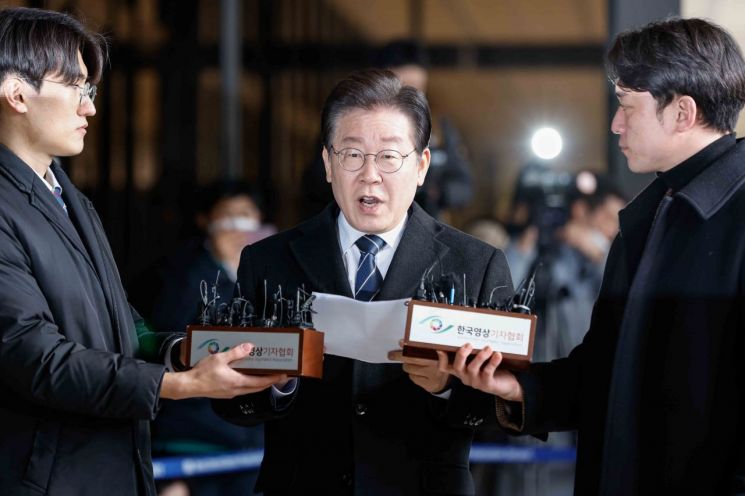 Lee Jae-myung, the leader of the Democratic Party of Korea, who is under suspicion of breach of trust related to preferential treatment allegations in the Daejang-dong and Wirye New Town development projects, is appearing at the Seoul Central District Prosecutors' Office on the 10th as a suspect. Photo by Kang Jin-hyung aymsdream@
The party leadership is focusing on internal discipline. Jin Sung-jun, the Democratic Party's senior deputy floor leader, said in an interview with MBC Radio's 'Kim Jong-bae's Focus' on the 13th, "If the arrest consent motion for Lee is submitted to the National Assembly, I think the party's consensus is to appropriately reject it," adding, "If the members' consensus is like that, the party line could be decided as rejecting the arrest consent motion."
However, Assemblyman Cho Eung-cheon publicly expressed opposition to adopting a party line to reject the arrest consent motion. In an interview with BBS Radio's 'Jeon Shin-young's Morning Journal' on the 14th, Assemblyman Cho said, "Giving up parliamentary privileges has been something our party has continuously advocated and was also a pledge during the last presidential election," and pointed out, "(Adopting a rejection party line) directly contradicts that, and a forced party line violates the Constitution and the National Assembly Act."
Even if defection votes occur, the general assessment is that the likelihood of the arrest consent motion for Lee passing is slim. Assuming all 299 members of the National Assembly participate in the vote, 150 votes in favor are required for the motion to pass. Even combining the People Power Party (115 members), the Justice Party (6 members), and Transition Korea (1 member) who support the motion, the total is only 122. In other words, about 30 defection votes from the Democratic Party would be needed for the motion to pass.
Considering the Democratic Party's number of seats, the arrest consent motion for Lee is likely to be rejected, but the party leadership appears to be making every effort to prevent any unexpected outcomes. However, there is an analysis that deciding whether to adopt a rejection party line is not an easy decision for the Democratic Party.
Even if a party line is adopted, since the vote is conducted by secret ballot, defection votes may occur, and the political repercussions in such a case would inevitably be significant.
Assemblyman Cho said, "Because it is a secret ballot, if a forced party line is set and later the conclusion does not exactly match, it causes great confusion with responsibility accusations. It also becomes a case of double standards."
© The Asia Business Daily(www.asiae.co.kr). All rights reserved.
![Clutching a Stolen Dior Bag, Saying "I Hate Being Poor but Real"... The Grotesque Con of a "Human Knockoff" [Slate]](https://cwcontent.asiae.co.kr/asiaresize/183/2026021902243444107_1771435474.jpg)















