[Asia Economy Reporter Yujin Cho] There is a forecast that the earnings growth rate of major U.S. companies may fall into an 'earnings recession,' showing negative growth for two consecutive quarters in the first and second quarters of this year. Due to the ongoing wage increases caused by labor shortages, it is expected that corporate earnings will be hit, raising the likelihood that the poor performance of companies in the fourth quarter of last year will prolong.
On the 13th (local time), financial information firm Refinitiv projected that the net profits of S&P 500 companies will decrease by 3.7% in the first quarter and 3.1% in the second quarter compared to the same period last year. Among the S&P 500 companies, the net profits of 344 companies that have announced their fourth-quarter results so far are estimated to have declined by 2.8%.
Accordingly, if the profits of S&P 500 companies decrease again in the first quarter of this year, it will mark the first earnings recession since 2020, the first year of the COVID-19 pandemic. Jonathan Golub, Chief U.S. Equity Strategist at Credit Suisse, said, "What is clear is that the pace of corporate earnings decline this year is worse than usual."
Apple, the U.S.'s largest company by market capitalization, saw its fourth-quarter sales fall by 5% and net profit by 13% compared to the same period last year due to weak sales of its flagship product, the iPhone. In the case of Alphabet, Google's parent company, sales increased compared to the same period last year but fell short of market expectations.
Cash Bosshard, Chief U.S. Economist at Nationwide Insurance, said, "Corporate earnings are steadily decreasing," and predicted that the vicious cycle of companies reducing employment and the economy entering a lull from mid-year will be difficult to break immediately.
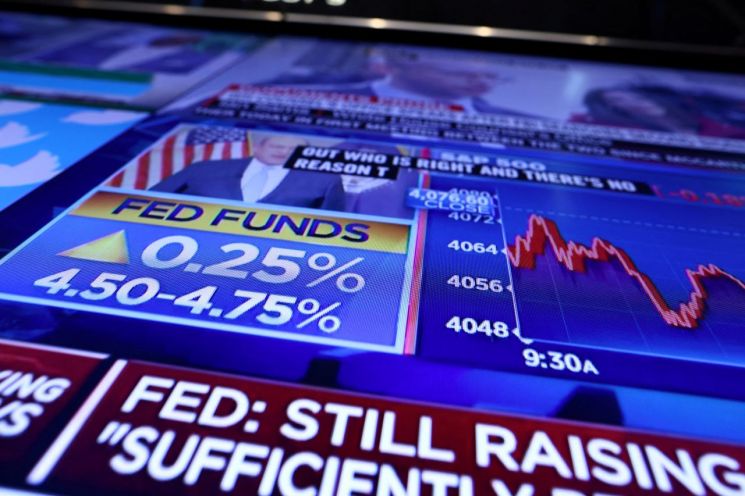
Wall Street consensus is that the stock market trend will deteriorate again due to the earnings recession. Experts diagnose that if corporate profits begin to shake seriously, the early-year upward trend of the New York Stock Exchange may not continue. Uncertainty about how much more the U.S. Federal Reserve (Fed) needs to raise the benchmark interest rate to control inflation is expected to act as a negative factor for the direction of the New York Stock Exchange.
With concerns that inflation is still not at a reassuring level, the Fed is likely to continue raising interest rates for the time being and maintain a high interest rate level. The U.S. consumer price inflation rate peaked at 9.1% year-on-year in June last year and then entered a gradual decline, but it still stood at 6.5% in December last year, significantly exceeding the Fed's target of 2%.
Morgan Stanley analysts pointed out, "The reality facing the stock market is that monetary policy remains in a tightening zone while earnings weakness has fully begun."
Also, the U.S. labor market, experiencing labor shortages, is pressuring corporate margins, leading to profit declines, and wages are expected to persist longer than other cost pressures, which is also negative. According to the U.S. Department of Labor, nonfarm payrolls increased by 517,000 in January, nearly double the previous month's increase of 260,000. The unemployment rate was 3.4%, the lowest in 54 years since May 1969. Average hourly wages rose by 0.3% from the previous month and 4.4% year-on-year.
© The Asia Business Daily(www.asiae.co.kr). All rights reserved.
![Clutching a Stolen Dior Bag, Saying "I Hate Being Poor but Real"... The Grotesque Con of a "Human Knockoff" [Slate]](https://cwcontent.asiae.co.kr/asiaresize/183/2026021902243444107_1771435474.jpg)















