[Asia Economy Reporter Eunju Lee] On the 14th, the Korea Fair Trade Commission (KFTC) announced that it has decided to impose corrective orders and a fine of 25.7 billion KRW on Kakao Mobility for directing calls to its affiliated franchise taxis. This case is the first to apply the newly established Online Platform Monopoly Review Guidelines enacted last month. Following a plenary session, the KFTC judged that Kakao Mobility intentionally favored its own franchise taxi drivers by directing calls (passenger requests) to them, thereby preferentially benefiting its own business and deliberately restricting market competition.
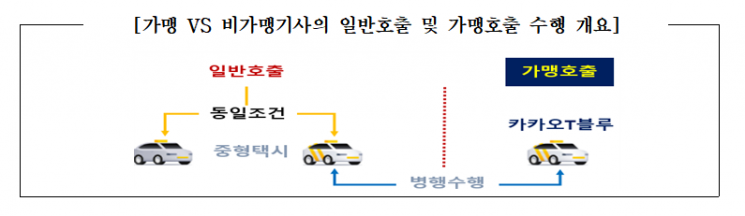
Kakao Mobility has been operating the franchise taxi service 'Kakao T Blue' since March 2019. Kakao T Blue is a subsidiary operated by KM Solution Co., Ltd., a 100% subsidiary of Kakao Mobility, and Digi T Mobility Co., Ltd., in which Kakao Mobility has invested shares. Franchise drivers of Kakao T Blue can earn revenue by handling both general calls (calls where passengers do not pay a commission) and Blue calls (calls where passengers pay a commission). However, non-affiliated general taxi drivers who have not joined Blue can also use general calls free of charge. Kakao T Blue franchise drivers perform both general and Blue calls to increase their earnings. The KFTC judged that the dispatch method for 'general calls,' which both affiliated and non-affiliated drivers can use, was intentionally designed to favor franchise drivers.
Among various issues, the core point is the 'acceptance rate' (the number of taxi calls accepted by drivers). The dispute centers on the KFTC's judgment that Kakao's algorithm for automatic taxi call dispatch, designed with acceptance rate as a key criterion, is 'discriminatory,' versus Kakao's rebuttal that it is a design choice to enhance 'platform competitiveness.' The KFTC pointed out that since Kakao Mobility's full-scale entry into the franchise taxi business in 2019, it has intentionally operated an algorithm that inevitably allows its franchise taxi drivers to receive more calls than non-affiliated drivers, constituting a 'competition-restricting self-preferential act' by a big tech platform.
On the other hand, Kakao Mobility argued that the dispatch algorithm criticized by the KFTC was not intended to favor franchise taxis but was a strategic decision made by the platform to achieve faster dispatch success. During the plenary session on the 1st, intense debates took place regarding the 'AI-recommended driver priority dispatch' algorithm introduced by Kakao Mobility after changes made in 2020.
Acceptance Rate (Number of Taxi Calls Accepted by Drivers)-Centered AI Recommendation Algorithm
KFTC: "Intent to Direct Calls to Franchise Drivers" vs. Kakao: "Rational Choice for Faster Dispatch"
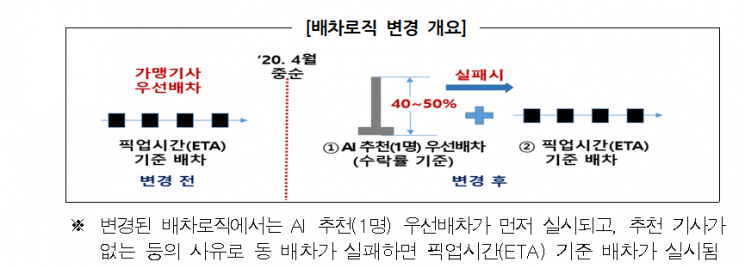
Since April 2020, Kakao Mobility has applied an algorithm designed so that franchise drivers with higher acceptance rates receive more dispatches than non-affiliated drivers. Before the change, the algorithm was designed to dispatch primarily to drivers expected to have a shorter 'pickup time' (ETA, Estimated Time of Arrival) to the passenger. From April 2020, the acceptance rate of drivers was added as one of the criteria for the first dispatch, alongside pickup time. According to the KFTC, this algorithm was designed so that drivers with acceptance rates of 40% or 50% or higher are prioritized for dispatch. At least for the 'first call,' the system connects passengers and drivers by focusing more on a kind of driver reputation (acceptance rate) accumulated previously rather than distance.
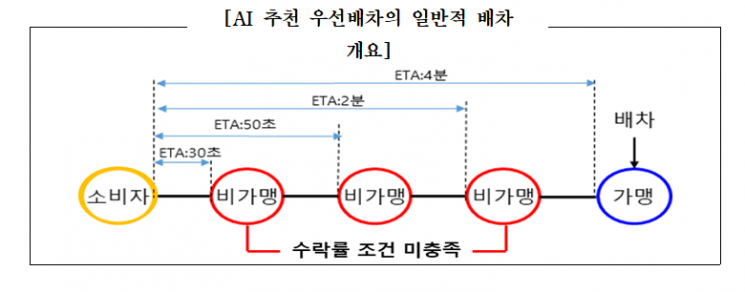
However, the KFTC views the design of 'acceptance rate' as a major dispatch criterion itself as an intentional discrimination against non-affiliated drivers. This is because the system is structurally designed so that non-affiliated drivers inevitably have lower acceptance rates. The KFTC examiner pointed out, "Although the algorithm appears value-neutral on the surface, in detail, the call acceptance methods for franchise and non-affiliated drivers are completely different." Kakao Mobility operates a forced dispatch system for franchise drivers to ensure a taxi service without call refusals. In contrast, non-affiliated drivers decide whether to accept calls themselves within 5 seconds after the destination is displayed. Due to this structural difference, acceptance rates inevitably differ, leading to criticism that the algorithm itself is 'discriminatory.'
On the other hand, Kakao Mobility claims this is a "rational strategy to pursue rapid dispatch and prompt service as a platform." Operating an algorithm that considers acceptance rates to maximize the matching possibility of suppliers in a matching platform connecting drivers and users is a reasonable decision to enhance business competitiveness. Regarding the lower acceptance rates of non-affiliated drivers, they argue it is because "non-affiliated drivers either do not accept calls after checking the destination for 5 seconds or receive call cards while using other call apps," and that differences in dispatch acceptance rates should be seen as the result of each driver's chosen mode of operation (whether to become a franchise or non-affiliated driver).
In response, the KFTC points out the 'intent' behind changing the dispatch logic algorithm to include 'acceptance rate' as a dispatch criterion. The investigation revealed that Kakao Mobility was aware in advance of the fundamental difference in acceptance rates between the two driver groups and sufficiently checked how dispatch numbers differed between franchise and non-affiliated drivers before introducing the AI recommendation priority dispatch method. According to the KFTC's investigation, Kakao Mobility confirmed in advance that about 73% of dispatches went to franchise drivers and 27% to non-affiliated drivers, confirming the 'advantage' for franchise drivers.
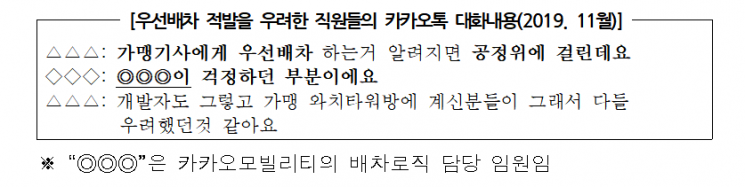
The KFTC also presented evidence that Kakao employees mentioned in KakaoTalk messenger used for work, "If it becomes known that we prioritize dispatch to franchise drivers, the KFTC will catch us." Furthermore, the KFTC examiner pointed out, "If this was to enhance service competitiveness as Kakao claims, the change in dispatch logic should have been disclosed to drivers as an important transaction condition beforehand." The fact that the algorithm was changed 'secretly' is judged to indicate an intention to restrict competition.
KFTC: Passenger 'Pickup Time' Increased vs. Kakao: Passenger 'Dispatch Waiting Time' Decreased
In response, Kakao Mobility pointed out the widespread reality of 'call cherry-picking' in the offline taxi market. They argue that it is impossible to consider only 'distance' as the main dispatch criterion and that 'acceptance rate' must be considered. Kakao Mobility stated, "If taxi drivers did not refuse calls, dispatching calls solely based on distance would have been possible. However, in a situation where call refusals are widespread, dispatching only by 'distance' would have increased passenger waiting times."
They introduced the concept of 'dispatch waiting time' (ELT, Estimated Leaded Time) instead of 'pickup time' (ETA, Estimated Time of Arrival), which is the estimated time for a taxi to arrive at the passenger. ELT refers to the time passengers wait from requesting dispatch until dispatch is completed. They claim that after the AI algorithm change, passengers' ELT was drastically reduced. Kakao Mobility asserted, "Since the introduction of the AI dispatch logic in April 2020, the dispatch success rate increased by 9 percentage points, and during the same period, the average waiting time for passengers until dispatch was shortened by 43%." In other words, Kakao's algorithm is a decision to promote platform competitiveness and increase consumer welfare, not to favor its own service.
On the other hand, the KFTC diagnosed that consumer welfare actually decreased. The KFTC examiner judged that when assessing consumer welfare, it is more important to look at how passengers' total pickup time (ETA) changed rather than whether dispatch waiting time (ELT) decreased. The investigation found that priority dispatch based on acceptance rate generally resulted in taxis farther away being dispatched, increasing the time passengers wait for taxis (pickup time). Since taxis also have to travel longer distances, it is difficult to evaluate this as an increase in consumer welfare. Furthermore, "Due to this preferential dispatch to franchise taxis, the number of Kakao T Blue franchise taxis rapidly increased in a short period, while the number of franchise taxis of competing businesses decreased, entering a declining trend," and "there is a risk that competing businesses may be excluded or excluded from the taxi franchise service market," the KFTC stated.
For these reasons, the KFTC judged that Kakao Mobility abused its market-dominant position and engaged in unfair trade practices, including discriminatory treatment and abuse of transaction status, by obstructing other businesses' activities. The KFTC ordered Kakao Mobility to stop discriminatory dispatch in the general call service of the Kakao T app currently in operation and to report on the implementation status of the corrective order. According to the corrective order, Kakao Mobility must report to the KFTC within 60 days from the date of receipt of the resolution on the removal of discriminatory elements from the general call dispatch algorithm of the Kakao T app.
© The Asia Business Daily(www.asiae.co.kr). All rights reserved.



















