Over 635,575 Houses Aged 30+ Years in Seoul
Escape Routes Filled with Illegal Obstructions, Firefighting Equipment Inadequate
Need for Expanded Local Government Support for Fire Safety Facilities Raised
[Asia Economy Reporter Choi Taewon] On the 14th, the corridor of Apartment A in Seodaemun-gu, Seoul, completed in 1965, was so cluttered with miscellaneous items such as shoe racks, chairs, sofas, storage cabinets, and jars that only one person could barely pass through. Some households even installed refrigerators in the corridor by connecting wires through the windows. There were no fire hydrants, but the fire extinguishers placed on each floor were covered with thick dust and cobwebs, and the stickers indicating their expiration dates had faded to the point of being unreadable.
The situation in Apartment B in Eunpyeong-gu, completed in 1972, was not much different. In one building, a makeshift storage room was installed on the stairs leading to the rooftop, and in another building, illegal storage occupied more than half of the rooftop entrance area. There were fire hydrants blocked by shoe storage cabinets as well as broken fire hydrants that could not be opened even with strong force.
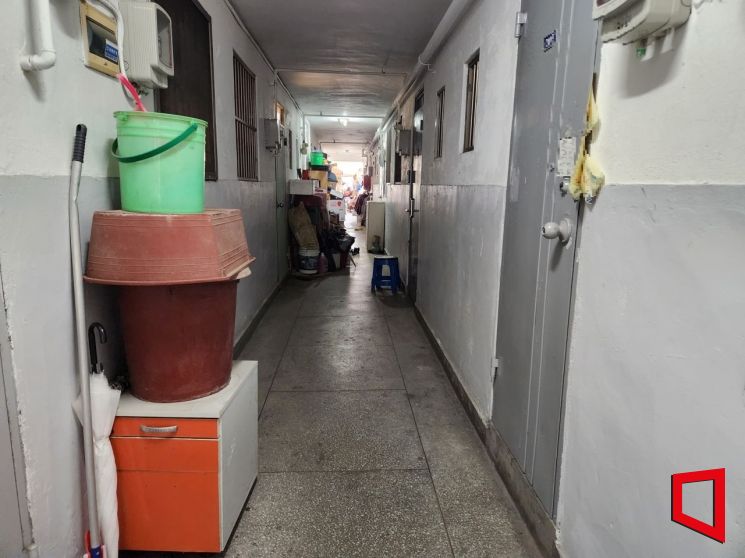 An apartment in Seodaemun-gu, Seoul, completed in 1965. The hallway was so cluttered with shoe racks, chairs, sofas, storage cabinets, and jars that it was barely wide enough for one person to pass through.
 Photo by Choi Taewon skking@
Although there are nearly 640,000 old houses over 30 years old in Seoul, concerns have been raised that they are exposed to fire risks due to inadequate fire safety facilities and insufficient fire prevention measures.
According to the ‘Seoul City Housing Status Statistics by Age’ on the 20th, as of 2021, there are 635,575 old houses over 30 years old in Seoul. Among them, some houses were found to be vulnerable to fire, with widespread illegal storage and lack of sprinklers and fire hydrants.
Stairs and corridors in apartments are critical evacuation facilities directly related to life. If there are obstructions, they can lead to secondary damage in the event of a fire. According to the Fire Safety Facilities Installation and Management Act (Fire Safety Facilities Act), if evacuation facilities such as stairs, corridors, and emergency exits are closed or damaged without justifiable reasons, or if objects or obstacles are stored around them hindering evacuation or firefighting activities, a fine of up to 3 million won can be imposed. If the correction order is not followed, the responsible person may face imprisonment of up to 3 years or a fine of up to 15 million won.
Resident Lee (29) of Apartment A said, “My home is on the edge, but there are so many things piled up in the corridor that it seems difficult to escape in case of fire,” adding, “The kitchen faces the corridor, so if a fire breaks out, it could easily spread to the clutter in the corridor and lead to a large fire.”
Fire extinguishers and fire hydrants, which should be proactively used in case of fire, were also not properly maintained. Most of the fire extinguishers in Apartment B were manufactured in 2006, far exceeding the 10-year service life from the manufacturing date. According to the revised Fire Safety Facilities Act in 2017, fire extinguishers older than 10 years must be replaced. If performance is confirmed to be normal, the usage period can be extended once for up to 3 years. Broken or blocked fire hydrants also appeared difficult to use urgently in emergencies. The old fire extinguisher on the first floor of Apartment A was even installed outside the apartment entrance, meaning it could only be used by going outside the building in case of fire.
Resident Kim (32) of Apartment B said, “I live with my daughter and feel uneasy due to the lack of fire safety facilities. I hope fire safety facilities can be reinforced even in places where electrical wiring is concentrated near the apartment stairs,” expressing concern, “During last summer’s monsoon season, the wiring broke down and had to be repaired, so I never know when an accident might happen.”
Old houses also lack sprinklers. Sprinklers were only mandated for apartments of 16 floors or more according to related laws revised in 1992. The standards were strengthened in 2005 with the enforcement of the Fire Safety Facilities Act Enforcement Decree, requiring sprinklers in all floors of apartment buildings with 11 floors or more. It was only in 2018 that sprinklers became mandatory on all floors for buildings with 6 floors or more.
Experts unanimously agreed that continuous crackdowns and education are necessary to address illegal storage and facility management issues.
Professor Lee Changwoo of the Department of Fire and Disaster Prevention at Soongsil Cyber University pointed out, “Despite the service life being set at 10 years, many places still use old fire extinguishers. Thorough crackdowns are necessary.” Professor Choi Donmook of the Department of Fire Protection Engineering at Gachon University also emphasized, “Fire protection equipment should be carefully reinforced, and education and publicity should be strengthened to raise awareness about the use of firefighting equipment and fire risks.”
Opinions were divided on the fact that the legal amendments mandating the installation of sprinklers and fire hydrants were not applied retroactively.
Professor Lee said, “Without automatic fire extinguishing equipment like sprinklers, there is an inherent risk of having to suppress fires after they have spread,” adding, “If costs are a concern, it is necessary to consider installing them selectively in high-rise buildings where fire suppression is difficult or places where fire truck access is not smooth.” On the other hand, Professor Choi said, “It would be ideal to install sprinklers everywhere, but the cost and process of installing fire safety facilities are not trivial. It’s like turning the building upside down,” and added, “If it is realistically difficult, it is necessary to consider alternatives such as focusing on existing facilities and education.”
 A fire extinguisher placed in an apartment in Eunpyeong-gu, Seoul. The service life of the fire extinguisher is 10 years from the date of manufacture, but a fire extinguisher manufactured in 2006 is installed. / Photo by Taewon Choi skking@
In response to this situation, Seoul City has been promoting the distribution of residential fire safety facilities since 2010 by designating ‘priority installation targets for residential fire safety facilities.’ According to the ‘Seoul Metropolitan Government Ordinance on the Installation of Fire Safety Facilities in Residential Buildings,’ priority installation targets for residential fire safety facilities include ‘houses where elderly people live alone,’ ‘houses where disabled people live,’ and ‘houses where recipients of basic livelihood security live.’ When a local district informs the frontline fire station of the priority installation targets in its jurisdiction, the fire station asks the target residents if they wish to have the facilities installed, and if they agree, the installation is done free of charge. The supported residential fire safety facilities include fire extinguishers and fire detectors.
However, there is a blind spot in that installation is impossible if the resident is not a support target or if the target resident does not want the installation. Resident Han (71) of Apartment A said, “Fortunately, the previous resident was a basic livelihood security recipient, so our home has a fire extinguisher and fire alarm,” but added, “I’m worried that neighbors who are not eligible probably did not receive support.”
Professor Choi said, “Fire alarms and personal fire extinguishers are essential equipment for old houses vulnerable to fire,” adding, “If a fire breaks out in one house, neighboring houses cannot be safe. The scope of support for residential fire safety facility installation should be expanded, and local governments should actively promote and persuade residents using community leaders or similar means.”
© The Asia Business Daily(www.asiae.co.kr). All rights reserved.
![Clutching a Stolen Dior Bag, Saying "I Hate Being Poor but Real"... The Grotesque Con of a "Human Knockoff" [Slate]](https://cwcontent.asiae.co.kr/asiaresize/183/2026021902243444107_1771435474.jpg)
















