Korea Institute of Science and Technology, Development of Biosensor
Mental illnesses such as schizophrenia, depression, panic disorder, insomnia, and dementia have been difficult to diagnose and treat early because, unlike other diseases, there are no objective direct diagnostic methods available in the initial stages. A domestic research team has developed a technology that can diagnose these mental illnesses early by identifying imbalances in neurotransmitters within the body.

On the 14th, the Korea Institute of Science and Technology (KIST) announced that the research team led by Dr. Youngdo Jeong and Dr. Kwanhee Lee from the Biomolecular Recognition Research Center developed a biosensor capable of distinguishing and accurately measuring neurotransmitters in bodily fluids.
Modern people suffer significantly more from various forms of mental illnesses such as schizophrenia, depression, insomnia, panic disorder, and dementia compared to the past, due to stress and increased average lifespan. The problem is that, unlike other diseases, only indirect diagnostic methods based on patient behavior and judgment are used by medical professionals. Diagnosis was only possible when the disease had progressed to the point where abnormal patient behavior appeared. Additionally, precise diagnostic tests such as MRI, CT, and PET scans are expensive and involve subjective judgment by doctors during image interpretation.
Accordingly, there has been research utilizing imbalances in neurotransmitters in bodily fluids, which play an important role in brain-related biological activities, as indicators of mental illnesses. Most neurotransmitters have very small molecular weights and similar chemical structures, so selective detection required expensive large-scale equipment such as liquid chromatography and specialized personnel.
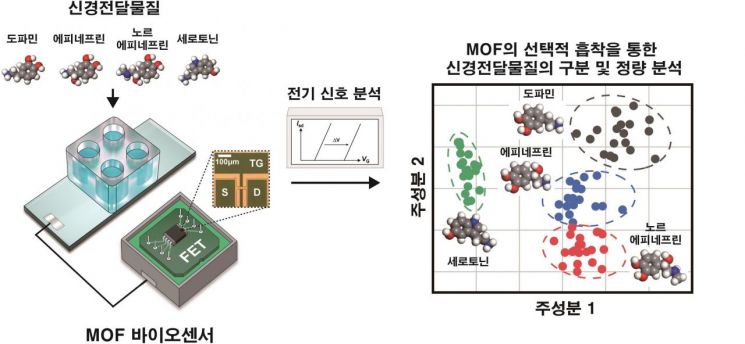 Development of Neurotransmitter Biosensors for Early Diagnosis Technology of Mental Disorders. Image courtesy of Korea Institute of Science and Technology (KIST)
The research team fabricated a conductive MOF, a porous material that selectively adsorbs neurotransmitters, in film form and applied it to an on-site electrical signal sensor. Since each neurotransmitter adsorbs to the MOF to different degrees depending on differences in size, charge intensity, and chemical bonding affinity, they were able to create a biosensor that produces specific electrical signal patterns according to the type and amount of neurotransmitter. This biosensor accurately distinguished multiple species of neurotransmitters with similar chemical structures and enabled high-sensitivity quantitative detection. For example, serotonin is observed at low concentrations in depression patients, and dopamine is low in Parkinson’s disease patients; using this system, imbalances of multiple neurotransmitters can be measured at once without multiple biosensors.
The research team stated, “The developed technology has the advantage of enabling early diagnosis of mental illnesses based on quantitative analysis results of neurotransmitters,” adding, “We plan to expand this into clinical translational research and develop it as a screening technology to identify candidates who require additional precise examinations such as MRI and CT.”
The research results were published in the latest issue of the authoritative chemical engineering journal, Chemical Engineering Journal (IF: 16.744, top 2.448% in the JCR field).
© The Asia Business Daily(www.asiae.co.kr). All rights reserved.
![Clutching a Stolen Dior Bag, Saying "I Hate Being Poor but Real"... The Grotesque Con of a "Human Knockoff" [Slate]](https://cwcontent.asiae.co.kr/asiaresize/183/2026021902243444107_1771435474.jpg)















