[Asia Economy Reporter Yujin Cho] Contrary to initial expectations, the European economy, which was hit hard by the Russia-Ukraine (hereinafter Rus-Ukr) war, is projected to avoid a recession this year. With energy prices falling, confirming that the soaring inflation has passed its worst phase, the European Central Bank (ECB) has also been able to catch its breath. However, since inflation still remains well above the price stability target, the tightening measures are expected to continue for the time being.
On the 13th (local time), the European Union (EU) Commission forecasted in its economic report that the Eurozone (20 countries using the euro) will avoid a recession this year due to falling energy prices and strong consumer demand. It presented an economic growth forecast of 0.9% for the Eurozone this year. This is an upward revision of 0.6 percentage points from the forecast of 0.3% released in November last year.
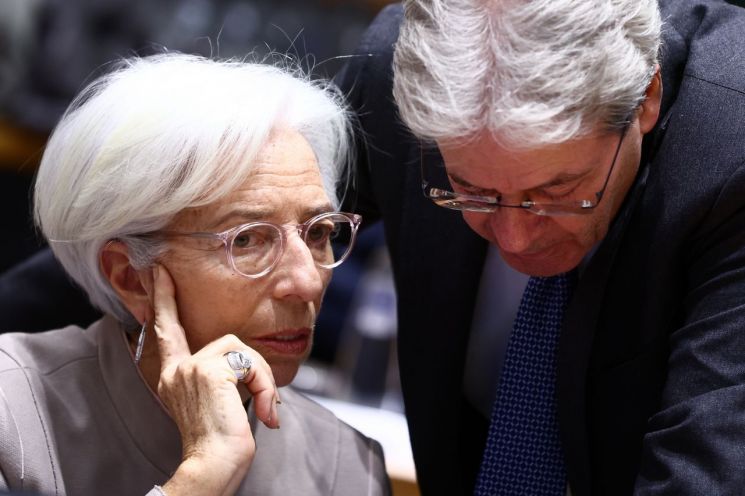
Last year, Europe faced an energy crisis caused by the Rus-Ukr war and Russia’s suspension of natural gas supplies, leading to widespread economic predictions of a recession. Since its economy is closely linked with Russia, it was expected to experience a deeper recession than other advanced countries such as the United States. However, the EU Commission explained that an unusually warm winter and energy-saving efforts by each country helped avoid a technical recession (two consecutive quarters of negative growth). Paolo Gentiloni, EU Commissioner for Economy and former Prime Minister of Italy, commented, "We have entered 2023 on a stronger foundation than expected."
Experts also diagnosed that the possibility of the Eurozone entering a brief recession phase and then recovering is low. According to a Bloomberg survey conducted from the 3rd to the 9th among economists, the Eurozone economy is expected to decline by 0.2% in the first quarter of this year and then rebound, thus avoiding even a shallow recession. Thanks to a mild climate and sufficient energy supply, the overall growth is expected to be 0.4% this year and 1.2% next year. However, Germany, which had a high economic dependence on Russia, is forecasted to experience the largest economic contraction among European countries.
Inflation is also assessed to have peaked. The EU Commission lowered its consumer price index (CPI) forecast for the Eurozone this year to 5.6%, significantly down from the 6.1% forecast in November last year. This is also a substantial easing compared to the previous year’s 8.4%. Inflation is expected to slow to around 2.5% next year. The Eurozone CPI inflation rate peaked at 10.6% in October, then fell for three consecutive months: 10.1% in November, 9.2% in December, and 8.5% in January this year. The report stated, "Now, one year into the Rus-Ukr war, the foundation is better than predicted last fall," adding, "Inflation has reached its peak, and further declines in energy prices are anticipated." Economic experts expect that the core CPI, which the ECB closely monitors, has also peaked. Bloomberg economists forecast that the core CPI, excluding energy and food, will peak at 5.2% in the first quarter and ease to 3.6% by the fourth quarter this year.
Even though inflation has passed its worst phase, since it still exceeds the price stability target (2%), interest rate hikes are expected to continue. The ECB implemented a big step (a 0.5 percentage point increase in the benchmark interest rate) this month, raising the rate to 2.5%, and has signaled additional hikes next month. ECB President Christine Lagarde said, "China’s unexpected resilience lowers the risks to the inflation outlook," and indicated that another big step is likely at the monetary policy meeting scheduled for next month. Economic experts expect the ECB to raise the benchmark interest rate to around 3.25%. ECB member Mario Centeno said in an interview with Bloomberg TV, "To adjust the pace of rate hikes, we will need to confirm that inflation is converging to 2% in the medium term."
© The Asia Business Daily(www.asiae.co.kr). All rights reserved.
![Clutching a Stolen Dior Bag, Saying "I Hate Being Poor but Real"... The Grotesque Con of a "Human Knockoff" [Slate]](https://cwcontent.asiae.co.kr/asiaresize/183/2026021902243444107_1771435474.jpg)
















