Controversy Related to SM Claimed as a 'Management Rights Dispute' Situation
Current Management and Others Criticized for Opposing Major Shareholder's Intentions
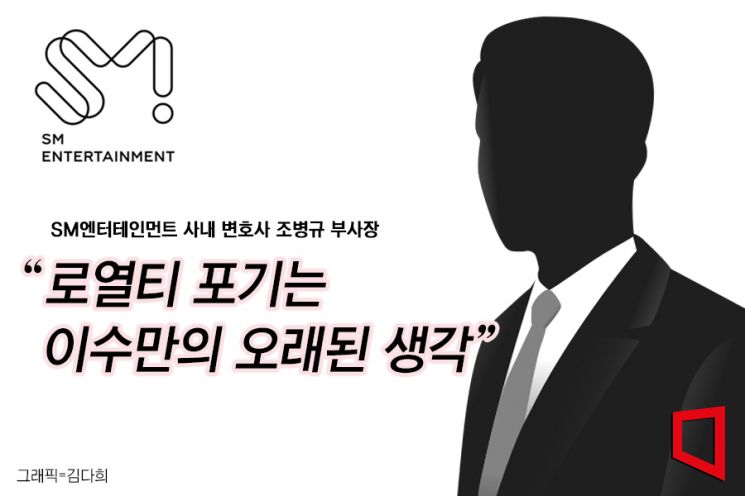
[Asia Economy Reporter Hwang Yoon-joo] SM Entertainment's in-house lawyer, Vice President Jo Byung-kyu claimed in an email sent to all employees that "the party attempting a hostile merger and acquisition (M&A) is not Kakao but Hive."
Vice President Jo, who said he was notified by the company that his contract would not be renewed after March 1, shared an email on the 13th detailing the controversies surrounding the SM management rights dispute. The email also included previously undisclosed statements from Lee Soo-man, such as "the idea to forgo royalties after the contract period was an old thought of the teacher (former SM General Producer Lee Soo-man)."
In the email, Vice President Jo emphasized the need to distinguish between the 'management rights' defined in business administration and those defined in the Commercial Act and Capital Markets Act to clearly understand the current conflict. In business administration, management rights refer to the authority of the CEO, summarized as personnel authority, organizational structure, and compensation system authority. The management rights defined in the Commercial Act and Capital Markets Act refer to the 'major shareholder,' meaning the power to appoint registered directors through the general shareholders' meeting and form the board of directors. Generally, the CEO/management (in the business administration sense) and the major shareholder (legal management rights) tend to coincide.
However, in SM's case, Vice President Jo pointed out that the interests of the current management (co-CEOs Lee Sung-soo and Tak Young-joon) in the business administration sense and the management rights under the Commercial Act and Capital Markets Act (former General Producer Lee Soo-man) conflict, and the situation has become complicated with the involvement of private equity funds and entertainment companies.
He explained, "When the major shareholder and the CEO have differing intentions as in the current situation, whether the M&A is hostile or friendly can only be judged based on the major shareholder," adding, "because the authority to form the board of directors lies with the shareholders' meeting composed of shareholders."
Vice President Jo stated, "The party currently attempting hostile M&A is Kakao," and "rather, Hive is conducting a friendly M&A, and the party trying to increase shares against the major shareholder's will is Kakao, aligned with the current management who have joined hands with Kakao."
Vice President Jo defined the current conflict at SM as a "dispute between the shareholder (Align Partners) and the major shareholder (Lee Soo-man)" regarding the auditor recommendation by the proposed shareholder (Align Partners) last year, the appointment and activities of the auditor accordingly. He claimed that after the January 20 agreement between Align Partners and the current management, the management rights dispute escalated between 'Align + current management' and 'major shareholder (Lee Soo-man).'
He explained, "Align, a shareholder with about 1% stake, and the current management, a shareholder with 0.3%, clashed with the major shareholder Lee, who holds 18%, over the company's future and how to form the next board of directors," stating that the dispute was over legal 'management rights.'
For this reason, Vice President Jo criticized the current management's opposition statement labeling Hive's approach as 'hostile M&A' as groundless. He said, "Hostile M&A means 'an acquisition and merger conducted against the management's will, without management's cooperation, and in an unfriendly manner,'" adding, "here, 'management' refers to the current major shareholder and allied forces exercising management rights as defined in the Commercial Act and Capital Markets Act."
Vice President Jo also raised his voice regarding Kakao's acquisition of a 9% stake in SM. He said, "The current CEO and board members hold 0.3%, and Align Partners holds about 1%," adding, "even if you combine both sides' shares, it would be around 2%." He then pointed out, "Therefore, what the current management naturally needs is a major shareholder with a large stake to support them. This is the reality behind the capital increase and convertible bond issuance to Kakao."
*Below is the full text of the email Vice President Jo shared internally
Hello all employees. I am General Counsel (in-house lawyer) Jo Byung-kyu. Many of you may not know me well, but I am writing this to explain the recent situation related to our company. There are many legal explanations needed regarding recent events, so I would like to clarify them.
First, let me talk about the management rights dispute and hostile M&A. What is a management rights dispute? When we say "management rights," we primarily think of the CEO's role. This includes the authority to appoint employees, organize the company, manage administrative affairs to ensure profitability, and evaluate and compensate employees. This is the management rights in the business administration sense.
However, the "management rights" in a management rights dispute have a different meaning. The management rights dealt with in the Commercial Act or Capital Markets Act refer not to the business administration management rights but to the power to appoint registered directors through the general shareholders' meeting and form the board of directors. Usually, the second and third largest shareholders unite against the largest shareholder in such disputes.
So, is the situation surrounding our company a management rights dispute or not? (1) The auditor recommendation by the proposed shareholder (Align Partners) since last year, the appointment and activities of the auditor accordingly, can be seen as a dispute between the shareholder Align and the major shareholder (the teacher).
And (2) after the January 20 agreement between Align and the current management, there is a management rights dispute between Align + current management and the teacher. This is because Align, a shareholder with about 1%, and the current management, a shareholder with 0.3%, clashed with the teacher, a shareholder with 18%, over the company's future and how to form the next board of directors.
(3) The business cooperation agreement between Kakao and SM on February 7, including the third-party allotment capital increase and convertible bond issuance, is also part of this. Kakao acquiring a 9% stake and siding with Align and the current management, and (4) Hive acquiring the teacher's shares and attempting a tender offer to acquire nearly 40% are all part of the management rights dispute.
Then, what is the "hostile M&A" opposed by co-CEOs Lee Sung-soo and Tak Young-joon and senior staff in the February 10 statement? Despite SM having ample cash assets, why did they issue new shares and convertible bonds to Kakao, allowing Kakao to purchase 9% of shares at a low price, and oppose Hive's purchase of the teacher's shares and tender offer as "hostile M&A"?
Hostile M&A means "an acquisition and merger conducted against the management's will, without management's cooperation, and in an unfriendly manner." However, here "management" does not mean the current co-CEOs or board of directors. It refers to the current major shareholder and allied forces exercising management rights under the Commercial Act and Capital Markets Act.
Generally, the company's board and CEO are appointed according to the major shareholder's will, so "management" is a general term. But when the major shareholder and CEO differ, whether the M&A is hostile or friendly must be judged based on the major shareholder, because the authority to form the board lies with the shareholders' meeting. Therefore, the party attempting hostile M&A now is Kakao, not Hive.
Rather, Hive is conducting a friendly M&A, and the party trying to increase shares against the major shareholder's will is Kakao, aligned with the current management and Align. Now that the concept is clear, I will interpret and explain the events that have occurred.
What does Kakao acquiring 9% of SM's shares mean? The current CEO and board members hold 0.3%, and Align holds about 1%. So, the combined shares of Align and current management after the January 20 agreement are about 2%. What did the current management need? Yes, a major shareholder with a large stake to support them. This is the reality behind the capital increase and convertible bond issuance to Kakao.
Right after last year's shareholders' meeting, CEO Lee Sung-soo clearly told me he opposed the teacher's share disposal and especially opposed Kakao acquiring the teacher's shares. But in January this year, after declaring a different path from the teacher, he resolved at the board meeting to issue new shares and convertible bonds to Kakao for SM's development. The media unanimously evaluated this deal as a prelude to Kakao or Kakao Entertainment acquiring SM, calling it an unprecedented hostile M&A attempt.
Why did CEO Lee Sung-soo's stance on Kakao and Kakao Entertainment change from last year to this year? Why did he promote the most likely acquirer this year after opposing it last year? Could it be due to calculations about his reappointment expiring on March 27 this year and the economic and social benefits he would gain?
What is the injunction against new share issuance/convertible bond issuance? I should explain the injunction filed by the teacher against new share issuance/convertible bond issuance. The court's consistent stance, i.e., precedent, is to strictly scrutinize the conditions and procedures for allotting new shares to third parties in management rights disputes and not allow artificial share changes. In other words, when shareholders fight, the company should remain neutral and not intervene.
Management rights, i.e., the authority to appoint directors and form the board under the Commercial Act and Capital Markets Act, are disputed by shareholders. Should the company side with one party? Just as the people are the owners of the country, shareholders are the owners of a stock company, not the chairman or CEO. When parties fight for power, should the government or state agencies side with one? Of course not. The major shareholder and Align + current management are clashing over the next board composition, but the company suddenly sides with Align and current management and increases their shares through new share issuance/convertible bond issuance to Kakao? This is like government interference in elections.
Then why did Align agree to this? For the company? For SM's future? Align is basically a fund. Funds aim to make money. It's not their own money but invested money. Funds invest anywhere and exit by selling when profits are realized. Align likely saw that keeping the current management and Kakao as a major shareholder would boost stock prices, maximizing their profit realization. Even Align's CEO Lee Chang-hwan self-nominated himself as a 'non-executive director' to gain "management rights (director appointment or board formation authority)" to help sell Align's SM shares at a higher price.
Kakao has long tried to buy the teacher's shares, courting him. But why did Kakao side with Align and current management? Kakao is also motivated by 'money' and saw an 'opportunity.'
By using new share issuance/convertible bond issuance, Kakao judged it could become a 9% shareholder with about 200 billion KRW, much less than the money discussed in last year's teacher's share transaction, at about 90,000 KRW per share. They planned to buy cheaply at first, join the board, and gradually increase their stake.
By joining hands with Align and SM's current management, they could buy shares cheaply, control the board, and then become the major shareholder. Diluting the founder and major shareholder's shares through such collusion and changing the largest shareholder is unprecedented. The M&A industry even calls this an unprecedented hostile M&A.
Upon hearing that the teacher, as a major shareholder, filed a lawsuit against SM's new share issuance and convertible bond issuance, I thought I would have to reveal the complex history I wrote earlier in court to expose the Kakao/Align/current management collusion. But that became unnecessary because Align is proving it themselves.
Align said in the media, "We oppose Hive's entry but agree and support Kakao and SM's business cooperation." Why? A fund should support what helps stock prices. Align's stated rationale for raising issues at SM was shareholder value. They said the company should do this or that to help shareholders. That's activism, right? But Align opposes Hive's 120,000 KRW tender offer as low, yet supports Kakao's 90,000 KRW new share and convertible bond issuance.
Note! In the teacher's contract with Hive, the teacher set the stock price and tender offer price the same. This is also the first in Korean M&A history. The teacher gave up any premium as a major shareholder so that shareholders could benefit. The teacher allowed all shareholders to sell at 120,000 KRW, while Kakao's 90,000 KRW price was a 'discounted price.' So who truly stands with the minority shareholders, Align or the teacher?
Align's statements are strange. If Align, claiming to represent shareholder interests, opposes Hive's 120,000 KRW as low, shouldn't they oppose Kakao's 90,000 KRW acquisition even more? Moreover, Align opposed Kakao's capital increase last March but supports it this year. Did Align's stance on shareholder value change in a year?
The only way to understand Align's double standards is that they value whether their influence over SM remains and continues more than true shareholder value. Align's current behavior is not activist but a management rights fund, acquiring and exercising management rights to increase value and sell again.
Then, what has been the teacher's position? I am cautious when discussing this. I do not fully know the teacher's intentions and may misunderstand. But as an in-house lawyer who has observed these issues, I want to convey the teacher's judgments and words.
First, the teacher has not been involved in management. The teacher entrusted management to the management team and focused solely on producing and the metaverse world. If the teacher had managed directly, such issues might not have occurred. There would have been no controversy about appointing a nephew or close aide as director to effectively manage.
When hearing Align's improvement demands from the current management, the teacher, as a major shareholder, mostly agreed. Furthermore, the teacher suggested that the current management focus on what they do well and delegate IR and management activities to professional managers.
The only demand the teacher opposed was Align directly joining the board. Align holds only about 1.2%, and the teacher considered it inappropriate for such a small shareholder to recommend outside directors or become a registered director. This is not out of dislike but because a shareholder with 1% holding exercising such rights is excessive and overestimates their influence on the company.
The teacher agreed to proposals such as appointing an outside director as board chair in November, a board centered on outside directors, and committees like internal transactions, outside director recommendations, compensation, and ESG committees with two-thirds outside directors.
As everyone knows, the teacher declared early termination in September last year and formalized it in October by sending a letter to the current management expressing the desire for early termination. Also, the teacher agreed to work within the company in the future, with roles and compensation determined by the internal transactions committee centered on outside directors and the company.
The teacher had long planned to forgo or donate royalties after the contract period. Regarding this year's regular shareholders' meeting, the teacher was considering whether to disclose this first or respond later, as Align was expected to raise issues. Then, as noted in Hive's disclosure, the teacher clearly expressed the intention to forgo royalties after the contract period. Hive did not request this first; it was the teacher's longstanding thought.
Similarly, since the new auditor's appointment, the teacher urged the co-CEOs to quickly improve any legacy issues that might hinder SM, especially urging early termination of the contract with Like Planning as mentioned above.
The teacher has long urged building a multi-producing system for SM's future after him, emphasizing the need for a producing system that can operate independently. Unlike before, when top experts created the best music with the general producer, the current management's announcement is like splitting one company into five. They plan to debut three rookie teams this year. That would be great if possible.
But I see this as delusion. It combines Align CEO Lee Chang-hwan's ignorance of the cultural industry and CEO Lee Sung-soo's ambition to take the teacher's place and accomplish this, giving shareholders false hope. The announcement sounds like building a bigger brick factory and adding more brick-making machines to produce more bricks. We are not brick makers. The teacher's multi-producing is not that.
The teacher's only demand was one! Let's go back to January 15, Sunday, when the teacher and co-CEOs announced agreed matters. All announced items were agreed upon by the teacher and co-CEOs. Who proposed or decided first is less important than the fact that the major shareholder and current management agreed. On that day, the teacher asked the co-CEOs one thing: as a major shareholder, "I can stop producing, you say internal transactions have issues and will improve, and accept external proposals. But both of you stand firmly by my side. You must stand with me as one team to block external attacking groups. If you don't stand proudly by me, we will collapse under external attacks." That was it.
But the co-CEOs immediately went silent. They turned off phones, didn't come to work, and on Friday, January 20, announced an agreement with Align, fully accepting Align's proposals and appointing Align CEO Lee Chang-hwan as a registered non-executive director! Is this for the teacher? Is this a decision for the company's future?
Twenty-five years ago, before activist funds appeared, I helped introduce the term economic democratization in Korean society through minority shareholder movements. I have experienced many shareholder derivative lawsuits and reviewed related documents. So when I read Align's shareholder derivative lawsuit petition around January 16, I immediately sensed collusion and betrayal.
Shareholders file derivative lawsuits mainly to prevent current management from repeating mistakes, not to blame past management. For shareholders, investors, and funds, company value, stock value, and respect as shareholders are more important than "setting history straight," and these depend on how "current management" acts "going forward."
However, Align's derivative lawsuit petition unusually excludes any blame on current management. This is unprecedented; I have never seen such a petition. Now I understand why I was discouraged from meeting the auditor directly or discussing with Align.
Through Align's emergence and the new auditor's activities, the co-CEOs exaggerated risks, denied their faults, and used Align and the new auditor's stance to intimidate the teacher and members. The absence of co-CEOs and current board members' names in the petition clearly shows this.
I explained what CEO management rights are earlier. The current management exercising those rights for three years is completely omitted from Align's petition. As a lawyer who has seen countless derivative lawsuit documents, I am convinced this document is the result of betrayal and collusion.
What followed is known from media reports and company statements. On January 20, the co-CEOs announced an agreement with Align excluding Lee Soo-man. During the Lunar New Year holiday, they held a non-face-to-face board meeting. On February 3, they announced a multi-"producing" plan but presented a multi-"production center" plan without naming any producers. They effectively declared a co-CEO "general producer" system to take over the teacher's role.
The worst was at the end of that statement. CEOs Lee Sung-soo and Tak Young-joon looked at the screen and said goodbye to the teacher: "Finally, although the contract with SM as general producer has ended, we sincerely thank Lee Soo-man, who continues to support SM as a shareholder." They explained to employees that all this was for the teacher, but the teacher himself received no consultation, call, or letter.
On February 7, the current management announced a capital increase and convertible bond issuance with Kakao, saying SM 3.0 needs funds. The board meeting to approve this was convened with notice at 5 p.m. the previous day and held at 8:30 a.m. the next day. The purpose, who wanted it, and who benefits have been explained.
After it became clear that the current management sides with Kakao and Align, it was also widely known that the teacher transferred his shares to Hive. I understand many are concerned about SM's future, direction, and individual employees' futures. Whether Hive or Kakao becomes SM's largest shareholder is not something employees can decide.
However, there are things we can decide and execute. Regardless of who becomes SM's largest shareholder, only employees can protect SM's spirit, culture, tradition, and legacy.
I have received many voices debating right and wrong, assigning responsibility, and worrying about the future. I know revealing these details may fuel controversy and have worried about it. But appealing for stability and unity without sharing these details feels hollow, so I wrote this long message.
To emphasize, those who will protect SM, inherit its tradition and legacy, and achieve future development are the employees. I hope you regain courage and hope and avoid being misled by baseless rumors.
I am a lawyer. Not to boast but to stress that revealing client-consultant secrets can lead to lifelong disbarment. As an in-house lawyer, I have a duty to protect the company and its members' safety.
Any employee can consult me anytime about what to do for SM and our community. I will respond gladly, strictly protect confidentiality, and fulfill my professional and official duties sincerely.
I have already received text and email notices from HR Support that my contract will not be renewed after March 1, 2023, without any reason, and orders to stay at home. But I do not interpret this as permission to slack off during the remaining contract period. I will fulfill my duties during the remaining period. I am available 24/7 for consultation and will do my best to advise. Thank you. February 13, 2023, Jo Byung-kyu
© The Asia Business Daily(www.asiae.co.kr). All rights reserved.
![Clutching a Stolen Dior Bag, Saying "I Hate Being Poor but Real"... The Grotesque Con of a "Human Knockoff" [Slate]](https://cwcontent.asiae.co.kr/asiaresize/183/2026021902243444107_1771435474.jpg)















