Hyundai Department Store Posts Record High Consolidated Sales of 50.41 Trillion KRW Last Year
Department Store Focuses on Strengthening Fundamentals Amid Economic Slowdown and Base Effect This Year
Improving Duty-Free Profit Structure and Diversifying Jinus Sales
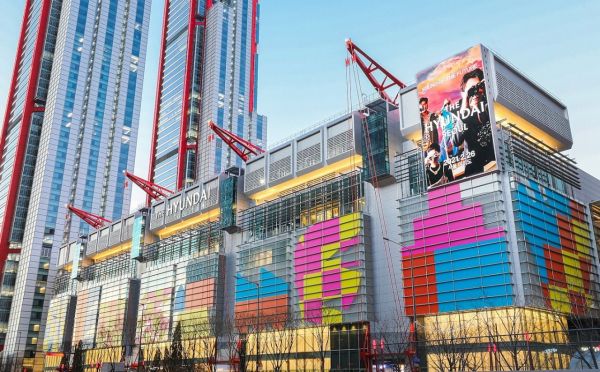
Hyundai Department Store, which recorded its highest-ever sales last year, is facing a test across its entire business this year, including department stores, duty-free shops, and Zinus. The department store sector must prepare for a 'reverse base effect' following the high growth during the COVID-19 period amid growing concerns over economic slowdown this year. Improving the profitability structure of duty-free shops and diversifying Zinus's sales are also challenges. Plans to actively invest in new growth engines beyond retail through structural improvements via spin-offs must be reconsidered from scratch.
According to the distribution industry on the 14th, Hyundai Department Store recorded an operating profit of 320.9 billion KRW on a consolidated basis last year, a 21.4% increase compared to the previous year. Sales during the same period rose 40.4% to 5.0141 trillion KRW. Thanks to the inclusion of Zinus, sales exceeded 5 trillion KRW, marking the 'highest annual sales ever.' Market consensus (estimates) also exceeded sales expectations. However, operating profit fell short of estimates. According to FnGuide, Hyundai Department Store's sales and operating profit estimates were 4.806 trillion KRW and 358.4 billion KRW, respectively.
Last year, with the lifting of social distancing and the 'endemic' effect, consumption of products related to outdoor activities such as clothing and cosmetics surged, centered on department stores, and steady growth in luxury sales contributed to strong performance, but the 'year-end effect' was disappointing. Hyundai Department Store's operating profit in Q4 last year was 68.6 billion KRW, down 27.2% year-on-year. Sales increased 43.8% to 1.5824 trillion KRW. Zinus's results have been consolidated into Hyundai Department Store's financials since Q3 last year. Zinus's results from the previous year and Q1 and Q2 last year were not reflected.
By segment, the department store recorded an operating profit of 94.5 billion KRW in Q4 last year, down 9.9% year-on-year, missing market expectations. Sales were 596.8 billion KRW, up 5.3%. Following Q3, fashion and cosmetics performed well again in Q4, boosting sales, but the growth rate was limited due to a high base in the previous year. The temporary closure of Hyundai Premium Outlet Daejeon also impacted results, reducing operating profit by 10.4 billion KRW. For the full year, sales recovered to 2.2896 trillion KRW and operating profit to 378.8 billion KRW, increases of 8.9% and 24.3%, respectively, compared to the previous year, driven by improved consumer sentiment following the easing of COVID-19 and better performance in previously underperforming high-margin product categories.
Duty-free shops also saw a significant sales recovery in the endemic era, but as a latecomer, they engaged in intense discounting, which widened losses. The duty-free sector recorded an operating loss of 23.3 billion KRW in Q4 last year, an increase of 12.8 billion KRW compared to the same period the previous year. Sales rose 24.0% to 704.4 billion KRW. For the entire year, an operating loss of 66.1 billion KRW was recorded, with losses increasing by 25.3 billion KRW compared to the previous year. Sales increased 41.8% to 2.2571 trillion KRW. Zinus posted an operating profit of 17.4 billion KRW in Q4 and a cumulative 28.0 billion KRW for Q3 and Q4. Sales during the same periods were 318.4 billion KRW and 604.6 billion KRW, respectively.
The department store plans to expand the 'future-type department store' concept, applying the successful formula of The Hyundai Seoul this year. They will focus on reducing sales floor space and creating nature-friendly spaces within the department store to make it a desirable destination. Following The Hyundai Seoul, Hyundai Department Store expects performance improvements from The Hyundai Daegu, which was renewed and launched in December last year. The Hyundai Daegu features a 4,565㎡ (approximately 1,380 pyeong) multi-cultural and arts plaza called 'The Forum by Jaime Hayon,' attracting customer visits. This year, efforts will also be made to strengthen the lineup of major brands, including luxury goods, amid weakened consumer sentiment. The Hyundai Seoul, expected to exceed 1 trillion KRW in sales this year, is focusing on discovering new content that excites the MZ generation (Millennials + Generation Z) and is continuing negotiations to add luxury brands such as Louis Vuitton for greater growth.
Duty-free shops will also leverage the normalization of overseas travel this year to further increase sales and prepare for China's phased reopening. As a latecomer that aggressively engaged in price competition during the COVID-19 period, the government has introduced restrictions on commission fees related to Chinese 'daigou' (overseas purchasing agents) to revitalize the duty-free industry, prompting the company to reconsider its business strategy. The company expects to reach the monthly break-even point (BEP) within the year due to China's lifting of quarantine restrictions, resumption of overseas travel, and the entry of key duty-free brands.
Zinus, the top mattress company on Amazon acquired last year, generates 97% of its sales overseas, so this year it plans to increase the domestic sales ratio. It is also considering joint product development with living and interior affiliates such as Hyundai Livart and Hyundai L&C, as well as developing a premium lineup tailored to department store customers' tastes.
© The Asia Business Daily(www.asiae.co.kr). All rights reserved.

















