Yoon Emphasizes "Ensuring Union Accounting Transparency" to Staff
This Week's Legislative Notice on Union Accounting Transparency and Eradication of Unfair Practices
Social and Economic Chief Offices Collaborate on Establishing Union Accounting Disclosure System
[Asia Economy Reporters Baek Kyunghwan and Lee Gimin] As the government prepares labor reform-related bills to enhance the accounting transparency of labor unions, it is reported that the regulations will include provisions to sanction unfair practices by labor unions, similar to those imposed on employers (companies). Ahead of the submission deadline for labor union accounting books requested by the government on the 15th of this month, President Yoon Suk-yeol repeatedly instructed "the need to secure transparency in union accounting."
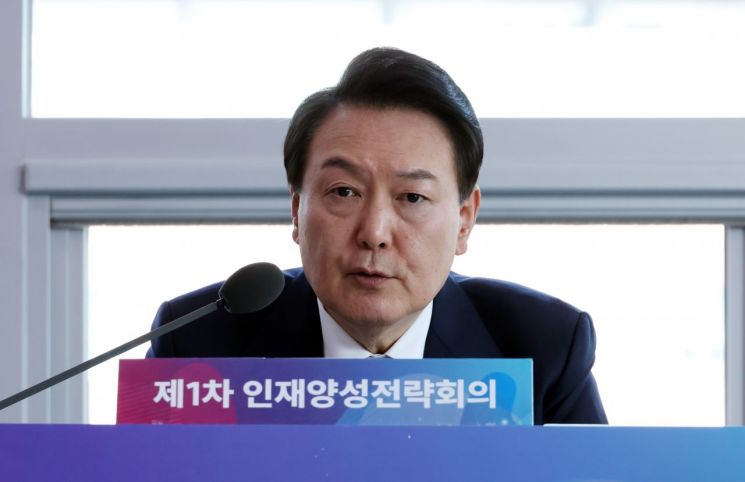
According to the Presidential Office and the government on the 13th, President Yoon recently emphasized in a meeting with his aides that "securing accounting transparency and resolving the dual structure of the labor market are the two essential methods of labor reform."
The Ministry of Employment and Labor plans to verify compliance with the obligation to keep and preserve financial books and documents by 334 labor unions with more than 1,000 members by submitting one cover page and one inner page of the accounting books by the 15th of this month, pursuant to Articles 14 and 27 of the "Labor Union and Labor Relations Adjustment Act" (Labor Union Act). For unions that fail to submit, a fine of up to 5 million won will be imposed according to Article 96 of the Labor Union Act.
Deadline for Union Accounting Book Submission on the 15th... President Yoon Orders "Securing Accounting Transparency"
The Presidential Office stated that since the government granted a self-inspection period to unions for about a month from the end of last year, no further compromise will be made. A Presidential Office official said, "If the intention is to check the cover of the legally prescribed accounting books rather than the detailed contents to confirm whether they are kept, the government has the obligation to inspect because the law mandates it. It is unfair to claim this infringes on autonomy," affirming the legal validity. Article 14 of the Labor Union Act stipulates that labor unions must keep members' lists, bylaws, names and address lists of executives, meeting minutes, financial books, and related documents at the union office.
In this regard, the government plans to announce a draft bill related to labor reform, including measures to enhance union accounting transparency, within this month. The bill will include provisions to establish a framework for mandatory disclosure of accounting books so that unions can objectively disclose their accounts, as unions receive tax deductions similar to public interest corporations. Additionally, the new bill will revise regulations related to industrial unions' bylaws that prohibit collective withdrawal of subordinate organizations (branches and chapters), allowing union withdrawal. Since the current Labor Union Act only regulates unfair acts by employers, the bill will be amended to punish unfair acts by workers as well, aiming to correct the irrationality where majority unions prevent minority unions from establishing institutional agreements, thereby guaranteeing the constitutional labor rights, according to the Presidential Office.
Office of Social Affairs and Office of Economic Affairs to Establish Union Accounting Disclosure System
After the legislative notice of the bill, the government plans to establish a union accounting disclosure system by the third quarter of this year based on it. The Presidential Office has decided that the Office of Social Affairs and the Office of Economic Affairs will cooperate in building the system. Although the union accounting issue is led by the Office of Social Affairs, assistance from the Office of Economic Affairs is necessary because the system will borrow from the Financial Supervisory Service's electronic disclosure system, 'DART.' A Presidential Office official explained, "We plan to review existing U.S. union accounting disclosure systems and apply them to the reality of our country." In the U.S., the Labor-Management Reporting and Disclosure Act was enacted in 1959 to eradicate illegal and corrupt acts by unions, requiring unions to disclose their financial statements in annual reports through a union accounting disclosure system. The annual report includes information on union assets and liabilities, received funds and their sources, salaries and other payments to union officers and employees who received more than $10,000 (about 12 million won), and direct or indirect loans of $250 or more to union officers, employees, or members.
The Presidential Office recently disclosed President Yoon's remark from the 'Dialogue with the President' last week, "If we leave illegal acts in industrial sites unchecked, can that be called a nation?" Meanwhile, the Ministry of Employment and Labor, the main department for labor reform, has begun policy formulation regarding the dual structure of the industrial sector and illegal acts, tightening the reins on labor reform. Apart from the related legislative matters being prepared by the Ministry of Employment and Labor and related ministries, it appears that the government intends to conduct a full-scale public discussion by examining issues by industry and sector.
In fact, the Ministry of Employment and Labor has recently launched a series of policy studies linked to labor reform, such as 'Regulation Measures for Illegal and Unfair Acts in Labor Relations' and 'Status of Dual Structure by Industry.' A senior government official said, "Since the president has repeatedly emphasized labor reform as the top priority reform, we believe a preliminary survey for social consensus is necessary apart from the response in the National Assembly," adding, "The background will also be reflected in the government proposal to be made soon."
Ministry of Employment and Labor Launches Policy Research on Unfair Labor Practices and Dual Structure by Industry
First, to prepare 'Regulation Measures for Illegal and Unfair Acts in Labor Relations,' the ministry will examine issues that destabilize labor relations and infringe on mutual rights, such as unfair labor practices by employers, abuse of power by unions, and violence. This includes unfair labor practices by employers that infringe on workers' labor rights, as well as recent social concerns about excessive and illegal actions by unions that infringe on the right to work.
In line with this, the Presidential Office belatedly disclosed President Yoon's remarks from the 7th, saying, "If I cannot normalize industrial sites where violence, threats, and extortion run rampant, I believe I do not deserve to receive taxes from the people." It is very unusual for the Presidential Office to disclose the president's remarks five days later. President Yoon also pointed out, "If the government neglects illegal acts such as union executives' children being hired and hiring being sold off with the remaining positions, private managers cannot do anything."
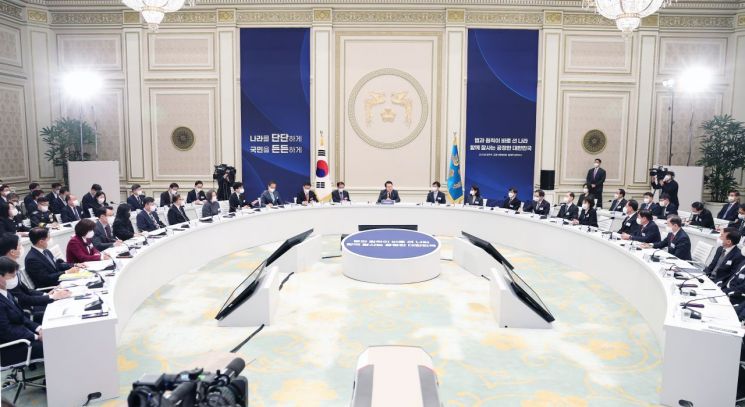
The government has also started policy formulation on the 'Status of Dual Structure by Industry' and 'Win-Win Cooperation Measures in the Shipbuilding Industry.' This follows President Yoon's visit to Hyundai Heavy Industries shipyard in Gunsan, Jeonbuk, on the 10th, where he pointed out the 'dual structure' where subcontractors suffer from low wages. He urged, "I ask that the field continuously consider and boldly implement measures to restructure wage systems and improve working conditions through win-win cooperation between primary and subcontractors." A government official said, "We plan to examine the possibility of applying this approach, where primary and subcontractors in shipbuilding autonomously devise and implement solutions to the dual structure, to other industries."
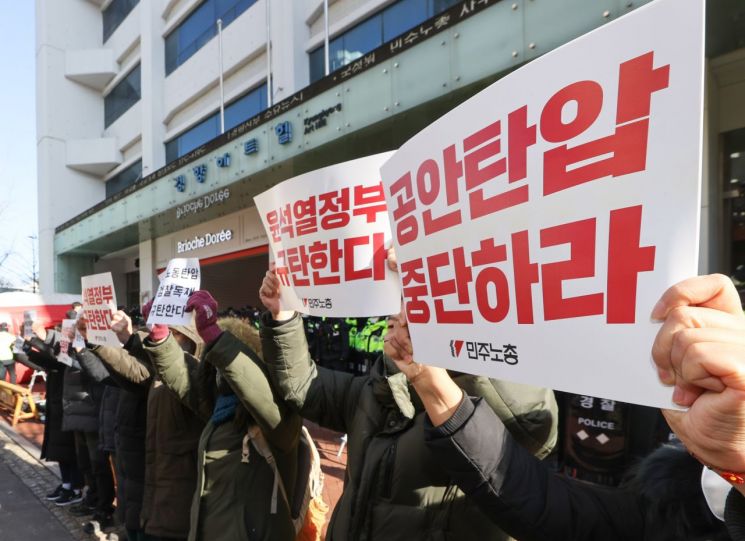
However, as President Yoon's sharp remarks toward the labor sector continue, there is analysis that labor-government conflicts may intensify rather than public discussion on reform. On the 1st, the Ministry of Employment and Labor sent official letters to 334 labor unions and federations with more than 1,000 members, requesting self-inspection and reporting on compliance with the obligation to keep and preserve accounting documents under the Labor Union Act, but unions are still strongly opposing.
Strong Labor Opposition... Presidential Office Prepares for Public Discussion on Labor Reform
The 'Win-Win Wage Committee,' launched by the government to improve the dual structure of the labor market, is also a source of conflict. The Federation of Korean Trade Unions criticized, "Reducing the labor cost ratio of large companies to raise wages for small and medium-sized enterprise workers ultimately means lowering wages overall," and the Korean Confederation of Trade Unions has scheduled a series of struggle declaration rallies, mass protests, and general strikes starting next month.
The National Assembly situation is similar. Although the ruling party and government are pushing for the Labor Union Act amendment known as the 'Union Transparency Act,' as well as the Enforcement Decree of the Serious Accidents Punishment Act and the Fair Recruitment Act, the confrontation between ruling and opposition parties is intensifying, making the passage of bills uncertain. Moreover, from the second half of the year, legislative processes are expected to be even more difficult due to preparations for the general election by both sides.
However, the Presidential Office is expected to further emphasize the inevitability of labor reform and prepare for the upcoming public discussion process. Since President Yoon's 'principled stance' during last year's Cargo Truckers Solidarity strike became the driving force for government reform, the administration plans to persuade the public with a consistent tone.
There is also an interpretation that the recent moves by the Presidential Office and the ruling party are linked to the recent decline in President Yoon's approval ratings. According to a public opinion poll conducted by Gallup Korea from the 7th to the 9th and released on the 10th, President Yoon's positive job performance rating was 32%, and negative rating was 59%. Compared to the survey a week earlier, the positive rating dropped by 2 percentage points, and the negative rating rose by 3 percentage points. In the results released on the 13th by Realmeter commissioned by Media Tribune, President Yoon's negative rating increased by 2.5 percentage points to 60.3%, and the positive rating fell by 2.4 percentage points to 36.9%. Since President Yoon's approval rating declined due to controversy over interference in the People Power Party leadership election, it is analyzed that he will again lead with labor reform to regain support.
For detailed information on the public opinion polls cited in the article, please refer to the website of the Central Election Poll Deliberation Commission.
© The Asia Business Daily(www.asiae.co.kr). All rights reserved.



















