"ChatGPT learns by 'compressing' knowledge
Only a blurry copy of the original remains
Creative work is impossible with the copy"
The artificial intelligence (AI) chatbot 'ChatGPT' developed by OpenAI sometimes submits incorrect answers, causing users to be perplexed. Google's 'Bard,' introduced as a 'ChatGPT rival,' even produced wrong answers during its first demonstration. Why does an AI trained on a vast amount of documents confuse even simple facts?
Ted Chang, one of the top science fiction writers in the United States, explained the reason in a lengthy article published in the American media outlet New Yorker. According to his article, AI learns information by 'compressing' it, and in the process, the AI's knowledge becomes dulled compared to the original source.
Ted Chang: "ChatGPT is a blurry version of the internet"
On the 9th (local time), Ted Chang published an article titled "ChatGPT is a blurry JPEG version of the internet" in the New Yorker. In this piece, he uses the image file extension 'JPEG' as a metaphor to explain the complex and difficult language generation model AI.
JPEG is one of the file extensions used when saving photos, drawings, and other files on computers or mobile phones. Although there are various extensions such as PNG and GIF, JPEG/JPG is the most actively circulated extension on the internet.
The reason JPEG emerged as the dominant image file type is due to its low file size. Compared to extensions like PNG, JPEG files can be uploaded and downloaded on the internet much faster. However, files saved as JPEG have lower image quality than those with larger file sizes. For example, if you draw a picture in Paint and save it as both PNG and JPEG, the JPEG version will appear slightly more 'blurry.'
Knowledge is also lossily compressed like image files
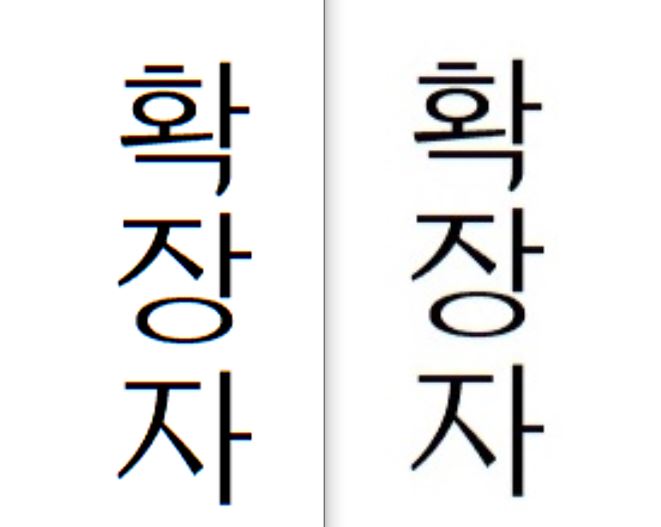 The difference between PNG image (left) and JPEG. You can see that the JPEG side has slightly blurrier quality.
The file saving method like JPEG is called 'lossy compression.' It is a technology that significantly reduces file size by sacrificing some data. Originally, even if the photo quality is slightly reduced, it does not cause much inconvenience to the naked eye, and thanks to JPEG, internet loading speeds have become faster, so the benefits are much greater.
This JPEG lossy compression technology is similar to how ChatGPT learns knowledge. It abstracts and stores complex and detailed information and then outputs it again in human language.
Ted Chang said, "Think of ChatGPT or similar language models as faint JPEG files scattered across the internet," adding, "ChatGPT holds most of the information on the internet, but that information is like a blurry image in a JPEG file."
He continued, "Therefore, if you try to zoom in on a part of that image to see extremely detailed parts, you won't be able to find them. What we can find in ChatGPT is only an 'approximation.'"
Ted Chang explains that the reason ChatGPT sometimes produces wrong answers or even fabricates facts that never existed is also a trace of 'lossy compression.' Because it recreates the blurred parts, some parts become completely different from the facts.
"The original still exists... so why use a low-quality copy?"

Ted Chang is also skeptical about using AI as an auxiliary tool in the creative process. He emphasized, "A machine that can only output a blurry copy of the original cannot be the starting point of original work," and "Rather, the trial and error and struggles humans experience while writing are the very process through which original ideas are born."
Instead, the moment when ChatGPT is useful is when the internet is completely cut off and access to information is impossible. When access to the original knowledge is lost, having even a somewhat inaccurate copy is better.
However, Ted Chang questions, "Right now, we are not suddenly at risk of losing internet access," and asks, "Since the original still exists, is there really a need to use the blurry JPEG version of knowledge?"
Meanwhile, Ted Chang is a figure who has swept awards given to science fiction (SF).
His representative works include The Tower of Babylon (1990), Understand (1991), Story of Your Life (2002), and Exhalation (2019).
He majored in physics and computer science at the prestigious Brown University in the United States and has won the highest honors in SF?the Hugo Award, Locus Award, and Nebula Award?four times each.
© The Asia Business Daily(www.asiae.co.kr). All rights reserved.
![Clutching a Stolen Dior Bag, Saying "I Hate Being Poor but Real"... The Grotesque Con of a "Human Knockoff" [Slate]](https://cwcontent.asiae.co.kr/asiaresize/183/2026021902243444107_1771435474.jpg)

















