Kakao Announces AI Assistant and Copywriter... Emphasizing Efficiency
Naver Applies Korean-Strong 'Search GPT' to Search
[Asia Economy Reporter Yuri Choi] Naver and Kakao have also entered the AI world war ignited by the AI chatbot 'ChatGPT.' Both companies announced plans to launch services applying large-scale AI within the year, but their strategies differ. While Naver is solidifying its search dominance with AI specialized in the Korean language, Kakao aims to strengthen its platform by linking cost-efficient AI with KakaoTalk.
Kakao Announces Vertical AI Services...Cost Efficiency as a Competitive Edge
On the 13th, Kakao announced it will launch various AI services, including a personal assistant, within the year. It is currently preparing an AI assistant linked with KakaoTalk. Kakao’s character 'Jordi' will act as an assistant by notifying schedules or recommending meeting places in the chat window. A service that creates KakaoTalk profile and background photos using the image generation AI 'Karlo' will be released in the first half of the year. For small business owners, Kakao will launch an AI that writes advertising copy for products and services.
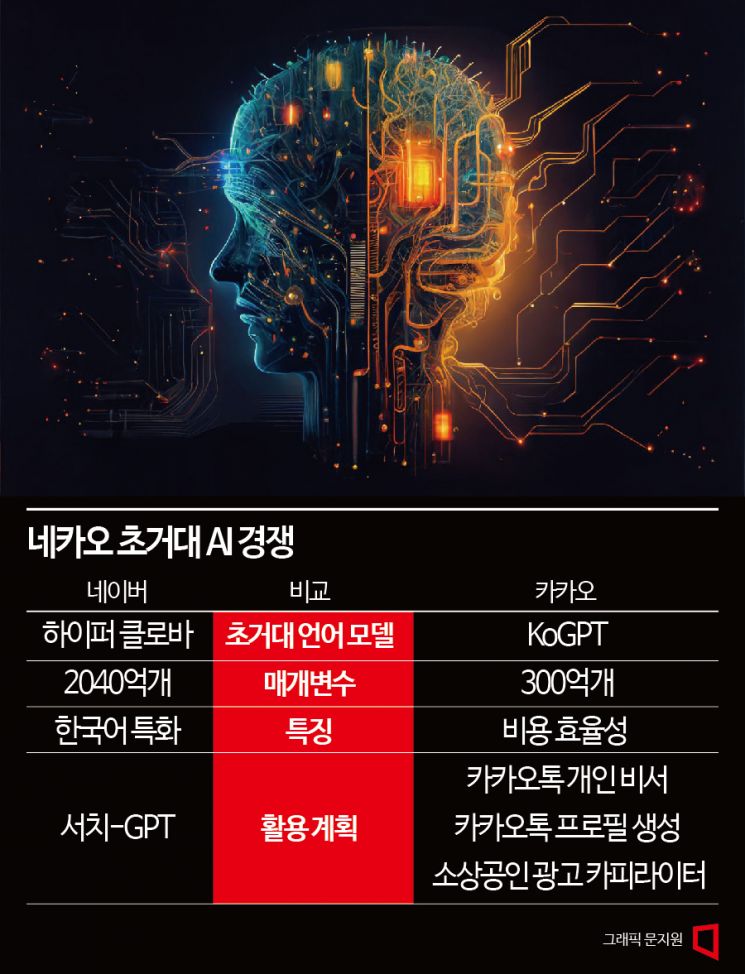
Kakao has adopted a strategy of deploying AI services across multiple areas. Rather than focusing on advancing large-scale AI, it aims to compete with AI specialized in each domain. The strategy is to grow the platform by linking various AI-generated content (ACC) with KakaoTalk. This decision was influenced by the difficulty of competing with global big tech companies using large-scale AI. Large-scale AI performs better as the number of parameters increases, but this requires massive computing infrastructure. Increasing parameters to 100 billion typically costs around 10 billion KRW in infrastructure.
Instead, Kakao accelerates commercialization with cost-efficient large-scale AI. Kakao Brain, Kakao’s AI specialized subsidiary, developed the large-scale AI 'KoGPT' with 30 billion parameters. Although it is about one-sixth the size of ChatGPT (175 billion parameters), it performs significant tasks such as product description writing, machine translation, and advertising copy generation. Parameter values are adjusted according to tasks to improve efficiency.
Hong Eun-taek, CEO of Kakao, explained, "The size of AI models and capital are proportional, so global companies have an absolute advantage. Rather than competing on the same level, we will focus on areas where efficiency combined with KakaoTalk creates great synergy."
Naver’s Korean-Strong 'HyperCLOVA'...Applied to Search Engine
Naver introduced 'Search GPT,' applying its proprietary large-scale AI 'HyperCLOVA' to its search engine. It plans to launch it as a separate service in the first half of the year and is considering applying it to existing search based on user feedback. For searches requiring summarized information, such as Seoul subway fares, it provides highly reliable, up-to-date content with sources. For searches needing advice, like "how to buy a laptop cheaply," it offers answers using diverse content.
Naver chose to bet on search because it believes its large-scale AI model is competitive. It is not behind global companies in technology and leads in Korean language capabilities. To run HyperCLOVA faster and lighter, Naver is collaborating with Samsung Electronics on AI semiconductors and focusing on advancing large-scale AI. Given its strengths, it plans to use this as a weapon in search, where understanding user intent is crucial.
Naver was the third in the world to unveil large-scale AI after OpenAI and Huawei. HyperCLOVA has 204 billion parameters, surpassing GPT-3. Its Korean language proficiency is the best worldwide. It has learned from 50 years’ worth of Naver news content, training on over 6,500 times more Korean data than GPT-3. GPT-3 mainly trained on English data, resulting in insufficient Korean responses, but Naver believes it can overcome this weakness.
Choi Soo-yeon, CEO of Naver, said, "We will combine abundant user data with Naver’s technological know-how. We can solve issues such as the decline in Korean information accuracy, lack of up-to-date information, and reliability, which are pointed out as weaknesses of ChatGPT."
© The Asia Business Daily(www.asiae.co.kr). All rights reserved.
![Clutching a Stolen Dior Bag, Saying "I Hate Being Poor but Real"... The Grotesque Con of a "Human Knockoff" [Slate]](https://cwcontent.asiae.co.kr/asiaresize/183/2026021902243444107_1771435474.jpg)















