5% Range Fixed Deposits and Household Loans Are Disappearing
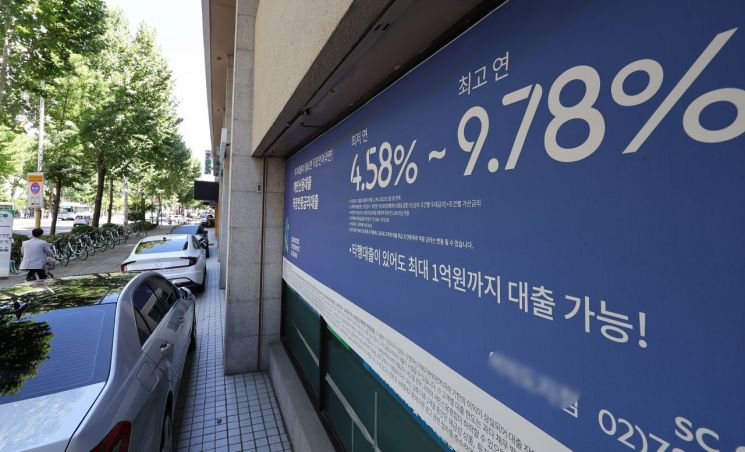
[Asia Economy Reporter Sim Nayoung] Fixed deposits with annual interest rates in the 5% range and household loans are disappearing. As the interest rates on bank bonds, which domestic banks use as a benchmark when setting deposit and loan rates, decline and financial authorities pressure banks to lower rates, interest rates are trending downward.
According to the Bank of Korea's Economic Statistics System on the 11th, the proportion of fixed deposits with interest rates in the 5% range among newly accepted deposits at deposit banks in December last year was 17.0%, nearly 10 percentage points lower than the previous month (27.9%). Instead, the 4% range increased by about 10 percentage points (November 35.6% → December 54.1%). A representative from a commercial bank said, "In November last year, due to the aftershock of Legoland causing instability in the bond market and banks being unable to issue bank bonds, banks tried to raise funds through deposits, pushing fixed deposit rates up to 5%."
Then, when financial authorities signaled banks to lower rates, stating that banks were overheating competition on fixed deposit and installment savings rates and attracting all market funds, 5% range products quickly disappeared. As of the 8th, the representative fixed deposit rates of the five major banks (KB Kookmin, Shinhan, Hana, Woori, NH Nonghyup) are all in the 3% range. For a one-year term, KB Star Fixed Deposit is 3.48%, Shinhan Solpyeonhan Fixed Deposit 3.55%, Hana Fixed Deposit 3.6%, Woori WON Plus Deposit 3.62%, and NH All One e-Deposit 3.38%.
Rapid Interest Rate Cuts Across Loans and Deposits
The proportion of household loans with interest rates in the 5% range is also slowing down. In December last year, the proportion of household loans with 5% range interest rates among newly accepted deposits at deposit banks was 30.1%, down 7 percentage points from the previous month (37.1%). Similar to fixed deposits, this decreased proportion shifted to the 4% range (November 28.6% → December 36.2%).
As of the 8th, the five major banks' mortgage loans have variable rates ranging from 4.86% to 6.89% and fixed rates from 4.08% to 6.18%. Internet banks offer even lower rates. K Bank announced on the 6th that its apartment mortgage fixed-rate hybrid loan product rates range from 3.98% to 4.98% annually.
Compared to November last year when COFIX showed an unprecedented surge and mortgage loan rates at banks were in the 5-7% range, recent rates have stabilized. Another bank official said, "With recent declines in deposit rates and bank bond rates, COFIX is highly likely to be lowered on the 15th," adding, "The financial sector also expects the Bank of Korea to keep the base rate unchanged this month, so there will likely be no sudden rate fluctuations for the time being."
Meanwhile, on the 6th, Financial Supervisory Service Governor Lee Bokhyun addressed concerns at a press briefing that ordering banks to lower fixed deposit and loan rates might offset the effects of the Bank of Korea's rate hike policy that continued until January this year. He said, "The public has already individually felt the effects of rate hikes, and since the second half of last year, economic downturn due to reduced consumption has intensified," adding, "The authorities' stance is that there is no need to worry about the lack of effect from rate hikes."
The Impact of Last Year's Rate Hikes Extended Until January
In fact, the effects of last year's rate hikes have continued into January this year. According to the Financial Services Commission's 'Household Loan Trends in January,' household loans in the financial sector decreased by 8 trillion KRW compared to the previous month. Notably, mortgage loans decreased for the first time since statistics began in 2015, dropping by 600 billion KRW. This decline was centered on jeonse loans (-1.8 trillion KRW) and non-bank sector mortgage loans such as mutual finance (-600 billion KRW).
A Financial Services Commission official explained, "Although policy mortgages increased, the decrease in bank sector jeonse loans and second-tier financial sector mortgage loans caused mortgage loans to turn downward for the first time since 2015 statistics began." Regarding the 7.4 trillion KRW decrease in other loans including credit loans compared to the previous month, the official cited "the impact of rising loan interest rates." Specifically, credit loans alone decreased by 5.2 trillion KRW month-on-month.
Both bank and second-tier financial sectors saw decreases in household loans. Bank sector household loans decreased by 4.6 trillion KRW. Savings bank household loans slightly increased by about 100 billion KRW compared to the previous month. Conversely, mutual finance (-300 billion KRW) and credit card companies (-400 billion KRW) mainly contributed to a 3.4 trillion KRW decrease.
© The Asia Business Daily(www.asiae.co.kr). All rights reserved.
![Clutching a Stolen Dior Bag, Saying "I Hate Being Poor but Real"... The Grotesque Con of a "Human Knockoff" [Slate]](https://cwcontent.asiae.co.kr/asiaresize/183/2026021902243444107_1771435474.jpg)
















