Flexible Response to Regional Development Demand
Significant Revision of Central Government's 'Uniform Regulations'
"Local Governments to Lead Growth"
[Asia Economy Reporter Koo Chae-eun] The most notable aspect of the "Central Authority Decentralization Promotion Plan" announced by the Office for Government Policy Coordination on the 10th is the development restriction zone (Greenbelt) in non-capital regions (local areas). The Yoon Seok-yeol administration has significantly expanded the area within which city and provincial governors have authority to lift Greenbelt restrictions by more than three times.
Previously, the authority to lift Greenbelt restrictions was delegated to city and provincial governors for areas up to 300,000㎡, but going forward, the delegation scope will increase to "within 1,000,000㎡." This expands the area from the size of the National Assembly building to one-third the size of Yeouido.
This reflects the intention for city and provincial governors to take direct leadership and respond flexibly to regional development demands. The strategy is to revitalize the local economy and increase jobs starting from this point. It is interpreted as a corrective measure against the central government’s excessive regulation of Greenbelt lifting in non-capital regions, citing fairness and environmental preservation.
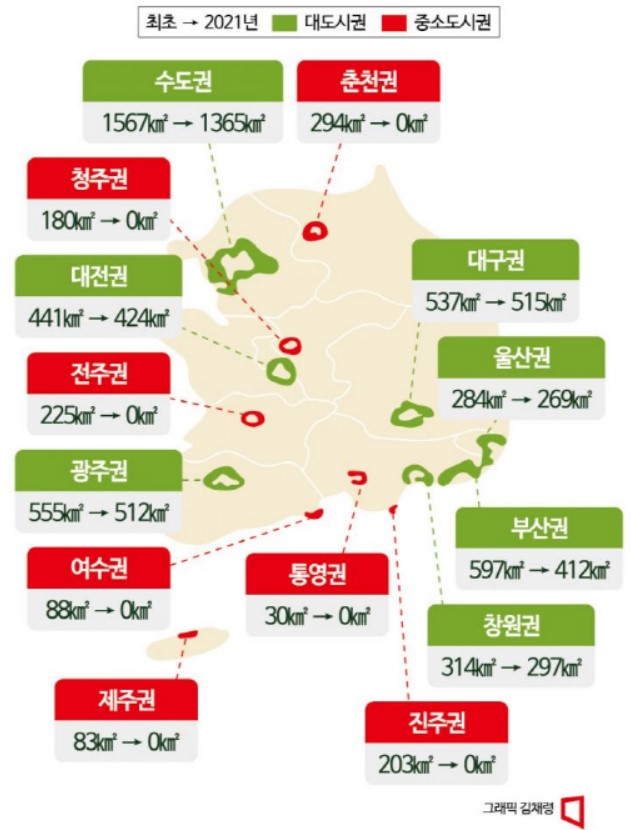 Status of remaining Greenbelt (development restriction zones) nationwide as of 2021. The government has delegated the authority to lift Greenbelt restrictions on areas of 300,000㎡ or less to provincial governors in non-metropolitan areas. Going forward, the delegation scope will be expanded to include areas up to 1,000,000㎡. This means the area has been increased from the size of the National Assembly building to one-third the size of Yeouido.
Additionally, the authority to provide financial support to regional universities, which have been embroiled in debates over their existence, has been delegated to local governments. This departs from the previous method where the Ministry of Education, a central government department, directly selected and supported regional universities, empowering local governments to take the lead in nurturing local talent and building a development ecosystem.
An official from the Office for Government Policy Coordination explained, "In a situation where low birth rates and intensified concentration in the capital region are making local extinction more visible, it was decided to boldly transfer central government authority to local governments so that they can lead growth."
Furthermore, the government has selected a total of 57 tasks across six areas including land, industry, employment, education, welfare, and systems. Among the core tasks are the approval authority for unmanned island development project plans, participation in determining and allocating the scale of foreign workforce introduction, application of environmental impact assessments according to city and provincial ordinances, authority over farmland conversion, and the expansion of city and provincial governors’ authority and participation scope in the development of hinterland complexes for local ports.
Prime Minister Han Duck-soo stated, "We will trust the potential of local areas and boldly promote authority decentralization," adding, "We are accustomed to a centralized administrative culture that views local governments as executing agencies and subjects of supervision, but maintaining the status quo is not the way to overcome crises."
© The Asia Business Daily(www.asiae.co.kr). All rights reserved.
![Clutching a Stolen Dior Bag, Saying "I Hate Being Poor but Real"... The Grotesque Con of a "Human Knockoff" [Slate]](https://cwcontent.asiae.co.kr/asiaresize/183/2026021902243444107_1771435474.jpg)















