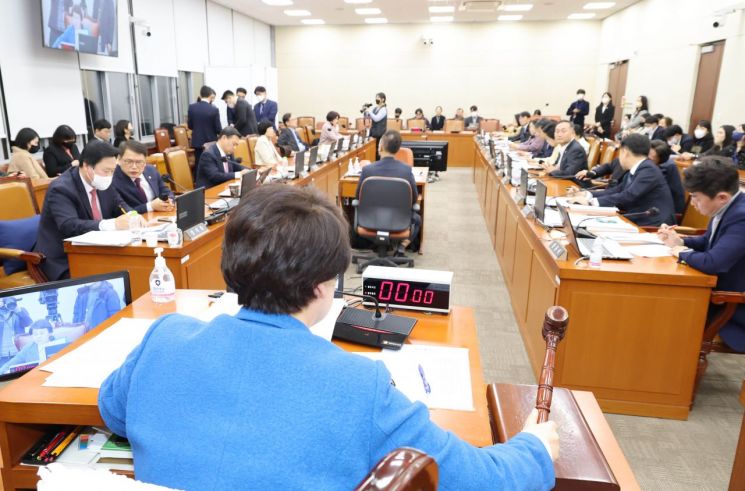
 On the 9th, at the National Assembly Health and Welfare Committee's plenary meeting, Chairperson Jeong Chunsuk is approving seven bills, including the Nurse Act, to be directly referred to the plenary session. [Image source=Yonhap News]
[Asia Economy Reporter Lee Gwan-ju] With the decision to send the Nursing Act bill directly to the National Assembly plenary session, it is expected to cause significant repercussions in the health and medical sectors.
On the 9th, the National Assembly Health and Welfare Committee referred seven bills, including the Nursing Act bill, directly to the plenary session at its full meeting. This comes nine months after the Nursing Act bill, passed by the opposition party alone in May last year, was forwarded to the Legislation and Judiciary Committee.
The Nursing Act bill includes definitions of the scope of nurses' duties, securing appropriate working hours, and nurses' rights to demand improved treatment. It separates the regulations concerning nurses that were previously included in the Medical Service Act to establish a separate law.
The Nursing Act has long been a "hot potato" dividing the health and medical community. Organizations, led by the Korean Nurses Association (KNA), which have raised their voices for the enactment of the Nursing Act, have argued that the law should be enacted to improve treatment and enhance nursing services. On this day, the National Movement Headquarters for the Enactment of the Nursing Act, centered on the KNA, held a rally in front of the National Assembly demanding the prompt enactment of the Nursing Act. Shin Kyung-rim, president of the KNA, emphasized, "We must immediately enact the Nursing Act to cultivate excellent nursing personnel, resolve the imbalance in nurse supply and demand, and meet the nursing care needs demanded by the public."
Conversely, the medical community, which has opposed the enactment of the Nursing Act, strongly criticized the Health and Welfare Committee's decision. The Korean Medical Association (KMA) promptly issued a statement saying, "The enactment of the Nursing Act, which pursues the interests of a specific profession only, could fundamentally collapse the Korean medical system that has functioned organically within the Medical Service Act framework, causing serious harm to the lives and health of the people." They added, "We strongly urge the National Assembly to immediately withdraw the Nursing Act bill and prepare a health care professional coexistence bill that protects public health and allows health care professionals to coexist."
The government has taken a cautious stance on the Nursing Act bill. At the Health and Welfare Committee full meeting, Minister of Health and Welfare Cho Kyu-hong, when asked about the position on the Nursing Act enactment, said, "I hope there will be more consultation," adding, "Because it completely changes the current Medical Service Act system." Park Min-soo, the second vice minister of the Ministry of Health and Welfare, also said, "In a situation where conflicts between professions are severe, if the law passes, it will be difficult for the executive branch." This is interpreted as a judgment that the enactment of the Nursing Act could negatively affect the ongoing essential medical agreement between medical professionals and the government.
Since the ruling party, the Democratic Party of Korea, is strongly pushing for the enactment of the Nursing Act, the passage of the bill in the plenary session is highly likely. However, since the health and medical sectors have experienced severe divisions over the Nursing Act issue, it seems unlikely that these divisions will be easily resolved in the near future.
© The Asia Business Daily(www.asiae.co.kr). All rights reserved.
![Clutching a Stolen Dior Bag, Saying "I Hate Being Poor but Real"... The Grotesque Con of a "Human Knockoff" [Slate]](https://cwcontent.asiae.co.kr/asiaresize/183/2026021902243444107_1771435474.jpg)















