Meeting with Moon Seong-yo, Director of the Ministry of Land, Infrastructure and Transport's Urban Planning Office... Proposal for the Establishment of the Southern Coast Comprehensive Development Agency
[Muan=Asia Economy Honam Reporting Headquarters Reporter Yoon Jamin] Kim Young-rok, Governor of Jeollanam-do, proposed to the Ministry of Land, Infrastructure and Transport (MOLIT) the necessity of establishing the Namhaean Comprehensive Development Agency to develop the southern coast into a world-class marine tourism destination.
According to Jeollanam-do on the 9th, Governor Kim held a preliminary meeting with Moon Sung-yo, Director General of the Land and Urban Office at MOLIT, who visited the province to attend the 'MOLIT-Jeollanam-do Regional Council' discussing ways to reflect government policies on Jeollanam-do's current issues such as social overhead capital (SOC) and national industrial complexes, and requested cooperation on Jeollanam-do's pending matters.
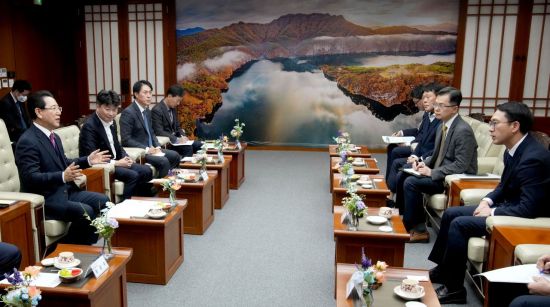
At this meeting, he mentioned the win-win agreement for establishing the Namhaean Global Marine Tourism Belt signed last December with the Mayor of Busan and the Governor of Gyeongnam.
Governor Kim emphasized, “The Namhaean coast should be developed into a world-class marine tourism destination comparable to the Mediterranean and Cancun, Mexico,” and added, “It is necessary to establish the Namhaean Comprehensive Development Agency led by MOLIT and involving multiple central government ministries.”
In response, Moon Sung-yo, Director General of the Land and Urban Office, said, “Jeollanam-do has great growth potential with key cities such as Mokpo, Naju, and Yeosu, as well as natural scenic spots like the Dadohae Archipelago and Jirisan Mountain,” and pledged, “We will continue to communicate closely with Jeollanam-do to achieve tangible balanced development results and actively consider support measures.”
At the subsequent council meeting, Jeon Geum-ju, Vice Governor of Jeollanam-do, along with the Director of Planning and Coordination, Director of Strategic Industry Bureau, Director of Tourism, Culture and Sports Bureau, and Director of Construction and Transportation Bureau attended, carefully explaining each issue and requesting support. MOLIT officials also showed deep interest in Jeollanam-do’s pending matters.
The major projects proposed by Jeollanam-do include ▲ exemption from preliminary feasibility study and early promotion of the Jeolla Line high-speed railway ▲ inclusion of a bypass route in the electrification project of the Gyeongjeon Line ▲ selection of the Gwangju-Wando Expressway Phase 2 for preliminary feasibility study ▲ selection of the Gwangju-Naju metropolitan railway for preliminary feasibility study ▲ national funding support for local road projects including bridges connecting islands and peninsulas ▲ rapid construction of Heuksan Airport ▲ inclusion of the Gwangju-Yeongam ultra-high-speed road in the national plan ▲ development of Muan International Airport as the gateway airport for the southwest region ▲ rapid establishment of the Naju Energy National Industrial Complex ▲ relocation of public institutions such as the National Agricultural Cooperative Federation (Nonghyup) and National Federation of Fisheries Cooperatives (Suhyup) from the metropolitan area to Jeollanam-do ▲ and establishment of integrated certification test infrastructure for future flying vehicles.
Many of these projects include metropolitan transportation networks connecting Gwangju with the eastern, central-southern, and southwestern regions of Jeollanam-do, expected to play a decisive role in forming the Jeonnam-Gwangju mega city.
The National Agricultural Cooperative Federation and the National Federation of Fisheries Cooperatives are key institutions that Jeollanam-do is particularly focused on attracting, targeting the government's policy of relocating public institutions from the metropolitan area.
On the 12th of last month, a bill to amend the Nonghyup and Suhyup Act specifying the location of their headquarters as ‘Jeollanam-do’ was introduced by Representative Shin Jeong-hoon, and a National Assembly forum is scheduled for the 16th.
Jeollanam-do plans to establish a continuous cooperative system with MOLIT through this council meeting and actively reflect regional pending projects.
© The Asia Business Daily(www.asiae.co.kr). All rights reserved.
![Clutching a Stolen Dior Bag, Saying "I Hate Being Poor but Real"... The Grotesque Con of a "Human Knockoff" [Slate]](https://cwcontent.asiae.co.kr/asiaresize/183/2026021902243444107_1771435474.jpg)















