Korea Investment & Securities Raises KOSPI Upper Target from 2600 to 2800 for the First Time
Expectations for Resolution of Uncertainties in Global Stimulus and Monetary Tightening
Profit Forecasts Continue to Decline... 2600 Level Seen as a Limit
[Asia Economy Reporter Lee Seon-ae] The KOSPI, which rallied in January, ultimately failed to break through the 2500 level and is now hovering around the 2400 range, while corporate earnings forecasts continue to decline. Nevertheless, for the first time, a securities firm presenting the annual KOSPI band has raised the upper limit. Given that the likelihood of a 'low-high-low' pattern is low so far and a 'high-low-high' outlook is more probable, the firm did not view the January rally or the first and second quarters as the 'high' phase, but rather expects the 'low' phase to form in the fourth quarter, projecting a rise to 2800.
Corporate Earnings Forecasts Lowered Again... Exporters Expected to Rebound in Second Half
According to the financial investment industry on the 15th, the biggest factor currently holding back the stock market is the decline in corporate earnings forecasts. While half of the listed companies recorded an 'earnings shock' by missing performance expectations in the fourth quarter of last year, downward revisions of earnings forecasts for listed companies continue this year. As the impact of major central banks' interest rate hikes intensifies this year, concerns are spreading that the economy and consumption may contract and growth may slow, causing investment sentiment to freeze.
According to financial information provider FnGuide, the operating profit forecast for 246 listed companies with earnings estimates this year is expected to total 171.8464 trillion won, a 7.2% decrease compared to the previous year (185 trillion won). Earnings forecasts have been further revised downward by 5% compared to a week ago. The sectors with notable downward revisions include semiconductors, displays, trade, energy, and air transportation.
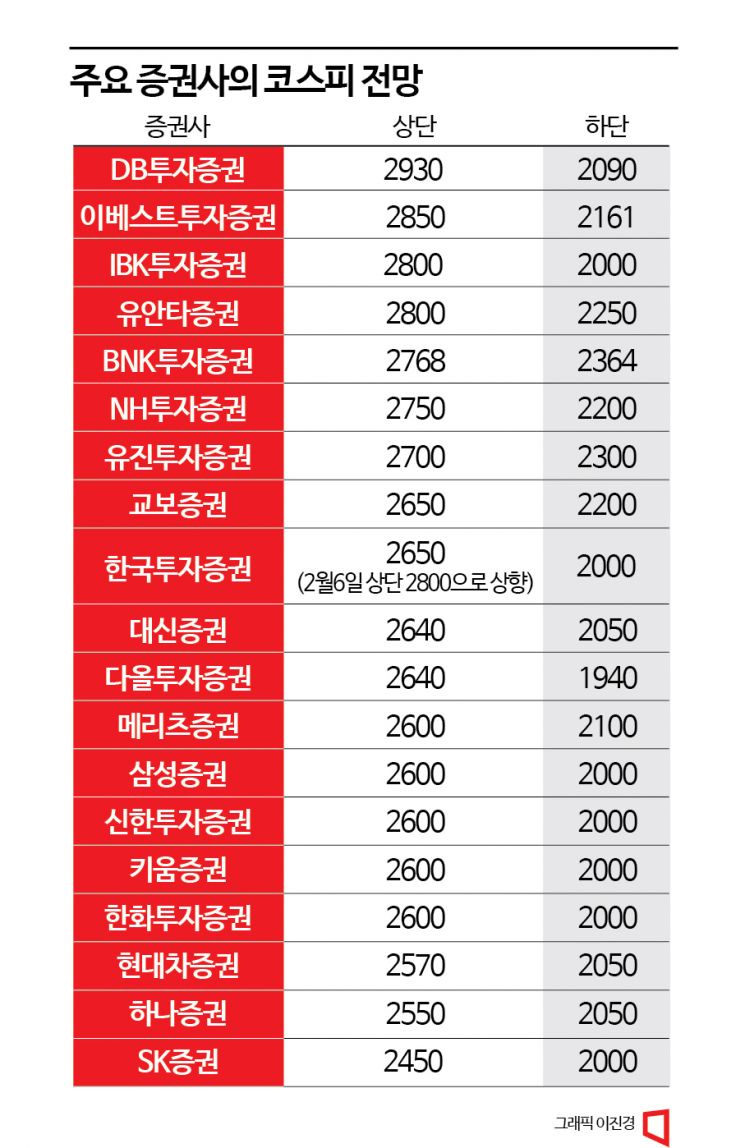
Nevertheless, Korea Investment & Securities recently raised the annual KOSPI band from 2000?2650 to 2200?2800. The rationale is the potential rise in Return on Equity (ROE) and the possibility of a decline in Cost of Equity (COE). The 2800 level reflects a scenario where the ROE of the KOSPI-listed companies rises to the high 7% range in the second half of the year. This is expected as export sectors such as semiconductors and automobiles rebound in the second half. The COE assumes the end of the interest rate hike cycle and a decline in the 3-year government bond yield, which is the market interest rate. The lower band assumes ROE remains at 7% due to negative macroeconomic conditions such as high interest rates and inflation. The COE reflects the possibility of market interest rates rising again due to concerns over the interest rate hike cycle.
Researcher Kim Dae-jun of Korea Investment & Securities maintained the 'low-high-low' view. As the KOSPI rallied in January, market attention focused on the minority forecast of 'high-low-high' presented by Hana Securities and Hi Investment & Securities. However, Kim predicted that the first quarter would mark the low point and the fourth quarter the high point. He said, "As we move into the second half, economic stimulus measures from various countries and the resolution of monetary tightening uncertainties will drive the KOSPI upward," adding, "The probability of breaking the yearly low (2180.67) again is low."
The accelerating cycle of corporate earnings forecasts also supports the 'low' phase outlook. Corporate earnings are the key driver of market rebounds, and currently, a faster bottoming cycle is emerging. Researcher Yang Hae-jung of DS Investment & Securities explained, "Although the trend of KOSPI operating profit estimates is clearly downward, the timing of the corporate earnings rebound is advancing to the first quarter," adding, "This is a response to the reduced possibility of a recession."
IBK Investment & Securities attracted attention by setting the KOSPI upper limit at 2800 at the end of last year. It also predicts a 'low' phase. Researcher Byun Jun-ho of IBK Investment & Securities said, "The economy is expected to face a severe recession, earnings will deteriorate, and panic or crisis situations may unfold, but the stock market has largely priced in these concerns," adding, "The stock market, which is bottoming out, is expected to show a full-fledged upward trend from March." He analyzed, "Considering that the average time from a negative turn in exports to the bottom has been 8 to 9 months, the bottom is expected in the second quarter of 2023 after entering negative territory in the fourth quarter of 2022," and "Since the stock market bottom occurred around the time of the export growth rate bottom, it is highly likely that the stock market will bottom in the first half of this year."
Low Expectations in Securities Industry... Doubts Over Earnings Improvement
Most securities firms that announced annual forecasts this year set the upper limit of the KOSPI band at around 2600. This reflects lowered expectations for the domestic stock market. No firm expects a recovery to 3000 this year.
Securities firms that view 2600 as the upper limit of the KOSPI band still base this on declining earnings. As the saying goes, "stock prices are a function of earnings," the gap between stock prices and earnings may narrow eventually, but under current circumstances, this gap can only be resolved if earnings forecasts improve or stock prices fall. Lee Kyung-min, head of investment strategy at Daishin Securities, said, "I think the expectations for interest rate cuts and a soft landing of the economy have peaked," adding, "As the momentum for stock price increases weakens, even small changes could disrupt the balance." He explained, "For the KOSPI to rise further, either interest rates must fall or earnings forecasts must be revised upward, but both are difficult." Labor Gil, head of domestic equity strategy at Shinhan Investment Corp., also said, "Considering valuation relative to earnings, current growth expectations, and liquidity, there is little benefit in taking on more risk asset preference," adding, "Since the stock market has already priced in a Goldilocks scenario (an ideal economic situation that is neither too hot nor too cold), the process of confirming this through economic indicators remains."
© The Asia Business Daily(www.asiae.co.kr). All rights reserved.

















