On the 8th, the Pension Special Committee proposes structural reform direction over parameter reform
Ruling party: "Structural reform comes first" Opposition: "Both should proceed simultaneously"
Structural reform discussions, hidden behind parameter reform, may be revived
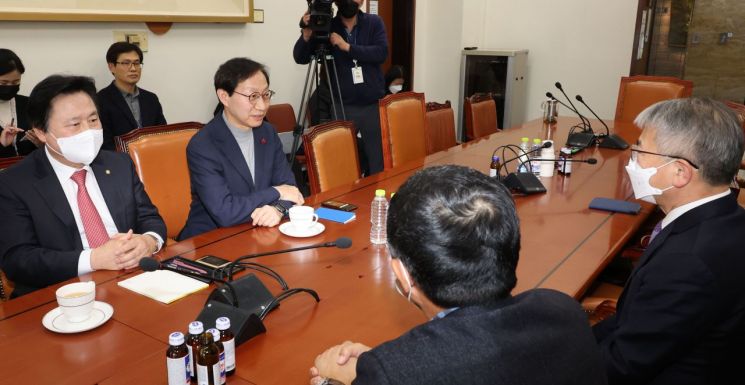
[Asia Economy Reporter Naju-seok] The Pension Reform Special Committee, launched to reform public pensions such as the National Pension Service, has fallen into confusion over its direction. The committee, which was supposed to receive pension reform proposals from a private advisory committee, suddenly brought up the idea of "prioritizing structural reform" and began to slow down the process. For this reason, discussions on pension reform in the National Assembly have started to be questioned not only in terms of direction but also in terms of will. Although the opposition party explained that there was no change from the original plan, differences between the ruling and opposition parties were also confirmed during this process.
On the 9th, Representative Kim Sung-joo, the Democratic Party's secretary of the Pension Reform Special Committee, explained at a press briefing in the National Assembly office building that emphasizing structural reform does not mean a change from the original pension reform direction. He explained that it is a process of normalizing the discussion structure, which had been overly focused on parametric reforms such as contribution rates and income replacement rates.
Rep. Kim said, "(Structural reform and parametric reform) are not a matter of precedence, but rather that proper parametric reform is possible only after the direction of structural reform is determined," adding, "Structural reform is a long-term task that requires much more discussion and social consensus, so it is impossible to do structural reform first and parametric reform later. They proceed simultaneously, but it is appropriate for the National Assembly to mainly deal with structural issues, and that structure should cover the entire old-age income system for the people." He further explained, "Emphasizing structural reform this time is a straightforward explanation of the process so far," and added, "If it were simply parametric reform to adjust the income replacement rate, that could be handled by the Health and Welfare Committee, but the fact that a special committee was formed means it is structural reform." The formation of a special committee instead of a standing committee from the start indicates that the National Assembly aimed to pursue structural reform beyond parametric reform.
Pension Special Committee Focused on Parametric Reform (Contribution Rate Increase, Income Replacement Rate) but Failed to Reach Agreement
He made this explanation because the Pension Special Committee caused confusion by announcing a direction to focus more on structural reform than the initially discussed parametric reform. On the previous day, Kang Ki-yoon, the People Power Party's secretary of the Pension Special Committee, said to reporters after meeting with the committee secretaries and private advisory members at the National Assembly, "Structural reform of the public sector must precede," adding, "When structural reform is being studied and incorporated, it is not too late to discuss parametric reform when the government proposal comes."
Originally, the Pension Special Committee was supposed to prepare one or multiple pension reform plans by the end of last month. However, the situation became complicated as the committee failed to find consensus on parametric reform issues such as contribution rates and income replacement rates. While there was general agreement on raising contribution rates, there were significant differences among private advisory members regarding whether to increase future National Pension benefits. Due to this, meetings between the committee secretaries and private advisory members are expected to adjust the advisory committee’s future schedule. However, after the meeting, the discussion shifted to the idea that structural reform must precede, and parametric reform would effectively wait for the government proposal expected around October this year.
This discussion differs from the pension reform concept submitted by the private advisory committee to the Pension Special Committee at the end of last year. Initially, the private advisory committee stated regarding the approach to pension reform, "Discussion should focus on parametric reform, with limited adjustments to parameters within the benefit formula as necessary for the consistency of the multi-layered income security system." They explicitly indicated that discussion should center on parametric reform, but now the stance has changed to discussing parametric reform only after the government proposal is released.
Structural Reform Normalizes Pension Reform Discussion Structure
Rep. Kim also emphasized that stressing structural reform serves to normalize the discussion structure. This is due to concerns that the focus on contribution rates and income replacement rates could lead pension reform direction into a black hole. He said, "There are various proposals and opinions on contribution rates and income replacement rates within the entire Pension Special Committee and private advisory committee, and it is not something that can be easily agreed upon. This is a matter to be finally decided when the government releases the comprehensive National Pension plan in October," adding, "The issue of raising contribution rates and adjusting income replacement rates, which occupies only about one page out of a 100-page draft report, has been publicized in the media, which has rather hindered calm, deep, and broad discussions." In a Q&A with reporters, Rep. Kim said, "The last thing I want is for the final intense discussion to be made without your understanding and empathy," and added, "We cannot assign scholars the task of solving that difficult higher-order equation entirely."
Democratic Party lawmaker Lee Yong-woo, a member of the Pension Special Committee, also told this publication in a phone interview, "I have always thought structural reform is more important," adding, "Ultimately, pension reform is just a matter of timing; it will be depleted anyway. We need to draw a bigger picture of how the state will handle this and then move into the details. Discussing only parts is wrong." He said it is wrong to handle detailed matters such as parametric reform without drawing the big picture. Lee said, "The Pension Special Committee should focus on how to solve old-age poverty, but it is nonsense to proceed with pension reform discussions without this issue," and added, "This part should be discussed more intensively on this occasion."
Opposition: "No Government Plan, Ruling Party Irresponsible"
However, during the series of discussions on pension reform direction, an uncomfortable relationship between the ruling and opposition parties regarding pension reform was revealed. It is known that the ruling party has emphasized fiscal stability while the opposition party has stressed old-age income security, but now complaints have emerged starting from whether there is any will for pension reform at all. An opposition party official from the Pension Special Committee said, "(The private advisory committee’s failure to submit a pension reform plan by the end of January and the growing controversy) is the result of the government’s lack of plan and the ruling party’s irresponsibility," adding, "Originally, there was an opinion to discuss pension reform plans together with the special committee and the private advisory committee, but it was rejected, and when the private advisory committee made a plan, it was refused to be accepted." Another official criticized, "The government seemed to intend to accept whatever is discussed in the National Assembly, but when it became a hot potato, it feels like they are backing out."
Rep. Kim also criticized the ruling party’s attitude. He pointed out, "When the ruling party first formed the special committee, they avoided participating in the advisory committee’s activities and discussions." He said, "I have continuously received government work reports and believed that private experts and National Assembly special committee members should discuss concrete plans together. Without participating in the process, the National Assembly may misunderstand the discussion content and make wrong decisions, but the ruling party wanted to leave it to private experts. Then the ruling party said the discussion was wrong and expressed the position that structural reform should precede."
Regarding the private advisory committee’s pension reform plan report originally scheduled for submission by the end of January, Rep. Kim said, "Since there is no objective data related to pension reform, they said they would allow time to supplement it. If the report is completed and submitted to the special committee by the end of February, the private advisory committee’s role will be fulfilled and the Pension Special Committee can achieve its goal," but he also pointed out, "The ruling party needs to clearly express its intention on this matter." He mentioned, "The impression I got at yesterday’s briefing was that the ruling party seemed unwilling to even receive this report."
© The Asia Business Daily(www.asiae.co.kr). All rights reserved.
![Clutching a Stolen Dior Bag, Saying "I Hate Being Poor but Real"... The Grotesque Con of a "Human Knockoff" [Slate]](https://cwcontent.asiae.co.kr/asiaresize/183/2026021902243444107_1771435474.jpg)
















