[Asia Economy Reporter Byeon Seon-jin] The Ministry of Health and Welfare has made its first ruling that the plan by some local governments, including Daegu City, to raise the free public transportation ride age from 65 to 70 is not a violation of the Elderly Welfare Act.
On the 9th, at the plenary session of the National Assembly's Health and Welfare Committee, Minister of Health and Welfare Cho Kyu-hong responded to a question from Seo Young-seok, a member of the Democratic Party of Korea, asking for the Ministry's opinion on raising the free ride age, saying, “I believe it is a matter that local governments can decide autonomously and at their discretion.” This means that a local government raising the age on its own is not a violation of the law.
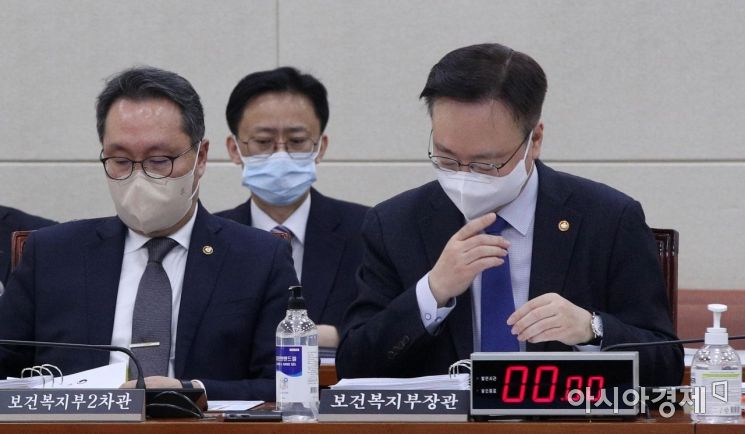 Minister of Health and Welfare Cho Kyu-hong is reviewing documents at the Health and Welfare Committee plenary meeting held at the National Assembly in Yeouido, Seoul, on the 9th. Photo by Kim Hyun-min kimhyun81@
Article 26 of the Elderly Welfare Act, enacted in 1981, stipulates that the state or local governments provide free or discounted access to transportation facilities and public facilities such as palaces, museums, and parks for elderly people aged 65 or older. Following the implementation of the “Senior Citizen Preferential System” the next year, the subway discount benefit of 50% for those aged 70 and above was lowered to 65. The current system of “100% free rides for those aged 65 and above” on subways and buses was established in 1984 when the Presidential Decree on the Elderly Welfare Act was revised under the leadership of former President Chun Doo-hwan. Since the 2000s, as Korea faced aging population issues, discussions on raising the free ride age have continued, but 65 has effectively become the standard for senior citizen benefits.
Recently, due to accumulated deficits caused by free rides, some local governments have announced plans to raise the eligibility age for benefits, prompting the need for an authoritative interpretation of the Elderly Welfare Act, which defines “65 and above” as elderly. Daegu City announced on the same day that starting in July, the free ride age for city buses will be 75, while for subways it will remain 65, with a plan to adjust the age by one year annually until all reach 70 by 2028. The rationale is that the law states “65 years or older,” not “upon turning 65,” so there is no legal issue.
A Ministry of Health and Welfare official explained, “There is no legal provision in the current Elderly Welfare Act that sets the age criterion for elderly,” adding, “As a result of legal review, it was determined that local governments applying the age as 70 or 75 instead of 65 for free or discounted access to public facilities for elderly people is not contrary to the explicit wording of the Elderly Welfare Act.”
Ministry of Health and Welfare: “Raising the Free Ride Age for Elderly Should Be Carefully Considered”
However, the Ministry views raising the free ride age for the elderly as an issue that requires careful consideration. Since Korea has one of the highest elderly poverty rates among OECD countries and the issue is linked to pension receipt and retirement age extension, sufficient social consensus is necessary. Nevertheless, since the judgment that adjusting the free ride age is not a violation of the law has been made, discussions on raising the age are likely to spread to other local governments. The Ministry of Economy and Finance’s stance that accumulated deficits from free rides are the responsibility of local governments also plays a role. Seoul City has already announced plans to reform the age criteria, and Daejeon City has decided to raise the free ride age for city buses from 65 to 70 starting in September.
“We Must Explore Multiple Options to Find the Optimal Solution”
Experts advise that since the government cannot bear the deficits incurred by local governments due to free rides, it is important to devise solutions, but multiple options should be considered to find the optimal approach.
Professor Heo Jun-su of Soongsil University’s Department of Social Welfare said, “If the free ride age criterion is uniformly raised, there is a risk that the activity of impoverished elderly people below the threshold may not be guaranteed,” adding, “Methods such as applying different criteria based on elderly income levels or restricting free rides during peak commuting hours could also be considered.”
© The Asia Business Daily(www.asiae.co.kr). All rights reserved.
![Clutching a Stolen Dior Bag, Saying "I Hate Being Poor but Real"... The Grotesque Con of a "Human Knockoff" [Slate]](https://cwcontent.asiae.co.kr/asiaresize/183/2026021902243444107_1771435474.jpg)















