New Elementary School Draws Attention in Sandong-eup, Gumi, Gyeongbuk
Population Influx as Companies Enter Following Industrial Complex Establishment
"Attracting Companies and Universities Is Ultimately the Solution to Regional Decline"
As the school-age population rapidly declines due to low birth rates, the number of schools closing their doors is increasing. Especially in rural areas, it has become commonplace for dozens or even hundreds of schools to shut down each year. Amid this trend, an opposite phenomenon is drawing attention in Sandong-eup, Gumi-si, Gyeongbuk, where a new elementary school is being established.
From 'Daycare Centers' to 'Nursing Homes' Amid Declining School-Age Population
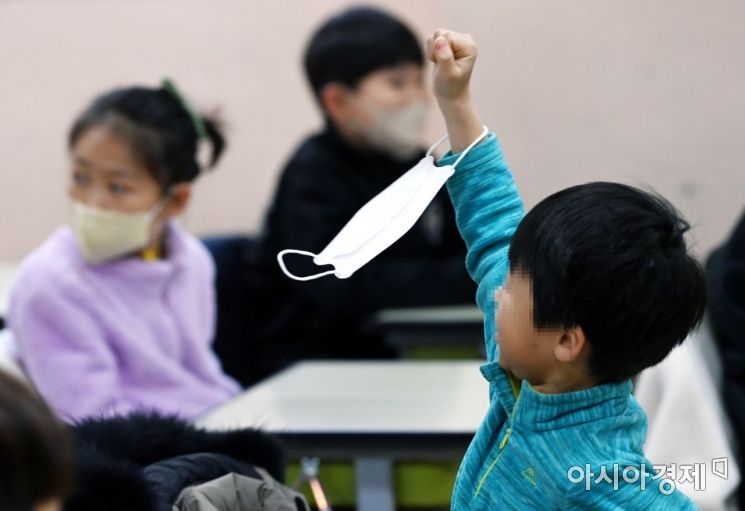 On the 30th of last month, when the indoor mask mandate was lifted, students wearing masks and those without masks attended class together at Gwangjang Elementary School in Gwangjang-dong, Gwangjin-gu, Seoul. One student raised their hand in response to the teacher's question, "Who wants to take off their mask?"
 [Photo by Heo Younghan]
The number of schools facing closure due to failure to recruit new students is steadily rising. Currently, out of 229 local governments nationwide, 89 have been designated as population decline areas under the Special Act on Balanced National Development. According to the Ministry of Education, as of 2022, there are 1,174 small-scale schools with fewer than 100 students nationwide, accounting for 18.7% of all elementary, middle, and high schools (5,259 schools) across the country.
The problem is that the number of these small-scale schools is expected to increase further as the low birthrate trend continues. According to statistics on the "Number of Elementary, Middle, and High School Students from 2023 to 2029" estimated by the Ministry of Education and the Korea Educational Development Institute, the total number of students nationwide is projected to decrease from 5,202,000 this year to 4,253,000 by 2029.
The decline in the number of elementary school students is particularly steep. The number of elementary students nationwide, which was 2,664,000 last year, is expected to drop sharply each year to 2,583,000 this year, 2,466,000 in 2024, and 2,309,000 in 2025. It is also predicted that by 2028, the number will fall below 2 million.
In response to this situation, some daycare centers have been converted into nursing homes. Daycare centers and private kindergartens fall under the category of "facilities for the elderly and children" (facilities for the elderly, children, etc.), such as nursing homes, making the process of changing their use relatively simple.
By remodeling to meet legal standards?such as removing thresholds to allow wheelchair access and enlarging window sizes?several facilities struggling due to the low birthrate are transforming into nursing homes.
While Other Schools Close... New Elementary School Established in Sandong-eup, Gumi
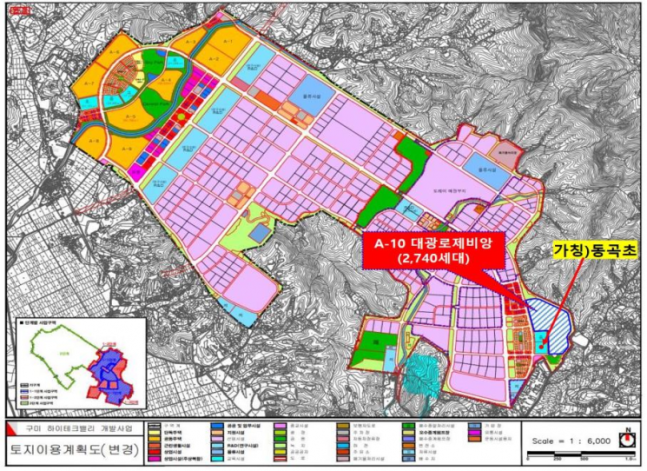 Site planned for the new Gumi Donggok Elementary School (tentative name). [Image provided by Gyeongbuk Office of Education]
However, Sandong-eup in Gumi-si, Gyeongbuk, is showing a completely opposite trend. The population of Sandong-eup increased by 22,181 people from 4,438 in 2016 to 26,619 in 2020, leading to its administrative status being upgraded from 'Sandong-myeon' to 'Sandong-eup' in January 2021.
Recently, a new school establishment has been promoted in Sandong-eup. On the 9th, the Gyeongbuk Office of Education announced that the Ministry of Education's central investment review had finally approved the establishment of the (tentatively named) Donggok Elementary School in Gumi-si, and that the school establishment would be actively pursued starting this year. Donggok Elementary School is planned to have a total of 28 classes, including 24 general classes and 4 special classes. This contrasts with some schools that are being consolidated or closed due to the declining school-age population.
The Gumi city officials stated, "The expansion complex is scheduled to be completed in 2024, and along with the influence of Gumi 5th Industrial Complex, population inflow has increased, making it possible to build an elementary school." This is seen as a measure to counteract regional extinction not by simply distributing subsidies but by attracting businesses. Gumi is known for having the largest inland industrial complexes. Currently, complexes 1 through 4 have been completed and are operational, while the 5th complex is under development. Additionally, the Jungheung S-Class Edufore expansion complex in Induk-ri, Sandong-eup, is scheduled for occupancy in January next year. These factors are believed to have influenced population inflow and school establishment.
Heo Moon-gu, Senior Research Fellow at the National Balanced Development Research Center of the Korea Institute for Industrial Economics and Trade, said, "To mitigate or overcome regional extinction, it is necessary to strengthen unprecedented, innovative, and bold corporate incentives." He added, "A differentiated incentive strategy that adjusts the degree of corporate tax reduction according to the severity of the crisis in the location is needed." Furthermore, he stated, "For population-vulnerable areas and regions facing local extinction to develop, there must be a significant number of agents driving innovation within the region," and "It is necessary to strengthen the role of local universities as a dam against local extinction through revitalization."
© The Asia Business Daily(www.asiae.co.kr). All rights reserved.
![Clutching a Stolen Dior Bag, Saying "I Hate Being Poor but Real"... The Grotesque Con of a "Human Knockoff" [Slate]](https://cwcontent.asiae.co.kr/asiaresize/183/2026021902243444107_1771435474.jpg)

















