[Asia Economy Reporter Park Sun-mi] An analysis revealed that failing to timely reflect international energy price increases in domestic energy prices will result in an economic loss of approximately 25.4 trillion KRW over four years from 2021 to 2024.
On the 10th, the Korea Economic Research Institute (KERI) stated in its report titled 'Economic Impact of International Energy Price Increases and Price Regulation' that price regulations which do not reflect international energy price increases in domestic energy prices distort resource allocation by causing excess demand and reduced energy efficiency, leading to economic losses.
KERI analyzed two scenarios over four years (2021?2024): the ‘market price’ scenario, where international energy price increases are immediately reflected in domestic energy prices, and the ‘price regulation’ scenario, where international prices are suppressed domestically (for the first two years) and price increases are implemented later to compensate for losses. The ‘price regulation’ scenario assumes that heating and electricity fees in 2021 and 2022 are frozen at 2019 levels, with 2021 losses compensated by fee increases in 2023 and 2022 losses compensated by fee increases in 2024.
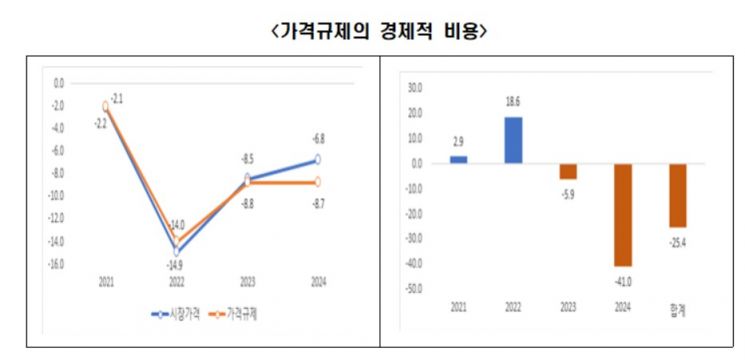
Comparing the decrease in Gross Domestic Product (GDP) between the two scenarios, the GDP loss caused by ‘price regulation’ is estimated to total 25.4 trillion KRW over four years.
Under the ‘market price’ scenario, GDP decreases by 2.20% in 2021, 14.92% in 2022, 8.49% in 2023, and 6.75% in 2024 due to the international energy price shock. In contrast, under the ‘price regulation’ scenario, GDP decreases by 2.05% in 2021, 13.97% in 2022, 8.78% in 2023, and 8.75% in 2024. If heating and electricity fees are raised in 2023 and 2024 to recover losses caused by price regulation, GDP will decline by an additional 0.29 percentage points in 2023 and 2.0 percentage points in 2024 compared to the ‘market price’ scenario.
When converted into monetary terms, GDP increases by 2.9 trillion KRW in 2021 and 18.6 trillion KRW in 2022, but decreases by 5.9 trillion KRW in 2023 and 41 trillion KRW in 2024, resulting in a net loss of 25.4 trillion KRW over four years due to regulation. This figure corresponds to about 1% of the average real GDP over the four years.
Cho Kyung-yeop, head of economic research at KERI, pointed out, “Even if losses caused by domestic energy prices being lower than import prices are later compensated through price increases, the economic inefficiency and losses caused by price regulation are not recovered.” He added, “The fiscal losses caused by the previous government’s price regulation will ultimately have to be covered by taxes or price increases. If losses must be compensated anyway, allowing price fluctuations according to market principles is far more beneficial than price regulation, which incurs economic costs.”
© The Asia Business Daily(www.asiae.co.kr). All rights reserved.
![Clutching a Stolen Dior Bag, Saying "I Hate Being Poor but Real"... The Grotesque Con of a "Human Knockoff" [Slate]](https://cwcontent.asiae.co.kr/asiaresize/183/2026021902243444107_1771435474.jpg)















