Analysis of Microdata from Statistics Korea's Household Trends Survey
Assemblyman Kim Hoe-jae: Deficit Households Nearly Reach 3.2 Million
[Yeosu=Asia Economy Honam Reporting Headquarters Reporter Choi Cheol-hoon] An analysis revealed that if last year's heating cost increase rate is reflected, the number of 'deficit households' among the bottom 30% low-income households will increase by about 180,000 households, approaching a total of 3.2 million households.
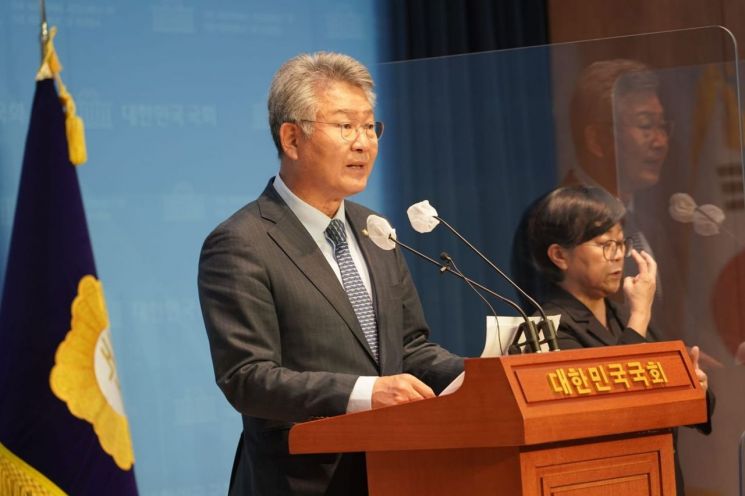
On the 9th, Kim Hoe-jae, a member of the Democratic Party of Korea (Jeonnam Yeosu-si Eul), analyzed the microdata from the Statistics Korea Household Trends Survey. Based on the first quarter household trends survey of last year, reflecting the heating cost increase rate (42.3%), it is estimated that among the total 6,312,365 low-income households in the bottom 30%, 3,199,400 households are deficit households.
This is an increase of 182,699 households compared to the deficit households (3,016,700 households) when the heating cost increase rate was not reflected.
Deficit households refer to those whose consumption expenditure exceeds their disposable income (income minus non-consumption expenditures).
Compared to about 1.69 million households eligible for heating cost support under the additional heating cost support measures recently announced by the Yoon Seok-yeol administration, this number is double. This means that about half of the low-income deficit households do not receive government heating cost support.
The proportion of low-income deficit households reached 50.7% when reflecting the heating cost increase.
Representative Kim Hoe-jae estimated deficit households by reflecting last year's residential gas wholesale price increase rate (42.3%) on household fuel costs as of the first quarter of last year. Last year, the gas wholesale price for residential use increased by 5.47 won per megajoule (MJ, a unit of gas heat energy), which is a 42.3% increase.
Even in the 4th to 8th income deciles, which can be considered middle class, it is estimated that the number of households switching to deficit households due to the heating cost increase will reach 150,000. The number of middle-class deficit households increased from 1,657,323 before reflecting the heating cost increase to 1,808,726 after reflecting it.
The problem is that the number of deficit households may increase further. In addition to heating cost increases, public transportation fares and local public utility fees are also expected to rise one after another.
Considering the tendency for fuel costs to increase in the first quarter, which is typically winter, and the electricity rate increase in the first quarter, the deficit gap for households is also expected to widen.
Representative Kim Hoe-jae said, "Due to the incompetence of the Yoon Seok-yeol administration, people are being driven into a heating cost bomb," and added, "However, the government's heating cost measures are only repeating patchwork solutions."
He emphasized, "We need to prepare comprehensive support measures, not patchwork solutions that create blind spots."
Yeosu=Asia Economy Honam Reporting Headquarters Reporter Choi Cheol-hoon hss79@asiae.co.kr
© The Asia Business Daily(www.asiae.co.kr). All rights reserved.

















