Need for Technological Independence from the US Linked to Next-Generation Fighter Development
[Asia Economy Reporter Jeon Jin-young] Mitsubishi Heavy Industries of Japan has announced the official termination of its jet aircraft development project, which had been pursued as a mid- to long-term project for 15 years. Meanwhile, reports analyzing the causes of failure and pointing out problems continue to emerge within Japan. This is because there are concerns that the project's collapse will significantly hinder Japan's long-standing efforts to secure independent aviation technology.
It is known that the Japanese government, aiming to secure aircraft production and technology that had been overly dependent on the United States since World War II, jointly implemented the project with Mitsubishi. Mitsubishi had produced the A6M fighter, known as the "Zero-sen (零戰)" during World War II, but technology development had been restricted after Japan's defeat in the war.
On the 9th, Mitsubishi Heavy Industries announced the official termination of the passenger jet development project called "Space Jet." The Space Jet was a domestic aircraft revival project that started in 2008, but it was ultimately terminated due to the decreased feasibility of the project following the COVID-19 pandemic. At a press conference on the 7th, Seiji Izumisawa, president of Mitsubishi Heavy Industries, explained the project’s suspension by saying, "We roughly estimated the scale of development," and "There were no engineers with experience." The project involved development costs of 1 trillion yen (approximately 10 trillion won), but it ended without obtaining even the type certificate (TC) required for commercial operation.
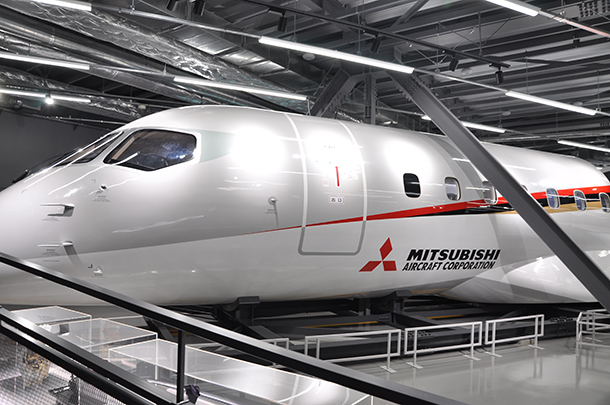 A model of a passenger jet displayed at Mitsubishi Heavy Industries' company museum. (Photo by Mitsubishi Heavy Industries official website)
Repeatedly Frustrated Dreams... Why Keep Trying?
In fact, this is not Japan's first civilian passenger aircraft project. Previously, Japan conducted a government-led project to produce a domestic civilian aircraft called the "YS-11." The project began based on the Japan Aircraft Manufacturing Corporation, established with 60% investment from the Japanese government and 40% from private companies. From 1964 to 1973, over nine years, 182 civilian aircraft were produced, but due to lack of price competitiveness and other factors, the project ended with a deficit of 36 billion yen and was dissolved. It ended in failure.
Afterward, Japan attempted to develop aircraft independently but judged it to be unfeasible, eventually joining the joint development of the Boeing 767. From that point, Japanese aviation companies began to play the role of suppliers responsible for carbon fiber and other components. They lacked the capacity to focus on aircraft production rather than parts.
There is also a unique characteristic of Japan that makes it difficult to simply import large passenger aircraft. Japan's civilian passenger aircraft rivals none other than the high-speed rail Shinkansen. Since competition must be based on train-level punctuality, small models such as the Boeing 737 and Airbus 320 are frequently used on domestic flights in Japan. Voices have consistently been raised that aircraft suitable for Japan’s circumstances must be developed to win the competition against the Shinkansen.
The Real Goal is Next-Generation Domestic Fighter Development
On the surface, it seems that Japan is trying to enter the future civilian aircraft market, but what Japan is truly concerned about following the project's failure is the military aircraft business. This aligns with the goals of Japan’s Ministry of Defense Industry. The Ministry aims to develop the next model of the F-2 fighter jet under Japanese leadership. However, as equipment becomes more advanced every year and development costs soar, they are considering a joint development approach with Europe rather than proceeding independently.
One Japanese media outlet analyzed, "The next fighter jet that the Ministry of Defense intends to develop requires not only aircraft functions but also network capabilities to cooperate with other fighter jets and warships," adding, "It requires the ability to negotiate and coordinate not only with fighter jet suppliers but also with various defense equipment manufacturers."
Moreover, since most of Japan’s aviation technology has depended on the United States, achieving self-reliance through domestic production was of utmost importance. Even Mitsubishi Heavy Industries had no experience developing civilian aircraft for 50 years. A Japanese internet economic media outlet analyzed, "The low fuel consumption, low noise technology, processing technology, and design technology acquired through the Space Jet project will be important resources for future aircraft development," and "Above all, these basic technologies could become Japan’s burning power in the joint development of the next fighter jet for the Air Self-Defense Force."
However, criticism has also arisen within Japan about whether Mitsubishi Heavy Industries can take charge of the next fighter jet project, given that the project has effectively failed. There are even concerns that, having failed in mass production, it will be difficult to stand shoulder to shoulder with leading overseas companies such as Canada’s Bombardier and Brazil’s Embraer, and that under these circumstances, it may be challenging to collaborate with foreign partners on the next fighter jet joint development.
Mitsubishi Heavy Industries announced that it plans to redirect management resources from this project to the next fighter jet project, which aims for development in three countries: Japan, the United Kingdom, and Italy. This also proves that the passenger jet business is not unrelated to military power enhancement.
Experts continue to call for active interest from both the public and private sectors. Shinsuke Ito, president of Rimono and former official in charge of the aviation weapons industry at the Ministry of Economy, Trade and Industry, wrote in a column, "In Japan, which is accustomed to peace, there are often negative opinions about enhancing the defense industry or defense technology," but he emphasized repeatedly that "working in the aircraft industry painfully reveals that defense and civilian sectors must function together, or Japan cannot compete with Europe, Russia, and China," highlighting that civilian aircraft development is directly linked to the defense industry.
© The Asia Business Daily(www.asiae.co.kr). All rights reserved.
![Clutching a Stolen Dior Bag, Saying "I Hate Being Poor but Real"... The Grotesque Con of a "Human Knockoff" [Slate]](https://cwcontent.asiae.co.kr/asiaresize/183/2026021902243444107_1771435474.jpg)















