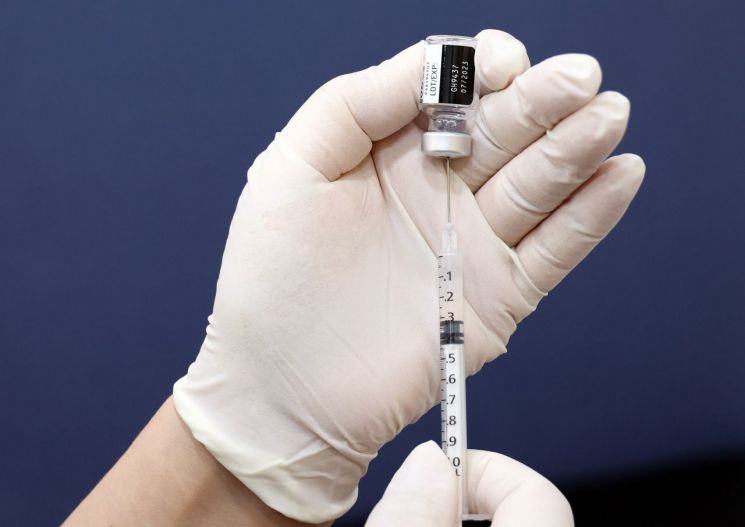
[Asia Economy Reporter Byeon Seon-jin] Although health authorities are considering regular COVID-19 vaccinations, experts point out that there are many hurdles to overcome. It is still difficult to predict which variant will be dominant that year, and if people have to pay for the vaccine, the already low vaccination rate could plummet further. If COVID-19 vaccination becomes regular, high-risk groups are likely to receive shots twice a year, and the general population once a year.
On the 9th, Professor Kim Woo-joo of the Infectious Diseases Department at Korea University Guro Hospital said that for vaccination to become regular, "COVID-19 must become endemic and circulate only during specific seasons like the flu." In the case of the flu, which circulates from December to February, the World Health Organization (WHO) selects the flu virus expected to circulate by the end of February, then manufacturers produce vaccines, and vaccinations begin in October. To prepare COVID-19 vaccines in advance, variants must be predictable. For example, if a modified vaccine targeting the Omicron subvariant BA.5 is made, no other subvariant with strong immune evasion should appear. If a new variant like 'Pi' emerges after Omicron, the situation changes entirely. Professor Kim emphasized, "It took about 25 years after the 1918 Spanish flu for the flu vaccine to be developed, and it took a long time to become regular. More data collection and research on COVID-19 are needed."
Including COVID-19 in the National Immunization Program (NIP) is also a challenge. The NIP covers the cost of vaccinations by the government and currently supports 17 diseases such as flu, tuberculosis, hepatitis A, pertussis, and tetanus. If COVID-19 vaccination becomes regular, the general population will likely have to bear the cost in the future. Moderna recently suggested a price of $110 to $130 (about 130,000 to 160,000 KRW) per dose. Currently, the vaccination rate among the general population during winter is in the single digits, and experts worry it could decline further.
There are also many opinions that it is premature to implement regular vaccinations within this year. After monitoring confirmed cases for two weeks from the third week of January, health authorities recorded a severe case rate and fatality rate of 0.22% and 0.09%, respectively. Although confirmed cases decreased, the severe case rate has risen for five consecutive weeks, and the fatality rate, which had been 0.08% for six weeks, has risen again. The fatality rate for those aged 80 and above was 1.96% as of the 4th, which is very high considering it is a highly contagious disease. Since Korea is not a key country holding the core technology for vaccine development, trends among overseas manufacturers are also variables. Lim Sook-young, head of the Central Disease Control Headquarters Situation Management Team, said, "Vaccines must be developed, approved in a timely manner, and supplied promptly."
© The Asia Business Daily(www.asiae.co.kr). All rights reserved.
![Clutching a Stolen Dior Bag, Saying "I Hate Being Poor but Real"... The Grotesque Con of a "Human Knockoff" [Slate]](https://cwcontent.asiae.co.kr/asiaresize/183/2026021902243444107_1771435474.jpg)















