US Commerce Department to Announce Guidelines
Concerns Over Reduced Chinese Investment Due to Guardrail Provisions
Korean Government and Companies Continue Negotiations with US
[Asia Economy Reporter Kim Pyeonghwa] The United States is specifying detailed provisions of the Chips Act, which provides subsidies and tax benefits to companies building semiconductor factories in the country. These provisions include restrictions preventing subsidized companies from investing in China. The South Korean government plans to continue negotiations with the U.S. to ensure that domestic companies are not restricted in their business operations in China due to these provisions.
The Wall Street Journal (WSJ) reported on the 7th (local time) that the U.S. Department of Commerce will announce detailed requirements of the Chips Act by the end of this month. The Department of Commerce is expected to disclose the application methods and payment schedules for the subsidies provided under the law at that time. Gina Raimondo, U.S. Secretary of Commerce, will announce the U.S. administration's position on the law's implementation plan on the 23rd in Washington D.C.
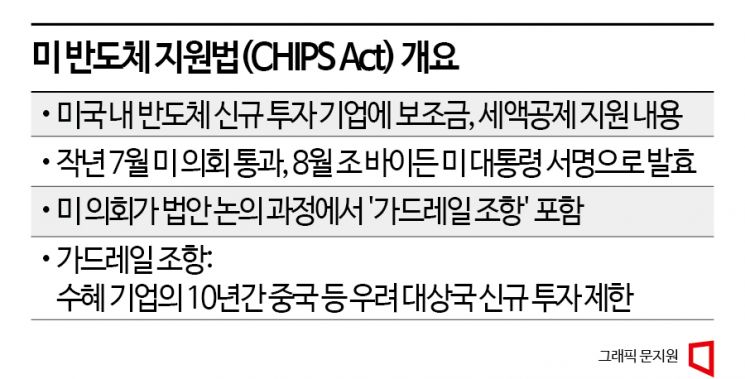
The Chips Act is a law enacted in August last year to foster the U.S. semiconductor ecosystem. It also aims to counter China. The law features $52.7 billion in subsidies over the next five years for companies building semiconductor production facilities in the U.S. It also supports a 25% tax credit worth $24 billion over ten years. However, a guardrail provision prohibits companies receiving subsidies from investing in new or expanded factories or equipment replacement in China and other countries of concern for ten years.
Since announcing the Chips Act, the U.S. Department of Commerce has been preparing detailed regulations necessary for its implementation. This time, it plans to introduce guidelines similar to domestic administrative rules and then conduct specific negotiations with companies that will receive subsidies. Previously, the Department of Commerce announced that it would establish the guardrail provisions through agreements with each supported company.
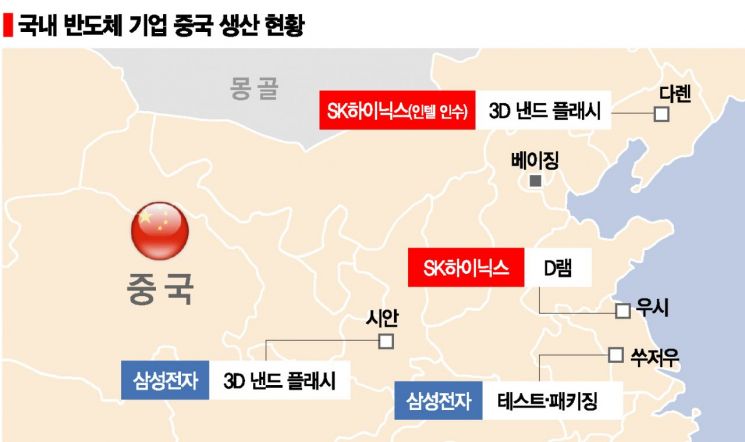
The South Korean government has responded. Related ministries, including the Ministry of Trade, Industry and Energy, have been consulting with the U.S. through various channels since last year. Samsung Electronics and SK Hynix are also known to have had multiple contacts with the U.S. side through domestic and international channels. This is because both companies are investing or planning to invest in the U.S. Both companies have factories in China producing a significant amount of memory semiconductors. If they receive subsidies in the U.S., the guardrail provisions may impose restrictions on their business operations in China.
The Ministry of Trade, Industry and Energy believes that even after the Department of Commerce issues guidelines, it will take time to conclude agreements with companies. They plan to continue negotiations until then. A ministry official said, “We must keep discussing and persistently requesting,” adding, “We will continue discussions with the U.S. side to ensure that the positions of our companies are reflected in the negotiations.”
Samsung Electronics is investing $17 billion to build a foundry (semiconductor contract manufacturing) plant in Taylor, Texas. SK Hynix plans to invest $15 billion to establish an advanced semiconductor packaging plant and R&D center in the U.S. Samsung Electronics produces 40% of its total NAND production in China, while SK Hynix produces 50% of its total DRAM production there.
© The Asia Business Daily(www.asiae.co.kr). All rights reserved.
![Clutching a Stolen Dior Bag, Saying "I Hate Being Poor but Real"... The Grotesque Con of a "Human Knockoff" [Slate]](https://cwcontent.asiae.co.kr/asiaresize/183/2026021902243444107_1771435474.jpg)
















