Operating Profit Up 89.9%·Sales 15.4 Trillion
Endemic Department Stores and Marts Growth
New Businesses and Structural Changes Propel Growth Despite This Year's Economic Downturn
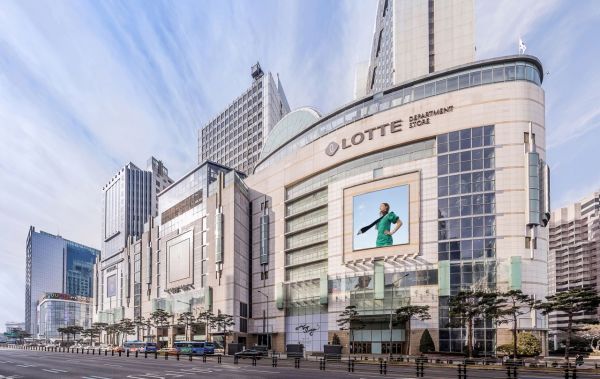
Lotte Shopping nearly doubled its operating profit last year as major business divisions such as department stores and marts maintained steady growth. However, the fourth-quarter performance fell short of market expectations, causing the annual results to also miss consensus estimates.
On the 8th, Lotte Shopping announced that its operating profit for last year reached 394.2 billion KRW, an increase of 89.9% compared to the previous year. Sales amounted to 15.476 trillion KRW, a decrease of 0.6%, and the net loss widened to 297.8 billion KRW. Market estimates had projected an operating profit of 466 billion KRW and sales of 15.5369 trillion KRW. For the fourth quarter of last year, operating profit was 101.1 billion KRW, down 7.5% year-on-year, while sales increased by 0.2% to 3.7901 trillion KRW. The net loss narrowed to 317.3 billion KRW.
Department Stores and Marts Hold Steady... Hi-Mart Slows Down
Department stores and marts performed well, but Hi-Mart's performance continued to decline due to a deteriorating market environment for home appliance specialty stores. Impairment losses of approximately 600 billion KRW were reflected due to external environmental changes, resulting in an annual net loss of 297.8 billion KRW and an expanded deficit. Overseas business saw sales increase in Vietnam and Indonesia due to COVID-19-related base effects, but sales declined in China due to a surge in COVID-19 cases.
Department stores recorded an operating profit of 498 billion KRW in 2022, a 42.9% increase from the previous year. Sales rose 11.9% to 3.232 trillion KRW. In the fourth quarter, operating profit was 177 billion KRW, down 13.7%, while sales increased 6.6% to 890 billion KRW. Department store sales exceeded 3 trillion KRW for the first time in three years since before COVID-19 in 2019. Both sales and operating profit recovered to pre-COVID-19 levels. Same-store annual sales increased by 10.7%, and in the fourth quarter, sales grew 5.8%, led by overseas fashion (+7.8%) and food (+14.8%). Major product categories showed balanced sales growth in the fourth quarter. One-time costs for improving the shopping environment and strengthening branding increased slightly. Overseas department stores saw a decrease in operating profit due to increased selling and administrative expenses despite net sales growth in Vietnam and Indonesia, while sales declined in China due to a surge in COVID-19 cases.
Marts turned profitable in 2022 with an operating profit of 54 billion KRW. Sales increased 3.3% to 5.904 trillion KRW. In the fourth quarter, operating profit turned positive at 12 billion KRW, and sales rose 6.5% to 1.422 trillion KRW. In the fourth quarter, due to inflation limiting dining-in demand, sales increased 6% centered on convenience foods such as home meal replacements (HMR). Operating profit also increased due to strong same-store sales and improved efficiency in selling and administrative expenses. Overseas marts grew 9.3% on a same-store basis, with sales and operating profit increasing mainly in Vietnam due to the base effect from strengthened COVID-19 prevention policies in the previous year.
Supermarkets recorded sales of 1.343 trillion KRW (-7.5%) and an operating loss of 4 billion KRW (reduced deficit) in 2022. Although sales declined due to 33 fewer stores, continuous restructuring efforts led to reduced selling and administrative expenses, shrinking the operating loss.
E-commerce posted sales of 113 billion KRW (+4.5%) and an operating loss of 156 billion KRW in 2022. Fourth-quarter sales rose 28.8% year-on-year to 36 billion KRW, and operating loss narrowed to 24 billion KRW. The platform business, a core part of the e-commerce division, saw sales increase 54.3% year-on-year. By internalizing IT capabilities, enhancing customer response systems, and improving efficiency in near-mart delivery services, operating losses were significantly reduced. The e-commerce division is improving its profit structure focusing on specialized sections such as beauty, luxury, and fashion, evolving into a lifestyle platform. The fourth-quarter transaction volume of the newly launched beauty, luxury, and fashion specialty sections all grew by double digits compared to the previous year.
Hi-Mart recorded sales of 3.337 trillion KRW (-13.8%) and an operating loss of 52 billion KRW (turning to a deficit) in 2022, while home shopping posted sales of 1.078 trillion KRW (-2.3%) and operating profit of 78 billion KRW (-23.5%). Hi-Mart's performance slowed due to reduced demand for home appliances caused by global inflation, high interest rates, and a decline in moving and wedding-related purchases amid a sluggish real estate market, compounded by one-time costs such as severance pay for voluntary retirement. Home shopping saw declines in sales and operating profit due to a reduced proportion of high-margin products like fashion and health foods.
Culture Works recorded sales of 497 billion KRW (+111.8%) and an operating profit of 1 billion KRW (returning to profit) in 2022. Although it suffered the most from COVID-19, it turned to an annual cumulative profit with the full-scale onset of the endemic. Domestic cinemas saw increased sales due to a recovery in attendance following blockbuster releases like 'Avatar 2,' and Vietnamese cinemas experienced sales growth due to the base effect from temporary closures in 2021.
"This Year, Leap Forward Through New Businesses and Structural Changes Despite Economic Downturn"
Although the economic downturn is expected to continue this year, the company expects endemic demand to persist following mask mandate lifts, and the department store division, which has strengths in the fashion category, is expected to maintain its growth momentum. The department store plans to grand open 'Lotte Mall Westlake,' a complex consisting of a department store, hotel, and office, in Hanoi, Vietnam, in August. The company plans to focus its capabilities on turning a profit from the second year after opening.
The mart division aims to achieve innovation in the grocery business by establishing a full-fledged synergy system with the supermarket division. As the first step in innovation, it began renegotiations with major manufacturers in October last year to improve purchase costs and established an integrated sourcing organization for marts and supermarkets. Currently, the integration of product codes between marts and supermarkets is underway, and once completed, sourcing efficiency is expected to improve significantly through integrated purchasing by the two divisions. The company plans to offer unique experiences exclusive to Lotte Grocery by renewing its private brand (PB) 'Yorihada' and launching new PB brands to encourage continuous customer visits.
The online business also plans to strengthen its position in the vertical service market through product and brand expansion and activation of online and offline customer traffic. Through a partnership agreement signed in November last year with global retail tech company Ocado, the company plans to enhance its competitiveness in the domestic online grocery market.
Additionally, Culture Works plans to enhance competitiveness by securing IP content for large-scale productions and strengthening drama production. Although Hi-Mart and home shopping are expected to face difficulties due to external environmental factors this year, Hi-Mart will focus on store efficiency and restructuring its online business, while home shopping will strive to recover profitability through product differentiation and expansion of live commerce.
Choi Young-jun, Chief Financial Officer of Lotte Shopping, said, "Last year was a year when sales of major business divisions such as department stores and marts, which had sharply declined after COVID-19, improved again with the endemic. This year, we will enhance profitability by business division through the opening of Lotte Mall Westlake, grocery innovation, and transformation into vertical specialty malls."
© The Asia Business Daily(www.asiae.co.kr). All rights reserved.
![Clutching a Stolen Dior Bag, Saying "I Hate Being Poor but Real"... The Grotesque Con of a "Human Knockoff" [Slate]](https://cwcontent.asiae.co.kr/asiaresize/183/2026021902243444107_1771435474.jpg)















