Operating Profit 394.2 Billion KRW... 89.9%↑ · Sales 15.4 Trillion KRW
Growth in Major Divisions Including Department Stores and Marts
Home Appliance Specialty Store Market Deterioration, Hi-Mart Performance Weak
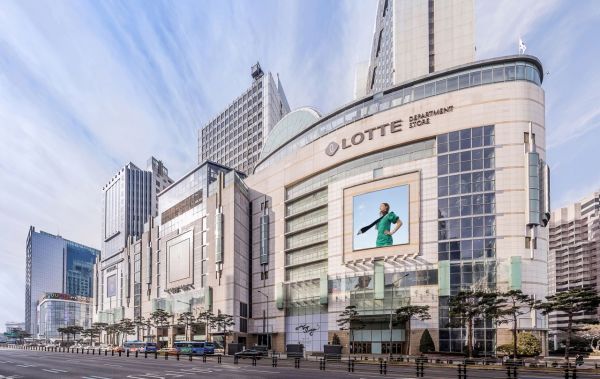
Lotte Shopping nearly doubled its operating profit last year as major business divisions such as department stores and marts maintained steady growth. However, the fourth-quarter performance fell short of market expectations, causing the annual results to also miss consensus estimates.
On the 8th, Lotte Shopping announced that its operating profit for last year was 394.2 billion KRW, an increase of 89.9% compared to the previous year. Sales amounted to 15.476 trillion KRW, down 0.6%, and the net loss widened to 297.8 billion KRW. Market estimates were operating profit of 466 billion KRW and sales of 15.5369 trillion KRW. For the fourth quarter of last year, operating profit was 101.1 billion KRW, down 7.5% year-on-year, while sales rose 0.2% to 3.7901 trillion KRW. The net loss narrowed to 317.3 billion KRW.
While department stores and marts performed well, Hi-Mart’s results continued to suffer due to a deteriorating market environment for home appliance specialty stores. Impairment losses of approximately 600 billion KRW were reflected due to external environmental changes, resulting in an annual net loss of 297.8 billion KRW and an expanded deficit. Overseas business saw sales increase in Vietnam and Indonesia due to a COVID-19-related base effect, but sales declined in China amid a sharp rise in COVID-19 cases.
The department store division recorded an operating profit of 498 billion KRW in 2022, a 42.9% increase from the previous year. Sales rose 11.9% to 3.232 trillion KRW. In the fourth quarter, operating profit was 177 billion KRW, down 13.7%, while sales increased 6.6% to 890 billion KRW. Department store sales exceeded 3 trillion KRW for the first time in three years since before COVID-19 in 2019. Both sales and operating profit recovered to pre-pandemic levels. Same-store annual sales grew 10.7%, and in the fourth quarter, sales increased 5.8%, led by overseas fashion (+7.8%) and food (+14.8%). Major product categories showed balanced sales growth even in the fourth quarter. One-time costs for improving the shopping environment and strengthening branding increased somewhat. Overseas department stores saw operating profit decline due to increased selling and administrative expenses despite net sales growth in Vietnam and Indonesia, while sales in China decreased due to a surge in COVID-19 cases.
The mart division turned a profit with an operating profit of 54 billion KRW in 2022. Sales rose 3.3% to 5.904 trillion KRW. In the fourth quarter, operating profit turned positive at 12 billion KRW, and sales increased 6.5% to 1.422 trillion KRW. In the fourth quarter, rising prices limited home meal demand, leading to a 6% increase in sales centered on convenient foods such as Home Meal Replacement (HMR). Strong same-store sales and improved selling and administrative expense efficiency also boosted operating profit. Overseas marts grew 9.3% on a same-store basis, with sales and operating profit increasing mainly in Vietnam due to a base effect from strengthened COVID-19 prevention policies in the previous year.
The supermarket division recorded sales of 1.343 trillion KRW (-7.5%) and an operating loss of 4 billion KRW (reduced deficit) in 2022. Although sales declined due to 33 fewer stores, continuous restructuring efforts led to reduced selling and administrative expenses, shrinking the operating loss.
The e-commerce division posted sales of 113 billion KRW (+4.5%) and an operating loss of 156 billion KRW in 2022. Fourth-quarter sales rose 28.8% year-on-year to 36 billion KRW, and the operating loss narrowed to 24 billion KRW. Sales from the platform business, a core part of the e-commerce segment, increased 54.3% year-on-year. By internalizing IT capabilities, enhancing customer response systems, and improving efficiency in mart last-mile delivery services, the operating loss was significantly reduced. The e-commerce division is improving its profit structure centered on specialty stores such as beauty, luxury, and fashion, and is transforming into a lifestyle platform. The fourth-quarter transaction volume of the beauty, luxury, and fashion specialty stores launched last year all grew by double digits compared to the previous year.
Hi-Mart recorded sales of 3.337 trillion KRW (-13.8%) and an operating loss of 52 billion KRW (turning to a deficit) in 2022, while home shopping posted sales of 1.078 trillion KRW (-2.3%) and operating profit of 78 billion KRW (-23.5%). Hi-Mart’s performance slowed due to reduced demand for home appliances caused by global inflation, high interest rates leading to consumer downturn, and decreased moving and wedding-related purchases amid a sluggish real estate market. One-time costs such as severance pay for voluntary retirement also contributed to a sharp decline in operating profit. Home shopping saw declines in sales and operating profit due to a reduced proportion of high-margin products such as fashion and health foods.
Culture Works recorded sales of 497 billion KRW (+111.8%) and operating profit of 1 billion KRW (turning to profit) in 2022. Although it was the hardest hit by COVID-19, it returned to an annual cumulative profit with the full-scale onset of the endemic phase. Domestic cinemas saw increased sales due to a recovery in attendance following blockbuster releases like 'Avatar 2,' and sales at Vietnamese cinemas rose due to a base effect from temporary closures in 2021.
© The Asia Business Daily(www.asiae.co.kr). All rights reserved.
![Clutching a Stolen Dior Bag, Saying "I Hate Being Poor but Real"... The Grotesque Con of a "Human Knockoff" [Slate]](https://cwcontent.asiae.co.kr/asiaresize/183/2026021902243444107_1771435474.jpg)















