"Local Government Intervention Needed for Abnormal Food and Beverage Prices"
Since COVID-19, domestic golf courses have been stigmatized as 'gapjil golf courses,' and there are numerous issues that need to be addressed. These include soaring green fees and caddy fees, neglected food and beverage prices, and unreasonable average spending per customer. Experts point out that the fundamental problem behind these phenomena is a 'supply shortage.'
On the 9th, Seocheon Beom, Director of the Korea Leisure Industry Research Institute, pinpointed, "The root cause of various unreasonable practices at domestic golf courses is ultimately the shortage of golf course supply." In fact, the number of opened golf courses (converted to 18 holes) reached 31.5 in 2013 but sharply decreased to around 10 since 2014. Although about 70 golf courses are under construction or planned from 2023 to 2027, their opening dates remain uncertain. For this reason, most domestic golfers reluctantly endure expensive costs to use the services.
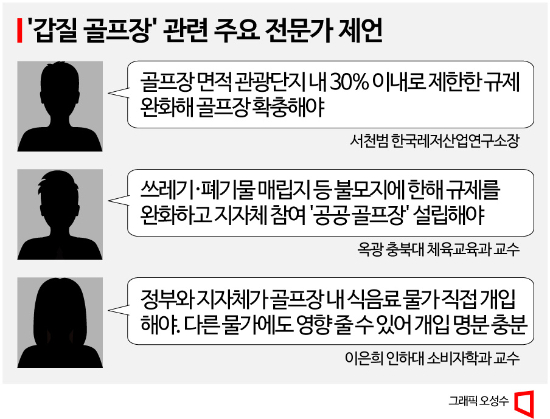
Director Seo stated, "To increase golf course supply, government regulations on golf course construction must be relaxed." Currently, the Ministry of Culture, Sports and Tourism manages golf course areas to be within 30% of tourist complexes. Despite no separate regulations in the 'Tourism Promotion Act,' the Ministry enforces restrictions through internal regulations. Considering that most golf courses currently being promoted are located within tourist complexes, the influence of such regulations is inevitably strong.
Professor Ok Kwang of the Department of Physical Education at Chungbuk National University also emphasized golf course supply. He argues that regulations should be relaxed only for barren lands such as garbage and waste landfills or abandoned mines to establish 'public golf courses' involving local governments.
The business models proposed by Professor Ok are broadly divided into two types: revenue-based (BTO) and lease-based (BTL). BTO involves the private sector developing a golf course on local government land, donating the facility, and operating it for a certain period to recover investment costs. In this case, since the private sector operates it, local government intervention in usage fees is necessary. BTL involves the private sector developing a golf course on local government land, donating the facility, and recovering investment costs by receiving rent from the local government for a certain period. Here, the local government determines the usage fees. Professor Ok advised, "If public golf courses centered on local governments are established, various cost reduction effects will occur. To reduce investment costs and risks, it is preferable to proceed with BTO or BTL methods rather than 100% local government investment."
There is also an opinion that the government and local governments should directly intervene in the abnormal food and beverage prices at golf courses. Professor Lee Eun-hee of the Department of Consumer Studies at Inha University said, "Prices within golf courses should be managed by the price control departments of the Ministry of Economy and Finance or local governments. Even if prices are within golf courses, if they are excessively high compared to the market, they can affect other golf courses or similar hotels and pensions. Therefore, there is sufficient justification for government intervention."
Director Seo expressed, "Now is the right time to correct the high-cost structure of golf courses. If appropriate solutions are not implemented, it will take more than 10 years for soaring green fees and caddy fees to return to pre-COVID-19 levels. Measures such as significantly relaxing golf course construction regulations must be taken as soon as possible."
© The Asia Business Daily(www.asiae.co.kr). All rights reserved.
![Clutching a Stolen Dior Bag, Saying "I Hate Being Poor but Real"... The Grotesque Con of a "Human Knockoff" [Slate]](https://cwcontent.asiae.co.kr/asiaresize/183/2026021902243444107_1771435474.jpg)















