Korea Institute of Materials Science Achieves Success in Developing Lithium-Ion Thin-Film Devices
[Asia Economy Reporter Kim Bong-su] Domestic researchers have developed a core device for next-generation artificial intelligence (AI) semiconductors using lithium ions.
The Korea Institute of Materials Science (KIMS) announced on the 8th that the research team led by Dr. Kim Yong-hoon and Dr. Kwon Jung-dae of the Nano Surface Materials Research Division succeeded for the first time in the world in realizing a next-generation neuromorphic semiconductor device with high integration and high reliability by thinning lithium ions, a core material of lithium-ion batteries.
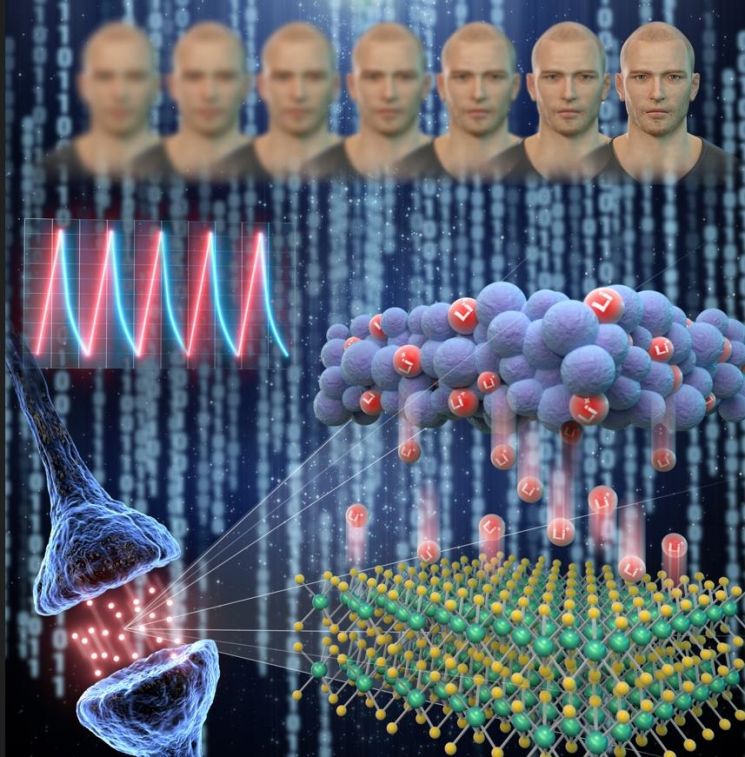 Schematic diagram of next-generation neuromorphic semiconductor devices with high integration and high reliability incorporating battery materials. Image courtesy of Korea Institute of Materials Science.
This technology involves ultrathinning lithium ions, a core material of lithium-ion batteries that have recently attracted attention, and combining them with two-dimensional nanomaterials to enable the manufacturing of next-generation AI semiconductor core devices that are highly integrated and highly reliable.
Neuromorphic semiconductor devices are composed of synapses and neurons similar to the human brain. At this time, the development of synapse devices that simultaneously perform information processing and storage functions is essential. Synapse devices receive signals from neurons similar to the human brain and modulate synaptic weights (connection strengths) in various ways, enabling simultaneous information processing and memory functions. In particular, if the linearity and symmetry of synaptic weights are satisfied, various pattern recognitions can be easily implemented with low power consumption.
Previous studies mainly controlled synaptic weights by using charge traps at interfaces of heterogeneous materials or by using oxygen ions. However, in these cases, it was difficult to control ion movement as desired according to external electric fields. The research team solved this problem by developing a highly integrated AI semiconductor device through a thinning process while maintaining the mobility of lithium ions under external electric fields. The ultrathin film with a thickness of several tens of nanometers allows wafer-scale thickness control and fine patterning processes, making it compatible with existing semiconductor processes.
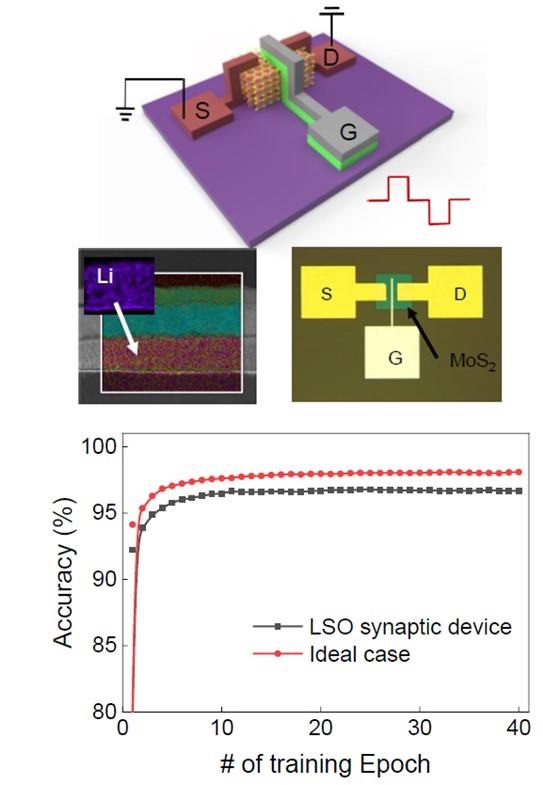 Thin-film lithium-ion material for highly integrated three-terminal devices photo and handwritten pattern accuracy. Image courtesy of Korea Institute of Materials Science
The research team succeeded in thinning lithium ions using a vacuum sputtering deposition method commonly used in semiconductor processes. The thickness of the deposited lithium ion thin film is below 100 nanometers (nm). Subsequently, by fabricating transistor-type devices on silicon wafer substrates through semiconductor processes and applying an external electric field, lithium ions within the lithium thin film carrying charge move reversibly, enabling fine control of the channel conductivity. Using the developed synapse device, the team implemented artificial neural network learning patterns and trained it on handwritten image pattern recognition. The fabricated AI semiconductor device maintained finely tunable synaptic weight characteristics even after more than 500 repeated electric field cycles, demonstrating a high handwritten pattern recognition rate of approximately 96.77%.
The research team stated, “Unlike conventional von Neumann architecture information processing devices such as CPUs and memory devices that require separate components, this device simultaneously performs information processing and storage and can perform image learning and recognition such as handwritten patterns,” adding, “It can be widely applied to world-class neuromorphic hardware systems, haptic devices, vision sensors, and various low-power AI devices.”
The research results were published on November 17 last year in the international academic journal ‘ACS Applied Materials & Interfaces (ACS AMI).’
© The Asia Business Daily(www.asiae.co.kr). All rights reserved.
![Clutching a Stolen Dior Bag, Saying "I Hate Being Poor but Real"... The Grotesque Con of a "Human Knockoff" [Slate]](https://cwcontent.asiae.co.kr/asiaresize/183/2026021902243444107_1771435474.jpg)
















