Court: "Limited implementation for some complex cases... Just concerns"
Prosecution: "Cannot rule out possibility of suspect fleeing or destroying evidence"
[Asia Economy Reporter Heo Kyung-jun] The Supreme Court is pushing for a revision of the rules to allow judges to summon and question parties involved, including prosecutors, before issuing search and seizure warrants, prompting opposition from the prosecution.
According to the legal community on the 8th, the Supreme Court's Judicial Administration Office announced a legislative notice on partial amendments to the Criminal Procedure Rules on the 3rd.
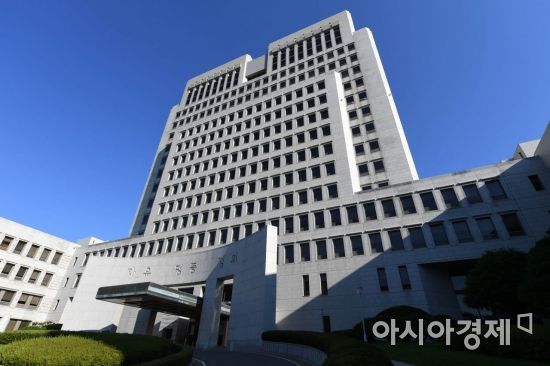
Due to the nature of electronic information such as data stored on mobile phones, there is a high risk of infringing on privacy, freedom, and the right to self-determination regarding information, so special regulation is necessary. The Supreme Court's position is that long-term discussions have been ongoing regarding this matter.
On the other hand, the prosecution holds the position that there is a risk of investigative information being exposed externally, making it unacceptable. They argue that if a hearing on the search and seizure warrant is conducted before the substantive review of the warrant, there is a risk of the suspect fleeing and the possibility of evidence destruction cannot be ruled out.
The Supreme Court prepared the rule amendment so that, unlike detention warrants which require hearings, search and seizure warrants can have face-to-face hearings only when necessary. This procedure is introduced for judges to more accurately examine particularly complex cases.
In fact, the Supreme Court's Judicial Administration Advisory Council, an advisory body to the Chief Justice, under the Trial System Subcommittee, after discussions starting in October 2021, presented the opinion that the introduction of face-to-face hearings by judges is necessary.
Within the court, there is a response that the search and seizure warrant hearing system is being introduced for prompt processing because sometimes the purpose or target of the search and seizure warrant requested by investigative agencies is unclear, requiring inquiries back to the agencies. Currently, when the prosecution requests a search and seizure warrant, judges review the requirements through written examination and decide whether to issue the warrant.
The Supreme Court sees that this also provides an opportunity for investigative agencies to explain the necessity of the investigation in detail to judges, and through sufficient hearings on the necessity of issuing warrants, search and seizure of electronic information can be conducted within the necessary scope.
Regarding concerns that conducting hearings on search and seizure warrants may compromise the confidentiality of investigations, the Supreme Court holds the position that no significant problems will arise. The subjects of face-to-face hearings will generally be investigative agencies such as the police who applied for the warrant or informants, and since the hearings themselves are discretionary procedures conducted restrictively in some complex cases, the concerns are considered excessive.
The Supreme Prosecutors' Office expressed discomfort on the same day, stating, "There was no prior consultation or notification regarding the Supreme Court's rule amendment to introduce pre-hearing procedures for search and seizure warrants."
They emphasized, "If the fact and content of search and seizure warrant requests made at the initial stage of criminal investigations to protect citizens' fundamental rights are disclosed in advance and hearings are conducted for parties involved, it will damage the confidentiality of investigations, lead to evidence destruction, and cause delays, seriously hindering swift and strict crime response."
They added, "Introducing unfamiliar procedures related to search and seizure warrants that have continued for over 70 years requires listening to various opinions from the public and related agencies, and going through consultation and careful consideration. We cannot help but be concerned that the rule amendment process is proceeding without any prior opinion gathering or consultation."
The Supreme Court plans to collect opinions from related agencies such as the Ministry of Justice, the Korean Bar Association, and the National Police Agency by the legislative notice deadline on the 14th of next month.
© The Asia Business Daily(www.asiae.co.kr). All rights reserved.
![Clutching a Stolen Dior Bag, Saying "I Hate Being Poor but Real"... The Grotesque Con of a "Human Knockoff" [Slate]](https://cwcontent.asiae.co.kr/asiaresize/183/2026021902243444107_1771435474.jpg)
















