Distribution of Cellular Mutations from Precancerous Lesion Stage
Primary Cancer Development through Evolution via Competition
Clonal Tracking Enables More Effective Targeted Anticancer Drug Selection
[Asia Economy Reporter Lee Gwan-ju] Domestic researchers have, for the first time in the world, elucidated the process by which normal gallbladder cells develop into gallbladder cancer. This is expected to help select more effective targeted anticancer drugs for treating gallbladder cancer patients.
The research team, including Professors Kim Ji-won and Kang Min-su from the Department of Hematology and Oncology at Bundang Seoul National University Hospital, Professor Na Hee-young from the Department of Pathology, and Professor Ahn Soo-min from the Department of Pathology at Samsung Seoul Hospital, announced on the 8th that they have revealed the process by which normal gallbladder epithelial cells evolve through precancerous lesions into primary gallbladder cancer and metastatic gallbladder cancer.
 Professors Jiwon Kim and Minsu Kang from the Department of Hematology and Oncology at Seoul National University Bundang Hospital, Professor Heeyoung Na from the Department of Pathology, and Professor Sumin Ahn from the Department of Pathology at Samsung Seoul Hospital (from left)
The gallbladder is a pouch that concentrates and stores bile, which aids in fat digestion. A mass of cancer cells arising here is called gallbladder cancer. Although the global average incidence ranks 20th among cancers and is relatively low, some countries including South Korea (ranked 8th), Thailand, China, and Chile show high incidence rates. Many cases are diagnosed at an advanced stage, making complete cure difficult.
The research team began their study by performing autopsies on two patients who died from metastatic gallbladder cancer, securing multiple samples of normal tissue, precancerous lesions, primary tumors, and metastatic lesions, and additionally analyzed nine more patients.
As a result, the distribution of mutations in cells was highly diverse even in the precancerous lesions, which are the cancer’s pre-stage. A single precancerous lesion consists of multiple cell clusters (clones) based on the mutation distribution of the cells forming the lesion. Through competition among clones, the winning clone is selected, undergoing an evolutionary process known as Darwin’s "theory of evolution," specifically the "survival of the fittest" or "selective sweep," eventually transforming into a primary tumor.
The clones constituting the evolved primary tumor also acquired new mutations over time, evolving into several new clones. Through subsequent competition, the winning clones are selected, and some of these metastasize to other organs. In this process, not a single cancer cell or clone but multiple cancer cells or clones metastasize simultaneously. The metastatic cancer cells or clones also undergo the same process of mutation acquisition → evolution into diverse clones → competition stages.
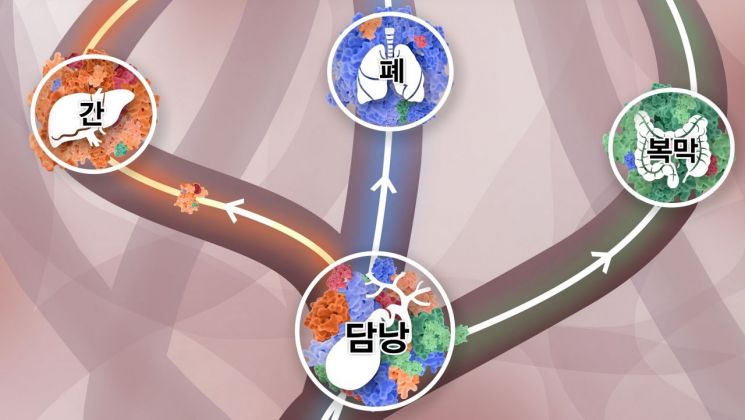 Various clones are mixed in the gallbladder, and cancer cells dominated by the orange clone spread to the liver, those dominated by the blue clone spread to the lungs, and those dominated by the green clone spread to the peritoneum. [Data provided by Bundang Seoul National University Hospital]
The research team interpreted that this complex process continuously occurs inside the bodies of gallbladder cancer patients, making treatment difficult. Therefore, when treating gallbladder cancer, tracking the temporal and spatial changes of tumor clones is essential to maximize treatment efficacy by using the optimal targeted anticancer drugs.
First author Professor Kang Min-su said, "Representative gene mutations of gallbladder cancer exist from the precancerous stage, but many mutations are observed only in some cancer cells. To maximize the effect of targeted anticancer drugs aimed at gene mutations, it is necessary not only to confirm the presence of mutations in cancer genome data but also to track the temporal and spatial changes of tumor clones carrying these mutations."
Corresponding author Professor Kim Ji-won added, "This study has enabled a deeper understanding of the mechanisms of gallbladder cancer onset and metastasis, but to translate these findings into therapeutic effects in actual patients, the development of various new drugs capable of neutralizing each gene mutation is essential. We deeply thank the two patients and their families who made the difficult decision of 'body donation' to enable this research to begin."
This study was selected as a Korean-style 'SGER (Small Grant for Exploratory Research)' project by the Ministry of Education in 2018 and received support for three years. It was published in the prestigious international journal in the field of biomedical sciences, eLIFE.
© The Asia Business Daily(www.asiae.co.kr). All rights reserved.
![Clutching a Stolen Dior Bag, Saying "I Hate Being Poor but Real"... The Grotesque Con of a "Human Knockoff" [Slate]](https://cwcontent.asiae.co.kr/asiaresize/183/2026021902243444107_1771435474.jpg)
















