MS Announces Chatbot Integration in Search Engines
Google, Dominating 93% of Search Market, Also on Alert
Chinese Baidu and Startups Enter the Market One After Another
[Asia Economy Reporter Jeong Hyunjin] The integration of artificial intelligence (AI) chatbots and search engines has officially begun. Since the release of the AI chatbot 'ChatGPT' last November, predictions have poured in that the way information is searched will completely change, marking the start of a full-scale battle in the search engine market. Microsoft (MS), the 'challenger' in the search engine market, officially announced on the 7th (local time) that it will equip its market second-place search engine 'Bing' with an AI chatbot. The market's 'absolute powerhouse' Google plans to launch 'Bard AI' soon to counter this move. The head-to-head competition between these two big tech companies has begun.
◆ MS equips search engine 'Bing' with AI similar to ChatGPT
On this day, MS announced its newly revamped AI-based search engine 'Bing.' The new version of Bing is equipped with an AI model developed by OpenAI, the developer of ChatGPT. OpenAI CEO Sam Altman explained that ChatGPT and GPT-3.5 have helped create the new Bing. ChatGPT is an upgraded version of GPT-3, which has over 175 billion parameters, known as GPT-3.5. MS only stated that Bing runs on a 'new next-generation language model' but did not specifically mention that it is based on GPT-4, according to foreign media reports.
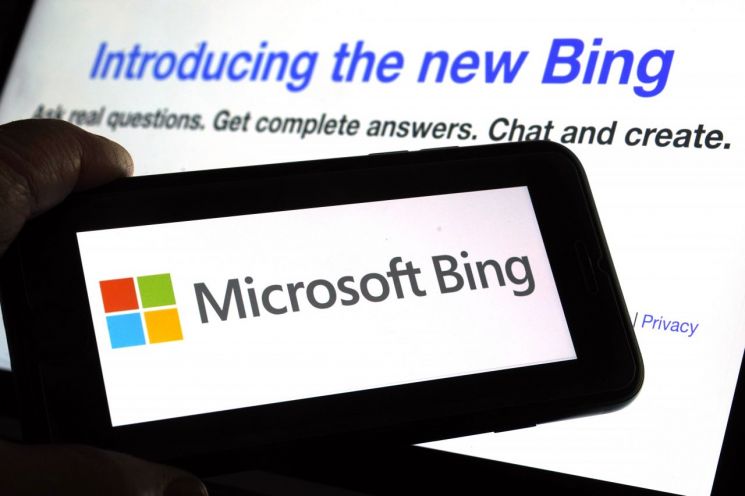
With AI integrated, Bing provides conversational answers alongside traditional search results when users input questions in conversational language. For example, if traveling to Mexico for five days, users can request 'plan a travel itinerary' and then ask follow-up questions like 'how much will it cost?' or 'can I add or change the itinerary?' The chat mode can be turned on or off by users, and it is also possible to click the chatbot embedded in the search engine to compose emails. Users can also summarize the web pages they are viewing or ask questions to receive answers.
Joanna Stern of The Wall Street Journal (WSJ) tried it on-site and commented, "It is very smart. Search will never be the same as before."
Satya Nadella, MS CEO, said, "We want to show how we will reshape the largest software category on Earth," adding, "That is search, which we have studied for a long time and are very excited about." He continued, "This is a new day for search and a new 'paradigm' for search," emphasizing, "Rapid and fast innovation will come."
◆ Despite overwhelming 93% market share, Google feels threatened... responds with 'Bard'
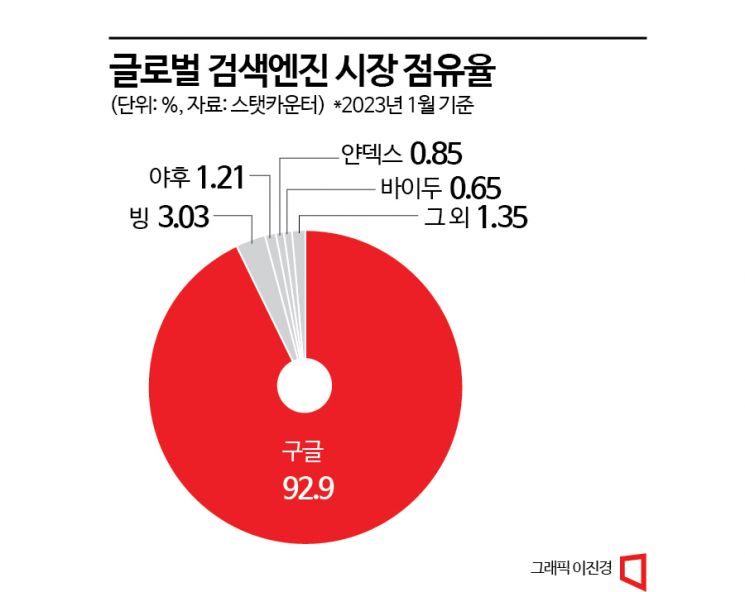
The global search engine market is currently dominated by essentially one company. According to market research firm StatCounter, Bing's market share in the global search engine market was 3.03% as of last month. Google's share, ranked first, is 92.9%. The gap between first and second place reaches 90%. The term 'Googling,' meaning using Google's search engine, was added to dictionaries in 2006 due to this overwhelming dominance. Search engines play a core role in Google's revenue structure, matching its status.
The success of ChatGPT shook Google. Predictions began to pour in that it could change the future of search engines. Feeling a crisis severe enough to issue a 'Code Red,' Google moved quickly. Alphabet CEO Sundar Pichai personally attended AI strategy meetings to give directions, and founders Larry Page and Sergey Brin, who left the company three years ago, were called back to devise countermeasures.
Google officially announced the launch of a new conversational AI service, Bard, the day before. It stated that the official service will be launched within weeks and integrated into the search engine. Bard is based on Google's existing language model 'LaMDA.' Google explained that Bard's distinguishing feature is its ability to simplify complex topics, such as explaining NASA's James Webb Space Telescope's new discoveries to a 9-year-old child. CEO Pichai evaluated Bard as "an outlet for creativity and a stepping stone for curiosity," saying it will provide high-quality answers based on the web.
◆ MS's challenge: "We must move quickly"
The showdown between Google and MS is attracting attention not only in the IT industry but worldwide. It is not only a direct confrontation between major big tech companies but also considered a 'game changer' that could change even the way information is searched through generative AI. According to the US economic media Business Insider, Wedbush Securities analyzed in a memo sent to clients immediately after MS's announcement that users will discover expanded benefits and user experiences in the new version of Bing, suggesting Bing will challenge the search engine market.
Moreover, if AI is additionally integrated into other software products such as MS's Excel and PowerPoint or Google's Gmail and Google Docs alongside search engines, it is currently impossible to predict what changes this will bring to the market. Most big tech companies, including these two, have been investing heavily in AI development, and the quality, delivery speed, and methods of AI services are expected to have a complex impact. Google acquired UK AI company DeepMind, developer of AlphaGo, in 2014 and declared 'AI First' instead of 'Mobile First' in 2017, viewing AI as a core business and nurturing it. Business Insider said, "MS has gained an opportunity to challenge Google with ChatGPT," but also warned, "They must move quickly."
◆ China's Baidu and AI startups also join the fray
Amid the generative AI craze, which creates new content similar to existing text or images, Chinese search engine Baidu has declared it will unveil its AI chatbot 'Ernie Bot' next month. According to Bloomberg and others, Ernie Bot is a large language model powered by AI developed in 2019, gradually improving its ability to perform tasks such as language understanding and language/image generation. Baidu is currently internally testing Ernie Bot and plans to launch it next month. Baidu, ranked fifth in the search engine market share, is expected to integrate this AI chatbot into its search engine.
Since the release of ChatGPT, startups developing generative AI have also been emerging one after another. Despite large-scale layoffs and cost-cutting in the IT industry since last year, there is a willingness to make massive investments in AI, making it appear as the only hope.
According to global market research firm CB Insights, the amount invested in generative AI startups last year totaled $2.654 billion across 110 deals. This is more than a 70% increase compared to the previous record of $1.548 billion in 2021. Looking at the investment amounts in generative AI startups over the past five years, there were significant increases in 2019 and 2021, which seems to be influenced by OpenAI receiving investment from MS. Last year, OpenAI's corporate valuation was $20 billion, the highest among generative AI startups.
© The Asia Business Daily(www.asiae.co.kr). All rights reserved.



















