Publication of Memoir Including Interview
Blaming Korea for Deterioration of Korea-Japan Relations
"Japan's Moral Superiority Through Comfort Women Denial"
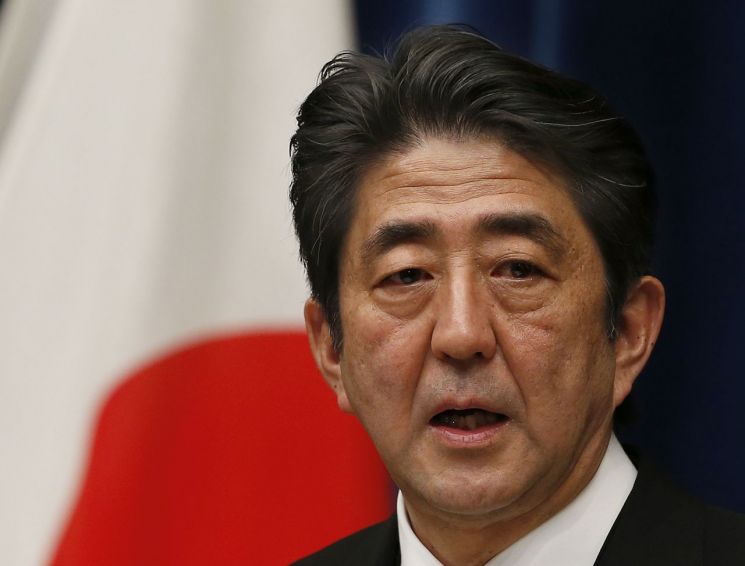
On the 7th, former Japanese Prime Minister Shinzo Abe, who was fatally shot last year, claimed in his memoirs distributed at Japanese bookstores that former South Korean President Moon Jae-in was a 'convinced offender' who knew that the South Korean Supreme Court's ruling on forced labor compensation violated international law.
In the book "Shinzo Abe Memoirs," which compiles interviews conducted during his lifetime, Abe strongly criticized the 2018 South Korean Supreme Court ruling ordering Nippon Steel and Mitsubishi Heavy Industries to compensate forced labor victims. He stated, "The Claims Agreement signed between South Korea and Japan in 1965 qualifies as an international treaty, and it clearly states that claims for compensation were 'completely and finally settled.' A ruling that denies the treaty cannot exist in the international community."
He further claimed that former President Moon Jae-in, who participated in a committee reviewing the Korea-Japan agreement during the Roh Moo-hyun administration, was aware of the problems with the forced labor compensation ruling but wanted to use anti-Japanese sentiment as a tool to support his administration.
After the South Korean Supreme Court ruling, Abe also shifted responsibility onto South Korea regarding the Japanese government's regulation of exports of three key semiconductor and display materials, including hydrogen fluoride, and the removal of South Korea from the whitelist. He emphasized, "The issue of how to respond to the Moon administration, which did not seek any solutions after the forced labor compensation ruling was finalized, led to the strengthening of export regulations." He argued that the export procedures were tightened, which differs from export restrictions, and thus did not violate World Trade Organization (WTO) rules. Although Abe maintained that export regulations and the forced labor compensation ruling were completely separate issues, he admitted that the two matters were actually intertwined.
Regarding the 2015 comfort women agreement, Abe said, "They (South Korea) did not keep their promises, so initially I was cautious," and added, "I thought it was a final and irreversible resolution, and if mutual accusations and criticisms were restrained in the international community, it could not be helped." He also stated, "Everyone has completely forgotten my apology, but I called former President Park Geun-hye to express my apology and remorse," while adding, "I did not acknowledge forced abduction." He claimed that the agreement was made so that his successors would not bring up the comfort women issue, and that Japan gained a 'moral superiority' diplomatically due to South Korea's breach of the agreement.
The "Shinzo Abe Memoirs" includes interview content totaling 36 hours over 18 sessions conducted from October 2020, after he stepped down as prime minister, for about a year.
It was written by a special editorial committee member and editorial board chairman of the Yomiuri Shimbun and supervised by former National Security Secretariat Director Shigeru Kitamura.
© The Asia Business Daily(www.asiae.co.kr). All rights reserved.
![Clutching a Stolen Dior Bag, Saying "I Hate Being Poor but Real"... The Grotesque Con of a "Human Knockoff" [Slate]](https://cwcontent.asiae.co.kr/asiaresize/183/2026021902243444107_1771435474.jpg)















