Increase in Union Formation and JY's Demand for Private Meeting
Samsung's 'Performance-Based' Approach and Parallel Paths
Labor and Management 'Different Dreams' Amid Inflation
"Raise Salaries" "Management Uncertainty"
[Asia Economy Reporter Moon Chaeseok] The labor and management at Samsung Electronics have entered into an extreme confrontation over the compensation system. The labor union demanded a 10% salary increase this year reflecting inflation and the abolition of the low-performance salary reduction system. The management shows reluctance, insisting on maintaining Samsung's unique 'performance-based' system that clearly rewards high performers. Samsung Electronics is experiencing its first serious labor-management conflict in its 54 years since establishment.
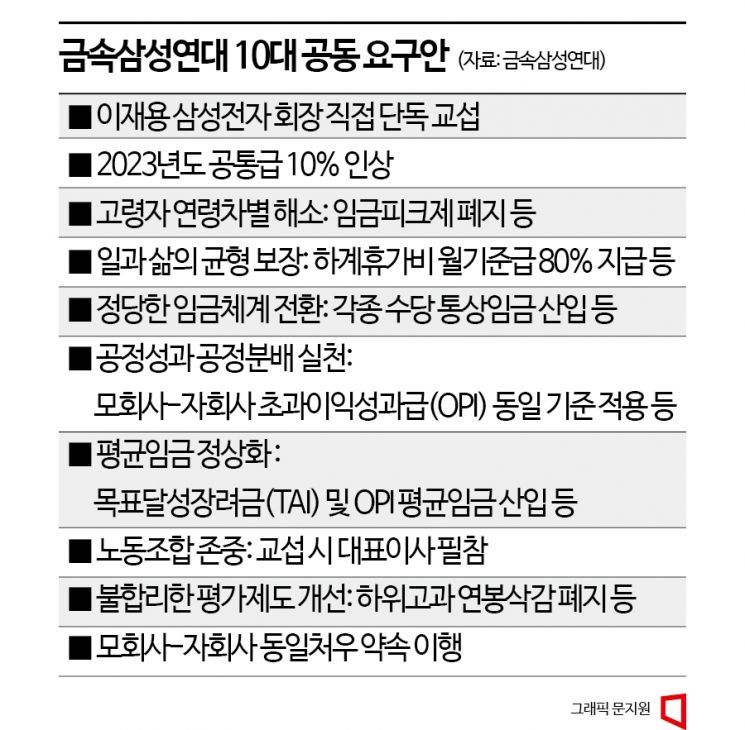
The Korean Metal Workers' Union Samsung Group Union Solidarity (Metal Samsung Solidarity), composed of labor unions from 12 Samsung affiliates, held a press conference on the morning of the 7th and announced ten joint demands including a 10% increase in base salary this year. They also released their own data showing a 5% decrease in real income last year. Considering this year's inflation rate of 5.9% and economic growth rate of 1.8%, they demanded a 10% wage increase.
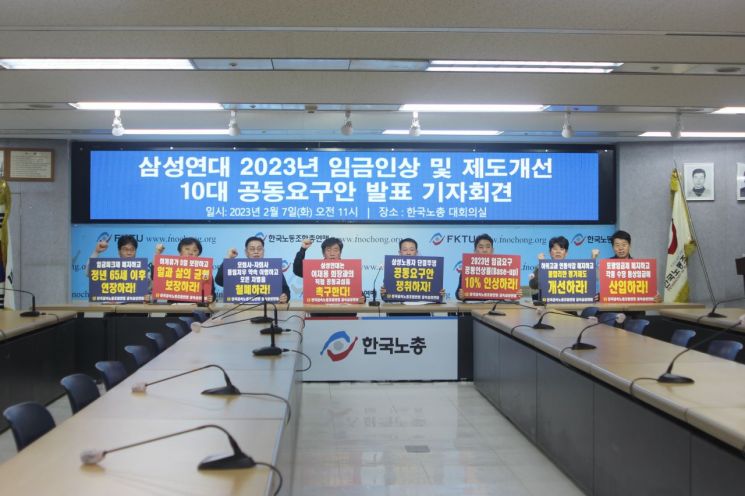 The Korea Metal Workers' Union Samsung Group Union Solidarity (Metal Samsung Solidarity) held a press conference on the "2023 Wage Increase and 10 Major Joint Demands for System Improvement" on the 7th at the Korea Metal Workers' Union conference room in Yeouido, Seoul.
 [Photo by Korea Metal Workers' Union]
Labor and management are running on 'parallel lines' in many respects. For example, regarding last year's inflation, the labor side calls it a "factor for wage increase," while the management insists it is a "cost-saving factor."
Notably, the union's demands go beyond wage increases to changes in the performance bonus payment and low-performance evaluation system. They raised the stakes to the extent of requesting a private meeting with Chairman Lee Jae-yong, saying, "Only Chairman Lee can change this." They demanded a change to Samsung's unique 'performance-based' system that clearly rewards high performers. This breaks the unwritten rule of not touching the owner if possible.
Since there are even signs of 'labor-labor (노노) conflicts' among employees after last year's performance bonus payments, the management is also closely watching the union. Last year, Samsung Electronics paid differentiated excess profit incentives (OPI) by business division according to the principle of performance-based pay. The difference was significant, ranging from a minimum of 7% (home appliances) to a maximum of 50% (semiconductors). Even among employees with the same salary, those working in certain divisions received the equivalent of half a year's salary more than others.
The union warned that Samsung's unique cost-cutting management, squeezing a dry towel until the water runs out, could hold back the organization. While the union is fighting for talent inflow, it questions whether good talents would welcome such a culture. The Metal Samsung Solidarity stated, "While the company grows, workers' real income has decreased, accelerating the phenomenon of excellent talent avoiding Samsung in the recruitment market," and added, "This is because management has focused on cost reduction and maintained low wage increase rates."
Despite the unsettled atmosphere, union formation within Samsung is becoming increasingly active. On the 2nd, nine unions from five Samsung affiliates gathered to launch a union solidarity. Three days earlier, Samsung Electronics' fifth union, the 'DX (Device Experience) Union,' was formed. The core members are employees from the home appliance business division who received only 7% of their annual salary as a performance bonus this year.
© The Asia Business Daily(www.asiae.co.kr). All rights reserved.
![Clutching a Stolen Dior Bag, Saying "I Hate Being Poor but Real"... The Grotesque Con of a "Human Knockoff" [Slate]](https://cwcontent.asiae.co.kr/asiaresize/183/2026021902243444107_1771435474.jpg)

















