Mangyangjeong~Wangpicheon Completion by Late June
Likely to Become Korea's 'Santiago Pilgrimage Route'
[Asia Economy Yeongnam Reporting Headquarters Reporter Koo Dae-sun] Gyeongbuk Province is promoting a project to construct a 16.7 km pilot section of the East-West Trail crossing the Korean Peninsula, from Mangyangjeong to Wangpicheon in Uljin County, which began construction at the end of December last year and aims to be completed by June this year.
The ‘East-West Trail’ is a long-distance trail spanning a total of 849 km across five cities and provinces, from Uljin County in Gyeongbuk to Taean County in Chungnam, planned to be developed in 55 sections.
The Mangyangjeong section, where groundbreaking is taking place, is the only section receiving ESG funds from Woori Financial Group, and it is expected to become a symbol of hope for the residents of Uljin County, who were devastated by a large-scale wildfire last spring.
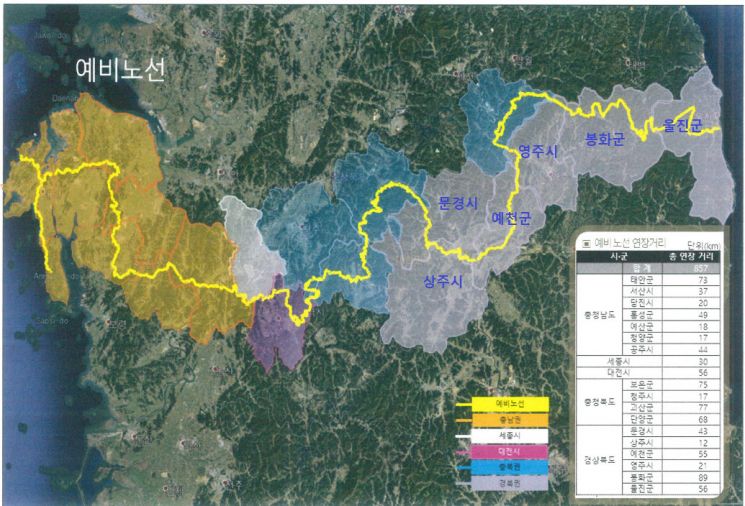
The 16.7 km priority construction section starting from Uljin Mangyangjeong, the top scenic spot of Gwandong Palgyeong, passes through the natural monument Seongryugul Cave, the mid-Joseon Dynasty scholar Gyeokam Namsago historic site, and continues from Hawon-ri, a forest ecological resource rich area with Korean red pines, to Sugok-ri forest paths, meeting the pristine scenic Wangpicheon River.
Once the pilot section, symbolic of the East-West Trail, is completed, it will be opened first to local residents and can serve as a hub connected to existing trails such as the Korean red pine forest trail, Nakdong Jeongmaek Trail, and Bobusang Road.
A Gyeongbuk Province official said, “The East-West Trail will be created as a forest path about 2 meters wide. It is a trekking path where vehicles cannot pass. We are conducting construction by maximizing the use of existing village forest paths and forest roads.”
The Gyeongbuk section of the East-West Trail, scheduled for completion in 2026, is the longest section accounting for 32% of the entire trail. The six cities and counties in the northern Gyeongbuk area along the planned route have diverse forest ecosystems, outstanding natural scenery, and rich historical and cultural stories, making it sufficient to establish itself as a famous destination.
Choi Young-sook, Director of the Environmental and Forest Resources Bureau of Gyeongbuk Province, said, “We will spare no support for the successful development of the Gyeongbuk section of the East-West Trail, and after completion, it is expected to play a major role in the development of northern Gyeongbuk as well as enhancing the status of Gyeongbuk as a great forest region.”
The entire East-West Trail, with a total project cost of 60.4 billion KRW and scheduled for completion in 2026, will include 90 hub villages and 44 campgrounds.
Connecting the Chungcheong and Gyeongbuk regions by forest paths will enable regional communication and is expected to contribute to revitalizing the local economy by discovering and utilizing various cultural and scenic resources.
It is the first forest path connecting east and west at the midpoint of the southern Korean Peninsula, and there are plans to develop a world-famous long-distance trail like Spain’s Santiago Pilgrimage Trail to attract foreign tourists.
© The Asia Business Daily(www.asiae.co.kr). All rights reserved.
![Clutching a Stolen Dior Bag, Saying "I Hate Being Poor but Real"... The Grotesque Con of a "Human Knockoff" [Slate]](https://cwcontent.asiae.co.kr/asiaresize/183/2026021902243444107_1771435474.jpg)















