Called the "Cradle of Human Civilization"
Gaziantep Castle and Alfore Fortress Damaged
Ancient relics were also damaged by the strong earthquake that struck southern Turkey and northwestern Syria. Turkey and Syria are regions known as the "cradle of human civilization" and possess numerous UNESCO World Heritage sites. Concerns are growing that the ancient cultural heritage in the earthquake-hit areas has been severely damaged.
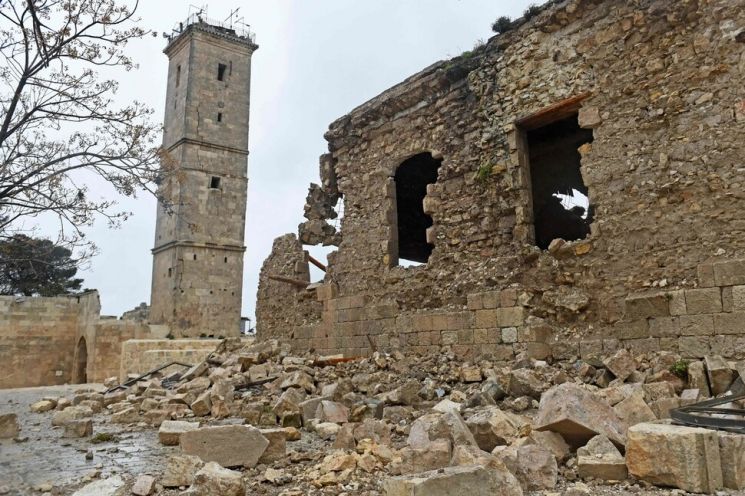 The ancient fortress of Al-Fawrah in Syria collapsed due to a strong earthquake.
 [Photo by AFP Yonhap News]
According to the British Guardian on the 6th (local time), the Roman-era fortress located in the Turkish city of Gaziantep was destroyed. Gaziantep Castle was built during the Roman Empire and is designated as a UNESCO World Cultural Heritage site. It is a landmark of the area and one of the best-preserved fortresses in Turkey, boasting over 2,000 years of history. However, being close to the earthquake's epicenter, the stone walls surrounding the fortress collapsed and cracks appeared on the fortress walls.
The situation in Syria is similar. According to AFP on the 6th (local time), Syrian cultural heritage authorities reported that part of the Aleppo Citadel in northwestern Syria was severely damaged by the earthquake. The Aleppo Citadel, a UNESCO World Heritage site, is a massive fortress located on a hill in the center of Aleppo, a city in northwestern Syria. Built in the 13th century, it preserves historical features such as temples, palaces, and baths. The minaret and gate of the Aleppo Ayyubid Mosque were also heavily damaged.
The authorities explained, "Some parts of the Ottoman-style mill inside the citadel collapsed, and various sections of the northeastern defensive walls cracked and fell." They also posted photos on Facebook, stating, "A portion of the dome of the Ayyub Mosque's minaret fell off, and the entrance to the Mamluk tower and the main gate of the citadel were also damaged."
Meanwhile, the magnitude 7.8 earthquake that struck southern Turkey and northwestern Syria has resulted in nearly 4,000 deaths. Due to ongoing aftershocks and harsh weather conditions, the scale of the damage is expected to increase further.
© The Asia Business Daily(www.asiae.co.kr). All rights reserved.
![Clutching a Stolen Dior Bag, Saying "I Hate Being Poor but Real"... The Grotesque Con of a "Human Knockoff" [Slate]](https://cwcontent.asiae.co.kr/asiaresize/183/2026021902243444107_1771435474.jpg)















