Proceeding Amid Difficulties in Cooperation with Impeachment Prosecutors
Change of Constitutional Court Justices Also a Variable
Impact on General Election and Others Inevitable Depending on Outcome
[Asia Economy Reporter Naju-seok] As the impeachment motion against Minister of the Interior and Safety Lee Sang-min is scheduled for a vote in the National Assembly on the 8th, concerns are rising that even if the motion passes, numerous variables remain. The political aftermath of an impeachment motion, which is akin to a political nuclear bomb, has become inevitable. The key question is when and in which direction the winds will blow.
According to political circles on the 7th, the National Assembly will proceed with the vote on the impeachment motion in the plenary session on the 8th. The day before, the three opposition parties?the Democratic Party, the Justice Party, and the Basic Income Party?jointly submitted the impeachment motion against Minister Lee with the signatures of 173 members.
After the impeachment motion is reported to the National Assembly, a vote must be held within 72 hours after 24 hours have passed. Considering the plenary session schedule, if the vote procedure is not carried out in the plenary session on the 8th, the impeachment motion will be discarded, so a vote is expected. Lee Su-jin, the Democratic Party’s floor spokesperson, told reporters that "if the motion is not submitted and voted on within 72 hours, it will be discarded," adding, "Since 176 members proposed it, I believe Speaker Kim Jin-pyo will make a sound judgment and submit it."
According to the Constitution, impeachment motions other than those against the president require the support of at least one-third of the total members of the National Assembly to be proposed and a majority vote to pass. Considering the three opposition parties and independent lawmakers sympathetic to the Democratic Party, it is expected that the majority requirement will be easily met. If the impeachment motion passes the National Assembly, Minister Lee will be suspended until the Constitutional Court issues a ruling. The Democratic Party held at least two party meetings before finally submitting the impeachment motion the day before. The Democratic Party’s main concern was not the National Assembly vote but the subsequent situation.
According to current National Assembly law and the Constitutional Court Act, the chairperson of the Legislation and Judiciary Committee serves as the impeachment prosecutor. Currently, the chairperson is Kim Do-eup, a member of the People Power Party, who is known to oppose the impeachment. Kim, who must act as the prosecutor in the impeachment trial, may be uncooperative regarding the impeachment. Due to this issue, the Democratic Party proposed a bill (by lawmaker Choi Ki-sang) to appoint one of the lawmakers who proposed the impeachment as the impeachment prosecutor instead of the chairperson of the Legislation and Judiciary Committee. However, since the law has not been amended, Kim must serve as the impeachment prosecutor.
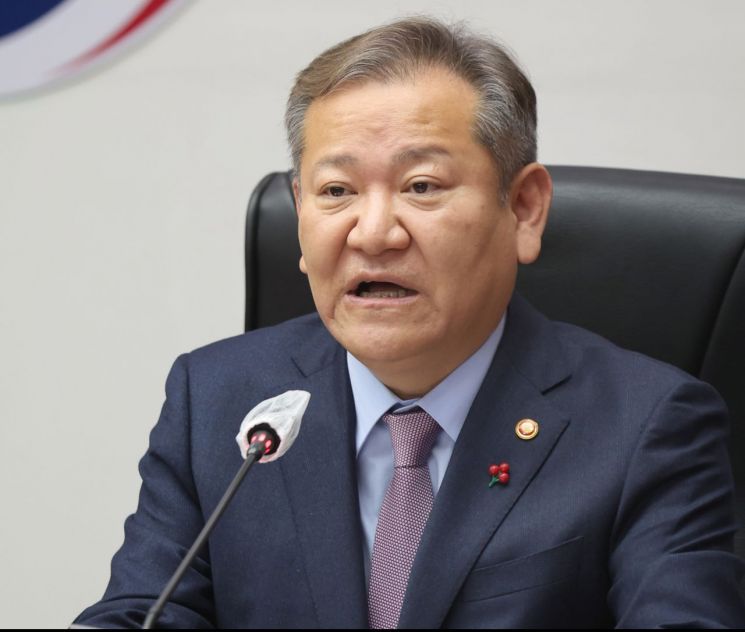 At the 2023 Central-Local Joint Meeting on Current Issues held at the Government Seoul Office, Lee Sang-min, Minister of the Ministry of the Interior and Safety, is delivering a greeting. Photo by Heo Young-han younghan@
Park Joo-min, head of the Democratic Party’s Itaewon Disaster Countermeasures Headquarters, mentioned at a meeting the day before that the Constitutional Court might exercise its ex officio investigative function (where the court bears the responsibility of collecting facts and evidence related to the lawsuit). This means that even if Chairperson Kim is uncooperative, the Constitutional Court can request necessary materials or hear opinions. However, unlike past impeachment cases, the unprecedented situation of impeachment proceeding amid the impeachment prosecutor’s non-cooperation is a variable in the Constitutional Court’s trial.
The situation at the Constitutional Court is also a variable. In March and April, Justices Lee Seon-ae and Lee Seok-tae will reach the end of their terms and retire. Additionally, Chief Justice Yoo Nam-seok’s term will expire in November this year. The remaining justices will be newly appointed during President Yoon’s term. The change in the Constitutional Court, which has shown a progressive inclination until now, is also expected to be a variable in Minister Lee’s impeachment trial.
If the impeachment is concluded after the second half of this year, political aftershocks will also occur. If the motion is upheld, it could hinder President Yoon’s governance, but if it is dismissed or rejected, the opposition parties, including the Democratic Party, will inevitably suffer damage. Although it is not comparable to past presidential impeachments, considering the general election scheduled for April next year, political repercussions are unavoidable. Former Blue House Senior Secretary for Political Affairs Choi Jae-sung said on SBS Radio’s Kim Tae-hyun’s Political Show, "I fully understand the intent and sentiment regarding Minister Lee’s impeachment, but it is regrettable that the responsible opposition party (the Democratic Party) is ultimately pushing forward with a risky move."
Meanwhile, if Minister Lee’s impeachment motion is passed, he will be dismissed by removal rather than resignation and will be barred from public office appointments for five years.
© The Asia Business Daily(www.asiae.co.kr). All rights reserved.

















