China's Core Solar Power Product Regulations in Xinjiang
Opportunity for Korean Industry Amidst Value Chain Disruption
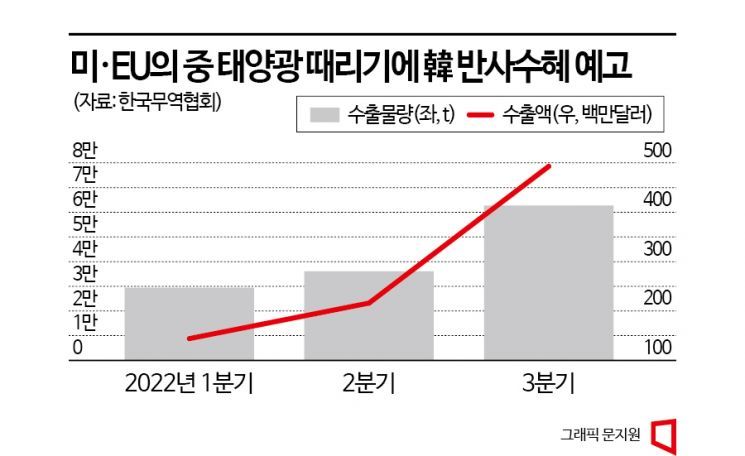
[Asia Economy Reporter Jeong Dong-hoon] The domestic solar power industry is receiving a 'reflective benefit' amid the continuous crackdown on Chinese solar power by the United States and Europe. As the restructuring of the eco-friendly energy supply chain accelerates this year, domestic companies have an opportunity to grow in earnest.
From the first to the third quarter of last year, the export value of domestically produced solar modules to the United States reached $852.67 million (approximately 1.2227 trillion KRW, according to Korea International Trade Association data). This represents a 143% increase compared to the same period the previous year. The export value of solar modules to the U.S. in the third quarter alone was $493 million, surpassing the total export value of $472.97 million in 2021. Monthly records continue to be broken.
Since the enforcement of the 'Uyghur Forced Labor Prevention Act (UFLPA)' by the U.S. in June last year, both the volume and unit price of solar module exports to the U.S. have surged. The UFLPA is a law that, in principle, bans the import of products produced in Xinjiang due to human rights abuses by the Chinese government in the Xinjiang Uyghur region.
Although justified on the grounds of human rights abuses, the law is also seen as a measure to curb China, which leads the global solar power supply chain. China virtually monopolizes the solar supply chain, accounting for 78-98% in key materials such as polysilicon and wafers, as well as in cells and modules. Among the top five global solar module manufacturers, three are Chinese companies.
The Xinjiang Uyghur region is considered a core area of China's solar power industry. Solar module materials must be refined using high-temperature heat. The Xinjiang region has hundreds of coal-fired power plants concentrated there, allowing for low-cost electricity to reduce production costs. Additionally, cheap labor is secured by forcibly mobilizing Muslim minorities for labor.
This year, the European Union (EU) is also moving forward with legislation on the 'Supply Chain Due Diligence Regulation (EU Supply Chain Due Diligence Act),' which targets China's solar power industry. The EU requires both domestic and foreign companies to review and report on human rights violations within their supply chains.
If forced labor or other human rights abuses are found within a company's supply chain, strong measures such as immediate suspension of sales are anticipated. These guidelines are expected to be legislated by European governments this year. Consequently, solar materials and modules produced in China will be banned from import not only in the U.S. but also in Europe.
The U.S. and Europe's crackdown on Chinese solar power presents an opportunity for domestic solar companies. Hanwha Solutions (Q CELLS division), the largest solar module manufacturer in North America, plans to invest 3.2 trillion KRW by 2024 to build an integrated solar production complex called 'Solar Hub' in the U.S. for ingots, wafers, cells, and modules.
They will expand annual solar module production capacity from 1.7 GW to 8.4 GW, enough to generate electricity for 1.3 million households in the U.S. for one year. Hanwha Solutions is also considering building new factories in Europe.
OCI has decided to expand the production capacity of its U.S. solar module subsidiary Mission Solar Energy's module factory from 210 MW to 1 GW. With a total investment of $40 million (approximately 57 billion KRW), they will expand their product lineup from residential modules to commercial and industrial modules.
© The Asia Business Daily(www.asiae.co.kr). All rights reserved.
![Clutching a Stolen Dior Bag, Saying "I Hate Being Poor but Real"... The Grotesque Con of a "Human Knockoff" [Slate]](https://cwcontent.asiae.co.kr/asiaresize/183/2026021902243444107_1771435474.jpg)















