Announcement of 'Basic Development Plan' Prioritizing Deaf Experience
Expansion of Korea Sign Language Education Center and Establishment of Level 1 Promotion Course
Interpretation Support Expanded to Public Institutions and Cultural Arts Organizations Announcements
Approximately 52,000 people use Korean Sign Language (KSL) as their everyday language. Most of them face difficulties in accessing information, enjoying culture, and social communication. This is due to the weak foundation for KSL education and interpretation, to the extent that there are no teaching materials for families of the deaf. Even government policies focus mainly on establishing institutional foundations, resulting in low effectiveness.
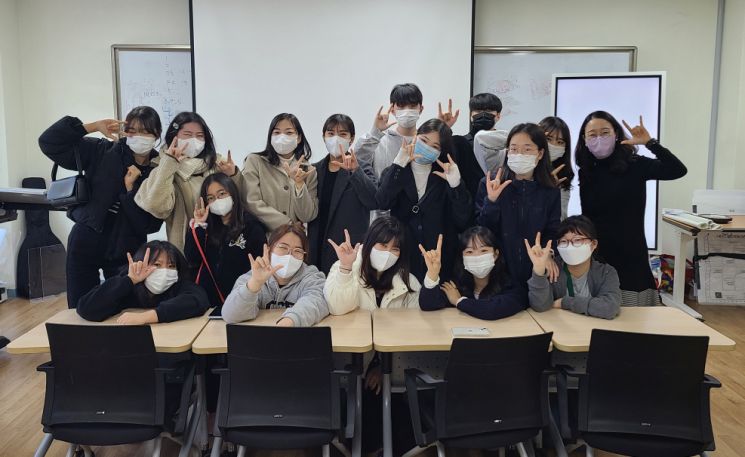
From this year, the Ministry of Culture, Sports and Tourism (MCST) is taking a new vision and direction. On the 6th, at the Social Relations Ministers' Meeting, it announced the "2nd Basic Plan for the Development of Korean Sign Language (2023?2027)" prioritizing the experiences of the deaf. Reflecting strategies from deaf experts and field feedback, it presented twelve tasks including ▲strengthening the institutionalization of KSL ▲expanding the foundation for KSL education ▲enhancing the capabilities of KSL teachers ▲improving professionalism in public sign language interpretation ▲and strengthening media accessibility of KSL. Sixty billion won will be invested this year alone. Park Bo-gyun, Minister of MCST, stated, "I am confident that improving the cultural, artistic, sports, and tourism environment will also improve the environment for non-disabled and hearing people," adding, "We will continue to prepare support not only for the deaf and their families but also for free communication and solidarity between the deaf and hearing communities."
The most anticipated policy is the expansion of the KSL system and foundation. The number of Korean Sign Language Education Centers will increase from four to seventeen, and the number of KSL teacher training institutes will grow from eight to seventeen. For sign language teachers who previously only obtained Level 2 certification, education courses and guidelines for Level 1 promotion will be established. Customized curricula and teaching materials will also be developed for different education targets so that anyone can learn KSL. MCST already organized a sign language subject in the "2022 Revised Special Education Curriculum" last December, which can be applied from next year. Separate curricula and teaching materials for deaf children and families of the deaf will be developed and applied in educational settings such as sign language education centers. Until now, the only KSL teaching material developed by the government was a grammar book titled "Korean Sign Language" for deaf adults.

MCST will also strengthen the professionalism of KSL interpreters. It will develop standard interpretation guidelines necessary for public sign language interpretation and operate a sign language interpretation monitoring team composed of deaf individuals. Furthermore, the scope of interpretation support will be expanded from government announcements to announcements by public institutions and cultural and artistic organizations, and the number of supported sessions will increase to over 2,000 annually by 2027. Last year, the number of supported sessions was only 440. An MCST official said, "We will produce and support KSL interpretation videos for museum and art gallery exhibition information and K-movies, and expand the mandatory broadcasting quota for KSL from 5% to 7%," expressing confidence that "the cultural enjoyment and media accessibility of the deaf will become much easier."
Efforts to digitize KSL in response to the artificial intelligence (AI) era are also accelerating. A Korean Sign Language-Korean corpus of one million words per year will be built, reaching six million words by 2027. Support will be provided for the development of automatic interpretation technology between Korean and KSL. The compilation of "Korean Sign Language-Korean Dictionary" and "Korean-Korean Sign Language Dictionary" based on the sign language corpus will be pursued as long-term projects. First, the former will be organized with about 4,000 KSL entries by 2026. An MCST official stated, "We plan to produce it in a form that provides various information such as the meanings of KSL, usage examples of KSL and Korean, handshape illustrations, and allows comprehensive searches of KSL forms."
© The Asia Business Daily(www.asiae.co.kr). All rights reserved.
![Clutching a Stolen Dior Bag, Saying "I Hate Being Poor but Real"... The Grotesque Con of a "Human Knockoff" [Slate]](https://cwcontent.asiae.co.kr/asiaresize/183/2026021902243444107_1771435474.jpg)

















