Research Team Led by Professor Lim Hyun-sik of Dongguk University Department of Physics and Semiconductor Science
Publishes Paper in Nature Physics
Professor Im Hyun-sik of the Department of Physics and Semiconductor Science at Dongguk University was invited to Japan's RIKEN in 2015 to research aluminum (Al) superconducting Josephson junction-based quantum computer devices (qubits) when he was surprised. Contrary to expectations, a previously unreported signal was observed. At first, he thought it was an experimental error or a fault in the device and repeated the entire experiment from the beginning. However, the measurements were the same even when using different devices. Professor Im sensed, "It could be a new discovery."
On the 7th, Professor Im gained worldwide attention by publishing a paper in the international journal Nature Physics about discovering a new quantum material through the condensation phenomenon of spin clouds in ultra-low temperature silicon metals.
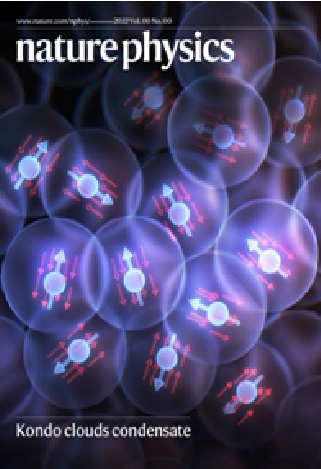 The international academic journal Nature Physics published on the 7th a cover paper authored by a joint research team led by Professor Im Hyun-sik of Dongguk University, reporting the discovery of a new quantum material using the spin cloud condensation phenomenon. Photo by Professor Im Hyun-sik, Dongguk University
Subsequently, Professor Im, along with Professors Kim Eun-gyu and Shin Sang-jin from Hanyang University and Professor Jung Yeon-wook from Sungkyunkwan University, devoted themselves to joint research and finally achieved this unique result. A spin cloud (Kondo cloud) refers to free electrons formed to indicate magnetism within metals or semiconductors. The role of spin clouds is known to be very important in high-temperature superconductivity phenomena, which have zero electrical resistance and are applicable in magnetic levitation trains and magnetic resonance imaging (MRI) devices. However, in the field of condensed matter physics, many unresolved challenges remain regarding the formation of spin clouds and further research into new quantum materials arising from interactions among them.
The research team accidentally discovered an unusual signal in silicon metal that had not been reported in academia while conducting research related to quantum computer devices. They began studying it, believing it to be a new quantum mechanical material rather than an error in the device or measurement equipment. Research on spin clouds has been extremely limited due to experimental difficulties and interpretative limitations, such as the need for measurements at ultra-low temperatures, but they persevered and continued research for several years starting in 2015. At that time, there were not many laboratories where ultra-low temperature device experiments and cutting-edge device processing could be freely conducted. They had no choice but to visit RIKEN in Japan during vacation periods each year and conduct research discreetly. Professor Im recalled, "On the one hand, it was good that graduate students participating in the research had the opportunity to experience cutting-edge international collaborative research."
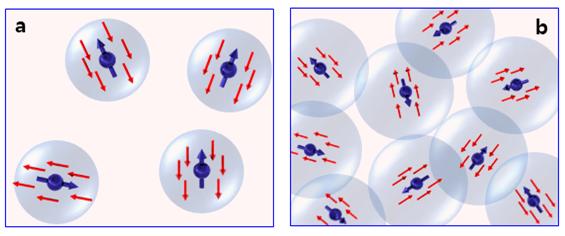 (Figure 1) a, Independent spin clouds (Kondo clouds) formed in a metal and b, an image illustrating the condensation of spin clouds.
 When the density of spin clouds formed in a metal is low, the spin clouds exhibit the well-known Kondo effect (an increase in electrical resistance at the critical temperature due to spin-spin scattering between magnetic impurities and surrounding electrons). When there are enough spin clouds to overlap and show condensation, a new quantum material similar to a superconductor without Cooper pairs can be formed.
Image provided by Professor Hyunsik Lim, Dongguk University
As a result, it was revealed through spectroscopy and electrical conductivity measurements that what was observed in silicon metal was a new material exhibiting characteristics of the 'Bose-Einstein condensate' state, discovered in the 1990s, following the solid, liquid, gas, and plasma phases of matter. By condensing spin clouds in silicon metal at ultra-low temperatures (1 Kelvin (K), minus 272.15 degrees Celsius), they succeeded for the first time in the world in discovering and elucidating the existence of a new quantum material.
This research achievement is expected to contribute to understanding spin-spin interactions in metals and semiconductors and to studying various strongly correlated materials, including high-temperature superconductors.
 Professor Im Hyun-sik, Department of Physics and Semiconductor Science, Dongguk University
Professor Im explained, "Since the condensed state of spin clouds is sensitive to temperature, magnetic fields, and the surrounding environment, it seems possible to use them as sensors. If quantum entanglement between spins can be controlled, it is expected to be applicable in the field of quantum information technology." He added, "It is urgently important to experimentally observe and understand how quantum states change according to the degree of condensation of spin clouds by controlling their concentration in pure metals, and how interactions between magnetic impurities and surrounding electrons vary. If another quantum condensed state can be generated and controlled, it is expected to be applicable to quantum device technology. Through follow-up research, understanding the various properties of spin clouds in response to concentration changes in pure metals is important."
© The Asia Business Daily(www.asiae.co.kr). All rights reserved.
![Clutching a Stolen Dior Bag, Saying "I Hate Being Poor but Real"... The Grotesque Con of a "Human Knockoff" [Slate]](https://cwcontent.asiae.co.kr/asiaresize/183/2026021902243444107_1771435474.jpg)
















