Nangsanj, a Local Faith Site, Developed into Historic Park and Trail
Gyeongju City Conducts Land Compensation around Queen Seondeok's Tomb Area
[Asia Economy Yeongnam Reporting Headquarters Reporter Kim Yong-woo] What will happen to the ‘Mystical Dolhalmae’ of Nangsang in Gyeongju?
There is a place that catches the attention of travelers as an interesting experience story about a stone spreads: ‘If you simply lift the stone and make a wish, the wish will come true only if the stone becomes hard to lift afterward.’
The Nangsang area in Gyeongju, famous as a land of folk beliefs, is home to many historic sites such as the tomb of Queen Seondeok of Silla, attracting steady foot traffic from tourists traveling to Gyeongju.
Nangsang is a place with traces of a long history and is known as a sacred site of folk beliefs. Visitors who come for fun to see the stones named ‘Mystical Dolhalmae (Stone Grandmother) and Dolhalbae (Stone Grandfather)’ have spread the word through word of mouth and social media, making it a popular travel course in Gyeongju.
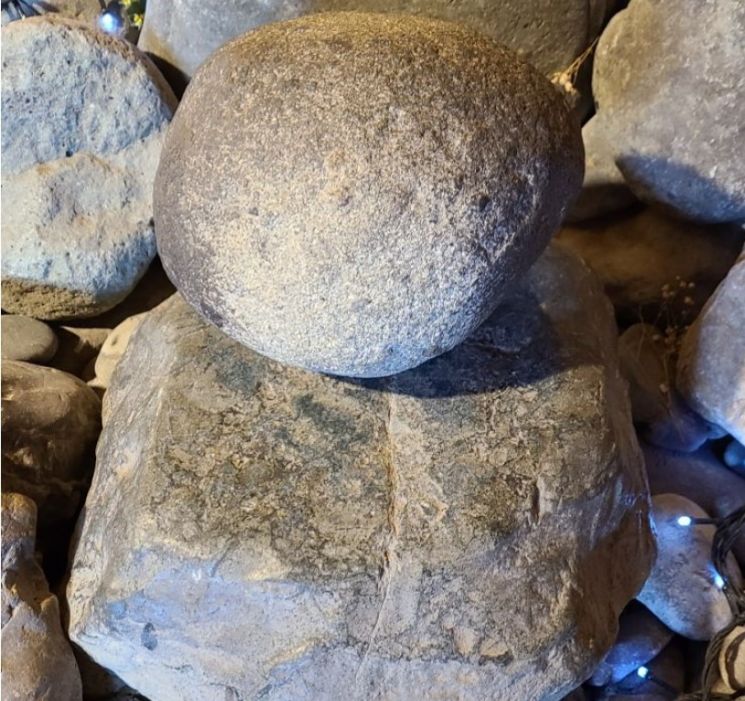 The upper stone is called 'Dolhalmae', and the lower one is 'Dolhalbae'. Originally, they are two separate stones placed on top of each other.
In Yeongcheon, Gyeongbuk Province, there are stones with the same name, and along with the ‘Dolgunong’ travel site that holds another storyline, it is also known as Dolhalmae Park, adding an indispensable fun element of shamanism and folk beliefs to domestic travel content.
About 20 years ago, Ms. Kim (in her 60s, female), who established a hermitage on about 1,100 pyeong of land at the foot of Nangsang, gathered stones she accidentally discovered inside the temple hall, and over time, many wishes have accumulated in front of the ‘mystical stones.’ Some people undergoing treatment have also visited the Nangsang area as a place of rest, praying for recovery.
Ms. Kim, the guardian of ‘Yaksaram’ which preserves folk beliefs, said, “The number of members has increased to about 2,000 registered believers of the hermitage, and about 1,000 tourists visit every month.” Mr. Kang (in his 50s), the head of the believers’ association, revealed, “Beopsa Kim collects money left by tourists as candle offerings and generously donates it as charity during Lunar New Year, Chuseok, and Buddha’s Birthday.”
Ms. Kim said that the tomb of Queen Seondeok, located near the hermitage, is neglected compared to other royal tombs in downtown Gyeongju, and for over 10 years, she has been holding memorial rites for the queen called ‘Seondeok Queen Festival’ at her own expense with about 100 believers.
There is the gently rounded ridge of Nangsang, and just below the summit lies the tomb of Queen Seondeok, the first queen in Korean history of Silla. At the foot of the mountain is Neungjitaepji, known as the cremation site of King Munmu. On the opposite southeast slope are historic sites such as Sacheonwangsa Temple Site, and facing Nangsang are the tombs of King Sinmun, Mangdeok Temple Site, and King Hyogong’s tomb, making the Nangsang area lined with historic sites.
Gyeongju City is revitalizing the Nangsang area as part of the ‘Restoration and Maintenance of 14 Core Sites of Silla Royal Capital’ project.
As the Nangsang area, which holds the sacred resting places of Silla kings and Buddhist historic sites, is included in Gyeongju’s comprehensive maintenance plan, it will be transformed into a historic park and a walking trail around the Silla royal tombs.
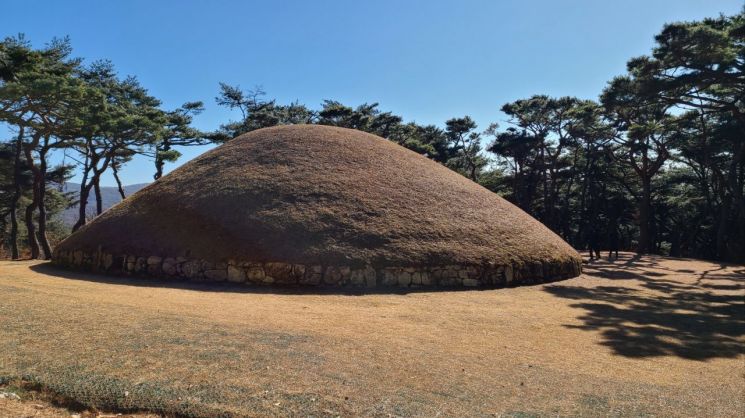
An official from Gyeongju City’s Cultural Heritage Division’s Historic Site Maintenance TF team said, “According to the comprehensive maintenance plan notification for 882,000 square meters of the Nangsang area, we are currently obtaining land purchase consent forms from residents,” adding, “Out of a total of 549 plots, we are proceeding with purchases for 430 plots excluding national and private lands.”
It is known that Gyeongju City has completed the purchase of 62 plots so far.
The land compensation standard is that after obtaining the landowner’s consent, the local government purchases the land at an average price determined by multiple appraisals based on the surrounding land market price.
Gyeongju City prioritizes purchasing land around excavation sites such as Neungjitaepji, followed by trails or walking paths as the second priority, and thirdly compensates and purchases areas where terrain damage has occurred.
While there is no theoretical problem in purchasing residents’ land or buildings based on the average appraisal value, it becomes complicated when the site is not a historic site but has long been known as a travel course marked by signboards along the way.
It is rare to establish an appraisal standard for the sweat and devotion Ms. Kim has put into maintaining the ‘Dolhalmae’ and ‘Dolhalbae,’ which she says receive the energy of Queen Seondeok as a folk belief travel course.
Ms. Kim said, “I fully support the plan to turn the area around Queen Seondeok’s tomb into a park,” but also lamented, “I am worried whether the current energy will continue if the Dolhalmae stones are moved elsewhere, and I feel sad that the connection with visitors and vacationers who have come here so far might be cut off.” The believers’ association also questioned, “We agree with the relocation plan, but what about the devotion and effort we have put in so far?”
An appraisal expert said, “When land compensation is made according to national or local government plans, it is not easy to evaluate places like hermitages or travel attractions with stories,” adding, “This is because there are no clear evaluation factors such as sales like restaurants or admission fees.”
If an individual owns travel content like Rome’s Trevi Fountain or the ‘Mouth of Truth,’ it becomes difficult to appraise its property value.
Since 2010, Gyeongju City has been promoting the comprehensive maintenance plan for historic sites as a ‘continuous project,’ so the groundbreaking for park creation is not imminent, but attention is focused on what kind of compensation will be made for the ‘Nangsang Dolhalmae.’
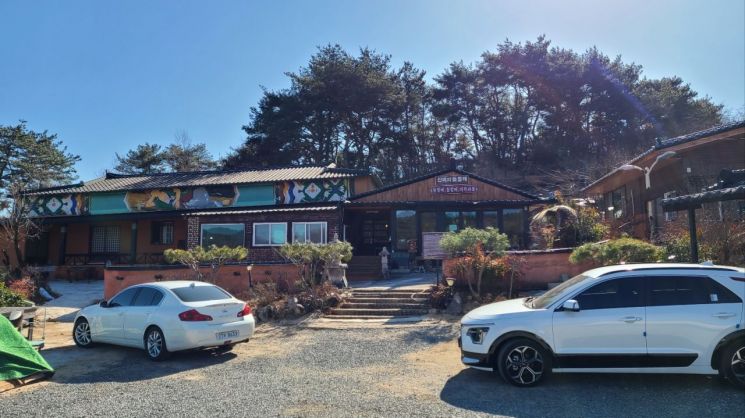 At the foot of Nangsang in Gyeongju, where the indigenous faith preserves 'Dolhalmae' and 'Dolhalmae', the area around Yaksam Temple attracts travelers. Behind the pine forest at the back lies the Seondeok Royal Tomb.
© The Asia Business Daily(www.asiae.co.kr). All rights reserved.
![Clutching a Stolen Dior Bag, Saying "I Hate Being Poor but Real"... The Grotesque Con of a "Human Knockoff" [Slate]](https://cwcontent.asiae.co.kr/asiaresize/183/2026021902243444107_1771435474.jpg)

















