[Asia Economy Reporter Byeon Seon-jin] Although health authorities predicted that “there is a possibility of a temporary surge as foreign studies suggest that lifting indoor mask mandates on the 30th of last month could increase cases by 10-20% compared to before,” a clear decline in cases is continuing. The reasons are complex, including mask-wearing habits, severe cold weather, and a lengthened reinfection cycle.
According to the Central Disease Control Headquarters on the 7th, the number of new COVID-19 cases on the 6th was 5,850, down by 1,562 from 7,412 on the 30th of the previous week. This is the lowest figure in 224 days since June 27 last year (3,419 cases). As the downward trend in the outbreak continues clearly, the number of critically ill patients hospitalized decreased by 24 from the previous day to 289. Critically ill patients, who had been above 400 for more than two months, dropped to the 300s on the 31st of last month and further declined to the 200s within six days.
Jung Ki-seok, head of the COVID-19 Special Response Team and member of the National Infectious Disease Crisis Response Advisory Committee, said, “Because the indoor mask adjustment was made while clearly seeing the decreasing trend, if the decrease is very rapid, the increase caused by not wearing masks can be offset and the numbers can continue to decline.”
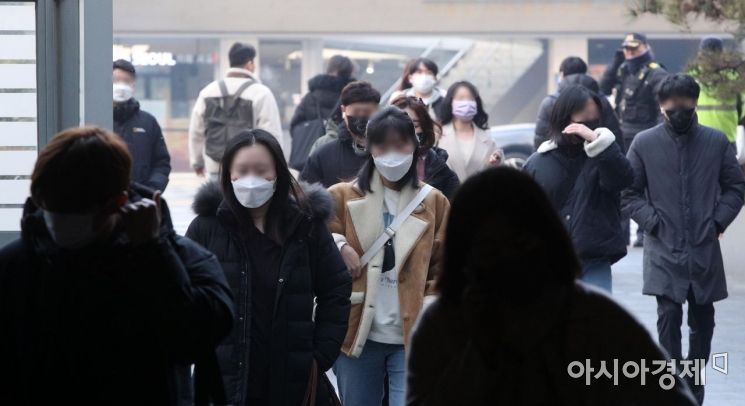
There is also analysis that masks still need to be worn when using public transportation, which many people use, and that the mandatory 7-day isolation if infected means the impact of mask adjustments is minimal for now. Additionally, the cold wave that lasted until early February caused temperatures in major areas like Seoul to remain below freezing, which contributed to many people continuing to wear masks. According to the Korea Disease Control and Prevention Agency, the number of reported cold-related illnesses nationwide from December 1 last year to February 2 this year was 388, a 68.0% increase compared to 231 cases during the same period the previous year.
The reinfection cycle, which was five months, has recently extended to nine months due to immunity acquired from vaccination and natural infection, leading to forecasts that there will not be a rapid spread like last summer.
However, experts believe that as the habit of wearing masks, which has continued for three years, gradually disappears, confirmed cases will inevitably rise again. Professor Kim Woo-joo of the Department of Infectious Diseases at Korea University Guro Hospital analyzed, “Students who do not need to wear masks have started attending school, and the pattern of COVID-19 has been transmission within households after infection, then spreading again to workplaces and other places. There is a possibility of a rebound around late February to early March.”
Health authorities emphasized the importance of booster vaccinations for high-risk groups as the outbreak continues. According to an analysis by the Korea Disease Control and Prevention Agency of all confirmed cases (1,437,659) from November 27 to December 24 last year, among those aged 80 and above, the severe illness rate and fatality rate for those who received the booster vaccine were 0.72% and 0.41%, respectively, which is about one-fifth to one-sixth of the rates for those who only received the first and second doses (4.14% and 2.38%).
© The Asia Business Daily(www.asiae.co.kr). All rights reserved.
![Clutching a Stolen Dior Bag, Saying "I Hate Being Poor but Real"... The Grotesque Con of a "Human Knockoff" [Slate]](https://cwcontent.asiae.co.kr/asiaresize/183/2026021902243444107_1771435474.jpg)















