Abuse of Contactless Serving... Saliva Found in Soy Sauce, etc.
Industry Rushes to Implement Measures... AI Cameras Also Installed
[Asia Economy Reporter Jeon Jin-young] As the Japanese dining industry has established contactless systems due to COVID-19 and rising labor costs, the entire country of Japan has been shocked by so-called 'hygiene terrorism,' where some customers exploit these systems by spitting on communal soy sauce bottles and other items. Dining businesses are urgently preparing countermeasures such as legal action and installing surveillance cameras.
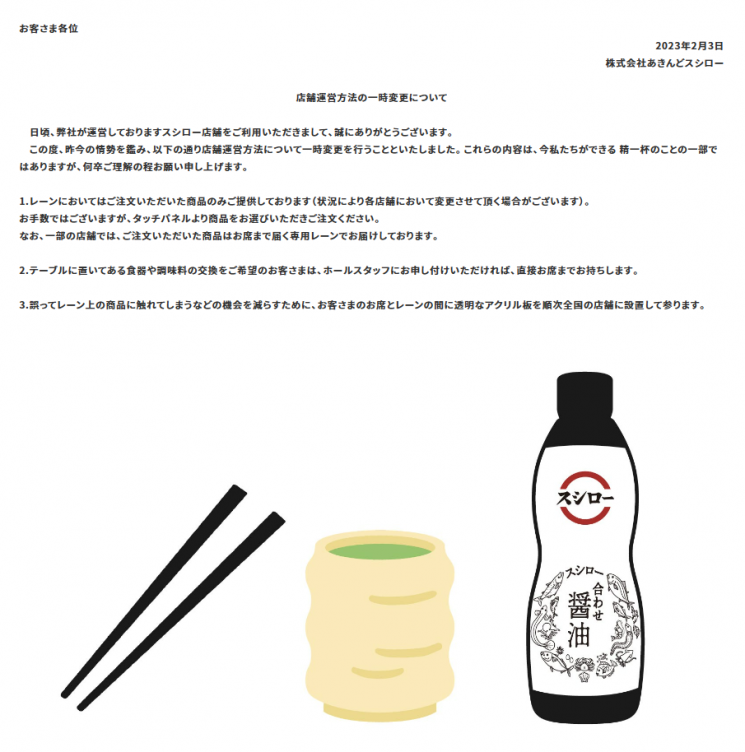 Notice from the Japanese conveyor belt sushi franchise Sushiro. Since the 'customer terror' incident, only the sushi ordered by customers is placed on the conveyor belt, and tableware or condiments are personally brought to customers by staff.
 [Image source=Official website of Sushiro Japan]
According to the Asahi Shimbun on the 6th, the Japanese conveyor belt sushi franchise Sushiro, which recently suffered damage from hygiene terrorism, announced on the 1st that "we will respond strictly both civilly and criminally regarding this incident." The Sushiro branch in Gifu City, Japan, where the incident occurred, reported the damage to the police on the 31st of last month, and an investigation is underway. On Japanese social networking services (SNS), a video has spread showing a young male customer who visited this branch licking the soy sauce bottle and water cup provided in the store, then returning them to their original places, and smearing saliva on sushi coming out on the conveyor belt. The internal anger in Japan is high to the extent that this customer's name, school, and other personal information continue to be exposed.
This so-called 'customer terrorism' hygiene terrorism is occurring frequently, especially at conveyor belt sushi franchises. Currently, videos of previously occurred terrorism are also becoming controversial again. At another conveyor belt sushi chain, Hamazushi, a video was posted showing a customer arbitrarily throwing wasabi with a spoon onto sushi ordered by another customer, and at Kurasushi, a video spread on SNS showing a customer placing a sushi plate they had once picked up back onto the conveyor belt and closing the cover.
The Asahi Shimbun analyzed that customer terrorism exploits the industry's establishment of 'contactless service' systems due to COVID-19 and rising prices. Due to the impact of high prices, conveyor belt sushi franchises that pursued cost-effectiveness with '100 yen per plate' raised prices to 120 yen at Sushiro and 115 yen at Kurasushi, resulting in fewer customer visits. In fact, as of December last year, the number of nationwide stores of Sushiro and Kurasushi decreased by 26.8% and 10.3%, respectively, compared to the previous year.
As customers preferred contactless services due to COVID-19 and business conditions worsened, companies changed their methods to use touch panels instead of hiring employees to reduce labor costs. The Asahi Shimbun stated, "It is possible to order and eat food without ever facing an employee."
Amid ongoing controversy, the industry has hurriedly taken countermeasures. Sushiro decided to limit sushi placed on the conveyor belt to items ordered by customers via touch panels, and changed its policy so that tableware and seasonings are provided by employees only upon customer request in pre-portioned amounts. Transparent acrylic panels will be installed between the conveyor belt and seats at over 600 stores nationwide.
Kurasushi will install artificial intelligence (AI) cameras above the conveyor belt to build a system that alerts employees if customers place plates they have picked up back onto the conveyor belt.
Japanese media also analyzed the causes of such behavior. Ry? Hirose, a researcher at the Nissei Basic Research Institute studying Generation Z psychology, told the Asahi Shimbun, "Generation Z has a blurred boundary between society and SNS communities. They post with the thought of sharing with peers, so their awareness that it spreads is low," and added, "From the perpetrator's perspective, it is not so much about informing society as it is about wanting to be recognized, which leads to irrational behavior."
© The Asia Business Daily(www.asiae.co.kr). All rights reserved.
![Clutching a Stolen Dior Bag, Saying "I Hate Being Poor but Real"... The Grotesque Con of a "Human Knockoff" [Slate]](https://cwcontent.asiae.co.kr/asiaresize/183/2026021902243444107_1771435474.jpg)















