[Asia Economy Reporter Jeong Dong-hoon] Domestic companies consider the 'European Union (EU)-initiated supply chain due diligence' as the biggest ESG (Environmental, Social, and Governance) issue this year.
The Korea Chamber of Commerce and Industry announced the results of the '2023 Major ESG Issues and Policy Tasks' survey on the 5th, which included this information.
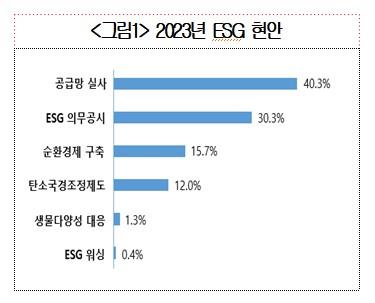
When asked about ESG issues among 300 domestic companies, 40.3% of respondents answered that responding to supply chain ESG due diligence was the priority. This was followed by mandatory ESG disclosure (30.3%), building a circular economy (15.7%), and the carbon border adjustment mechanism (12.0%).
The EU is promoting the introduction of a supply chain due diligence system that evaluates and discloses not only individual companies but also the ESG management levels of their partners. Accordingly, cases where large domestic and foreign companies require ESG due diligence from their partners are increasing.
Professor Lee Jae-hyuk of Korea University analyzed, "The supply chain ESG due diligence law is being implemented in Germany this year and will expand to the entire EU next year. Since the due diligence results may lead to the suspension of transactions or contracts with customers, interest in responding to ESG due diligence is intensifying."
However, the level of response to the supply chain due diligence law was low. Regarding short-term responses, 48.2% of primary contractors and 47.0% of partner companies answered that they had taken no particular measures. Regarding mandatory ESG disclosure, which will gradually begin in 2025, 36.7% of companies said they had no specific response plans.
Nonetheless, 61.6% of respondents predicted that "even if the economic situation is difficult this year, ESG management will become more important." Among the difficulties related to promoting ESG management (multiple responses allowed), 58.3% of respondents cited cost burdens. The proportion of those who answered that there is a lack of internal experts also reached 53.0%.
As policy tasks to strengthen ESG management, the largest number of companies chose providing industry-specific ESG guidelines (39.3%). This was followed by support for ESG diagnosis, due diligence, and consulting (28.0%), and expansion of tax support such as tax reductions and deductions (24.0%).
Woo Tae-hee, Executive Vice President of the Korea Chamber of Commerce and Industry, said, "Companies should not view ESG simply as a cost but should utilize it as a core competitiveness to overcome economic downturns and bring growth and leap forward to their businesses."
© The Asia Business Daily(www.asiae.co.kr). All rights reserved.
![Clutching a Stolen Dior Bag, Saying "I Hate Being Poor but Real"... The Grotesque Con of a "Human Knockoff" [Slate]](https://cwcontent.asiae.co.kr/asiaresize/183/2026021902243444107_1771435474.jpg)















